Explore Crisil, a company of S&P Global
Formerly known as Global Research & Risk Solutions
December 08, 2025
 Blog
Blog
Bolstering PE liquidity with data analytics
December 08, 2025
Blog
Blog
Reactive to proactive capital decisioning
 Share




Driving monetization on PE street
The private equity (PE) market is being buffeted by an unusually large inventory and a tighter exit market — longer hold times, slower velocity of initial public offerings (IPOs) and mergers and acquisitions (M&As), and interest rate pressure on leveraged deals.
This combination has compressed Limited Partner (LP) distributions and increased demand for alternative liquidity routes, principally secondaries, continuation vehicles led by General Partners (GPs), net asset value (NAV) loans and structured recapitalizations.
The consequent liquidity strain is reshaping the dynamics between GPs and LPs. With distributions slowing and capital calls continuing, LPs are facing mounting allocation imbalances — the so-called ‘denominator effect’. Meanwhile, GPs are extending fund lives, utilizing continuation vehicles and exploring creative secondary solutions to sustain liquidity. While there has been a rebound in deal and exit volumes, it is too shallow to materially ease liquidity pressures built up over the past few years.
The result is a market caught between abundant dry powder and constrained cash flow.
Amid these structural pressures, where intuition once guided decision-making, today’s private market participants are increasingly turning to advanced data models, predictive analytics and valuation intelligence to navigate uncertainty.
Data-driven intelligence is becoming a strategic lever in PE dealmaking — not only as a tool for efficiency but also as a strategic differentiator empowering market participants to move from uncertainty to informed opportunity.
From stress-testing portfolio exposures to identifying exit readiness and pricing secondary transactions, data is now central to unlocking liquidity and sustaining performance.
How slower exits are tightening LP liquidity
Large unrealized inventory and holding periods: A record surge in unrealized NAV has left vast sums of capital locked within PE portfolios, making it harder for investors to access returns. Bain & Company estimates that up to 29,000 un-exited companies now represent $3.2-3.6 trillion in unrealized NAV — evidence of a growing backlog caused by a wave of deals since 2010.
Further, holding periods for PE investments, which were historically 4-5 years, continues to increase. According to Bain & Company, the global median jumped to 6.1 years by 2024 from 5.3 years in 2020. Notably, Pitchbook reports that more than 30% of United States (US) buyout deals are now held for over 5 years, deepening the liquidity crunch.
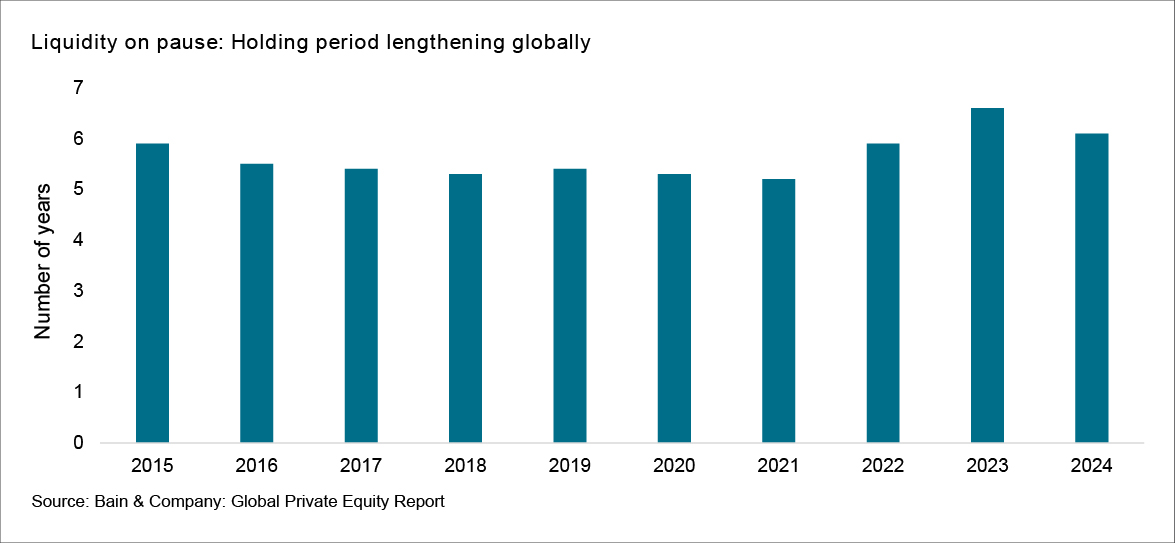
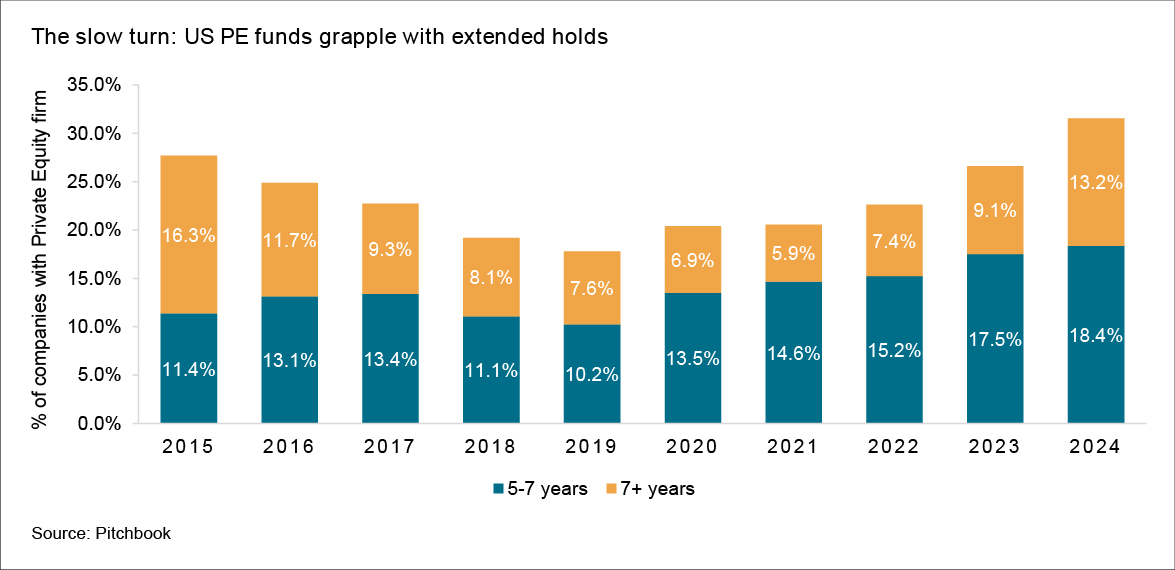
- Exit market weakness: There is also a slowdown in the ability of PE funds to sell assets profitably, whether via IPOs, trade sales or secondary buyouts. Exit weakness typically arises when public markets are volatile or closed to listings; strategic buyers cut M&A budgets, and valuation expectations between buyers and sellers diverge. The consequences are fewer exits, resulting in lower cash distributions, funds accumulating in un-exited holdings and LPs seeing slower returns.
Recent data from the second and third quarters of 2025 suggests the market is thawing, though not at the scale required to alleviate the broader liquidity crunch. There were 817 PE exits in the third quarter of 2025, a modest 4% rise from the second quarter, signaling that GPs are selectively re-entering the market. However, total exit value fell 24% on-quarter to $78.7 billion, indicating that the uptick is concentrated in smaller, mid-market deals rather than large transformative exits. (Source: S&P Global) - Leverage cost and valuation pressure: Higher rates increase financing costs for leveraged buyouts, reducing new deal flow and compressing valuation multiples as future cash flows are discounted more heavily. These create valuation pressure, as existing assets are marked down while new acquisitions face lower leverage availability
- LP liquidity needs: LPs, i.e. pension funds, endowments, insurers, etc., require steady cash distributions from PE investments to rebalance their portfolios or meet liabilities. When distributions slow but capital calls continue, LPs face a liquidity squeeze — they could become over-allocated to private markets, may turn to secondary markets to sell fund stakes and raise cash, or some could delay or cancel new PE commitments, constraining fundraising for GPs (Bain & Company: Global Private Equity Report, 2024)
The liquidity engine: Price, risk, and match intelligence in PE
PE markets continue to grapple with challenges around valuation transparency, liquidity constraints and transaction efficiency. Data-driven insights and analytical intelligence bridge these gaps — offering a structured approach to price discovery, risk assessment and liquidity generation by leveraging comparable pricing analytics, scenario-based NAV modeling, and buyer-match intelligence to help investors make informed, faster and more confident decisions across private market transactions.
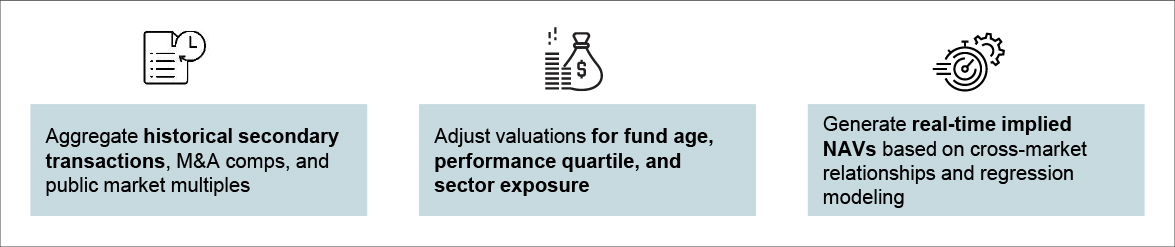
- Comparable pricing engines: One of the biggest friction points in private markets is valuation opacity. Comparable pricing engines address this by using big data to triangulate value across similar deals, vintages and sectors. This gives buyers and sellers price confidence before negotiation, narrowing bid-ask spreads and improving transaction velocity. Analytics effectively replace ‘gut feel’ with empirical pricing transparency, essential in a liquidity-constrained environment where every basis point matters. Comparable pricing engines are used to:
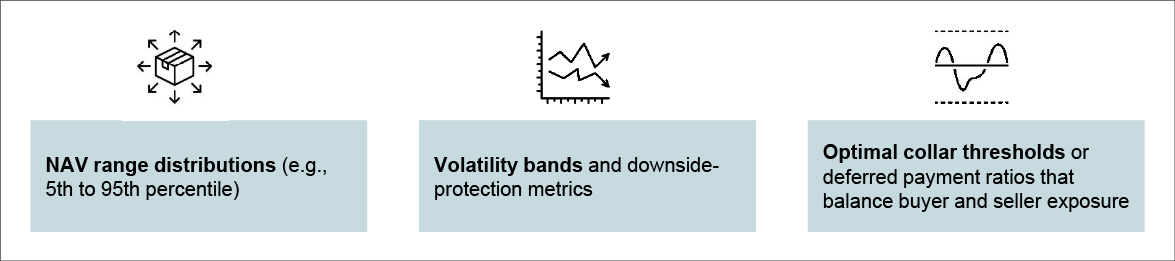
- Scenario NAV and stress-testing: When capital is tight, not all deals can be settled upfront. Buyers and sellers structure transactions using collars, deferred payments or earn-outs to share risk. Scenario-based NAV analytics make these structures credible and quantifiable. Advanced modeling platforms simulate thousands of macroeconomic and asset-level scenarios, such as interest rate shifts, EBITDA (earnings before interest, taxes, depreciation and amortization) compression, delayed exits or foreign exchange movements, and estimate their impact on the fund’s NAV. The model outputs include:
- Portfolio triage scoring and buyer-match algorithms: In today’s crowded secondary market, not every asset suits every buyer. LPs, GPs, secondaries funds and private wealth platforms all have different appetite profiles. Portfolio triage scoring models, built on historical transaction data and fund performance metrics, evaluate each asset on:
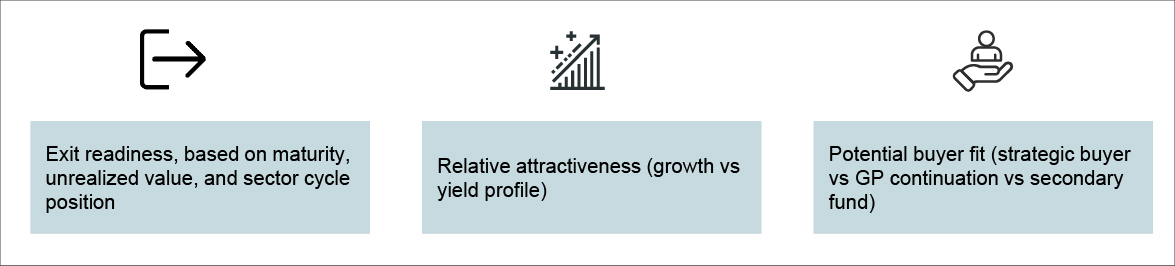
Simultaneously, buyer-match algorithms use machine learning (ML) to cross-reference buyer mandates, historical purchase behavior, fund strategies and liquidity availability. This creates a targeted buyer shortlist instead of broad marketing, dramatically reducing time-to-close and increasing hit rates.
Mapping the liquidity landscape: Data-backed routes to capital release
As PE faces constrained exit channels and rising funding pressures, firms are deploying diverse mechanisms to generate liquidity. From secondary to NAV-based financing, each route offers a unique balance of speed, valuation and risk. The following framework outlines how data and analytics strengthen every pathway — improving pricing precision, risk calibration and execution efficiency.
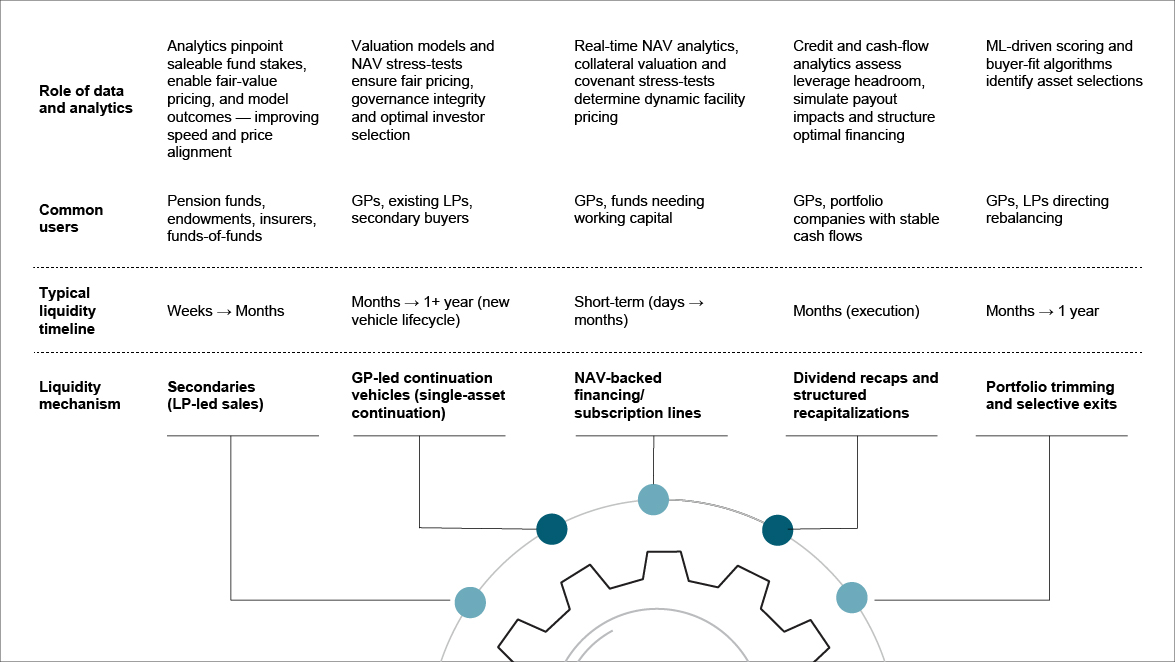
By leveraging data-led insights across valuation, benchmarking and risk modeling, market participants are better equipped to identify optimal exit pathways, calibrate secondary transactions and enhance portfolio-level visibility. The integration of predictive analytics, scenario planning and asset-level intelligence is enabling GPs as well as LPs to navigate volatility with greater precision.
Also, data and analytics reduce time, information asymmetry and pricing uncertainty to turn ‘trapped NAV’ into an exit. By speeding diligence and price discovery, improving portfolio triage, and enabling better structuring (NAV loans, collars and deferred consideration), analytics convert illiquid holdings into a monetizable asset faster and with lower discounts, thereby easing the crunch.
So, is the liquidity crunch going away?
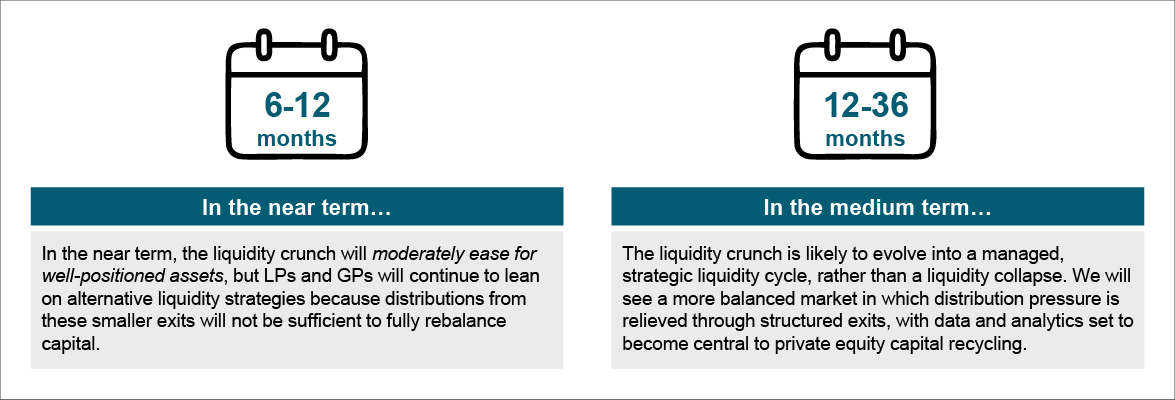
Not completely and not immediately. The structural overhang of unrealized assets and the longer holding periods mean the liquidity squeeze will ease only slowly across strategies and vintages.
The crunch is transforming rather than disappearing. Primary exit markets (IPOs, strategic M&As) are still inconsistent, many older vintages remain unsold, and valuation pressure persists for certain sectors and risk profiles. So:
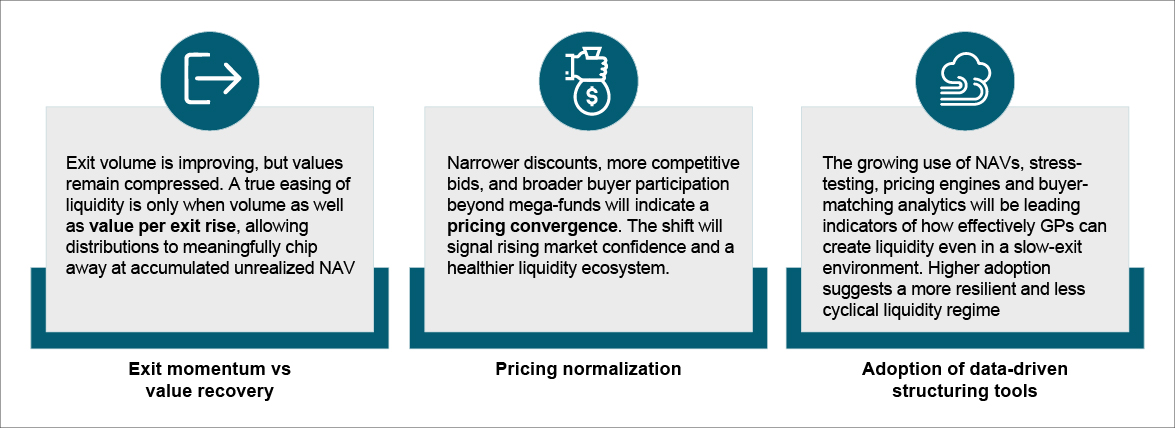
What to watch next — practical signals
How our solutions can help
As the PE ecosystem adapts to a period of constrained liquidity, the focus is shifting from reactive capital management to proactive, data-driven decisioning. Traditional levers such as refinancing and delayed exits are proving insufficient in an environment defined by higher rates, extended holding periods and valuation uncertainty. In this context, advanced analytics and market intelligence have emerged as key enablers of liquidity and resilience.
Our suite of private market analytics, valuation advisory and risk intelligence solutions helps investors and asset managers make informed decisions in uncertain market conditions. By combining robust data models, domain expertise and technology-led frameworks, we support clients in driving transparency, improving liquidity outcomes and unlocking value across the private capital lifecycle.