Explore Crisil, a company of S&P Global
Formerly known as Global Research & Risk Solutions
January 09, 2026
 Blog
Blog
Liquidity guardrails tightening for open-ended funds
January 09, 2026
Blog
Blog
In line with a broader regulatory trend of enhancing financial stability
 Share




Unpredictably high redemption rates for open-ended funds (OEFs) and concerns about financial stability have prompted regulators to reassess the liquidity risk management (LRM) frameworks of asset managers.
Two recent high-profile instances exemplify this trend. Starwood Capital's flagship non-traded real estate investment trust (REIT) with roughly $10.0 billion in assets has been limiting investor withdrawals since May 2024 to preserve liquidity in a challenging commercial real estate market. Similarly, in November 2022, Blackstone's REIT, with more than $100.0 billion in assets, restricted redemptions after a surge in withdrawal requests surpassed the fund's preset liquidity limits.
To mitigate systemic vulnerabilities and safeguard investor interest, regulators worldwide have been tightening liquidity requirements for OEFs.
The Financial Stability Board (FSB) and the International Organization of Securities Commissions (IOSCO) are the primary agencies that collaborate closely on LRM to ensure OEFs can withstand market stress.
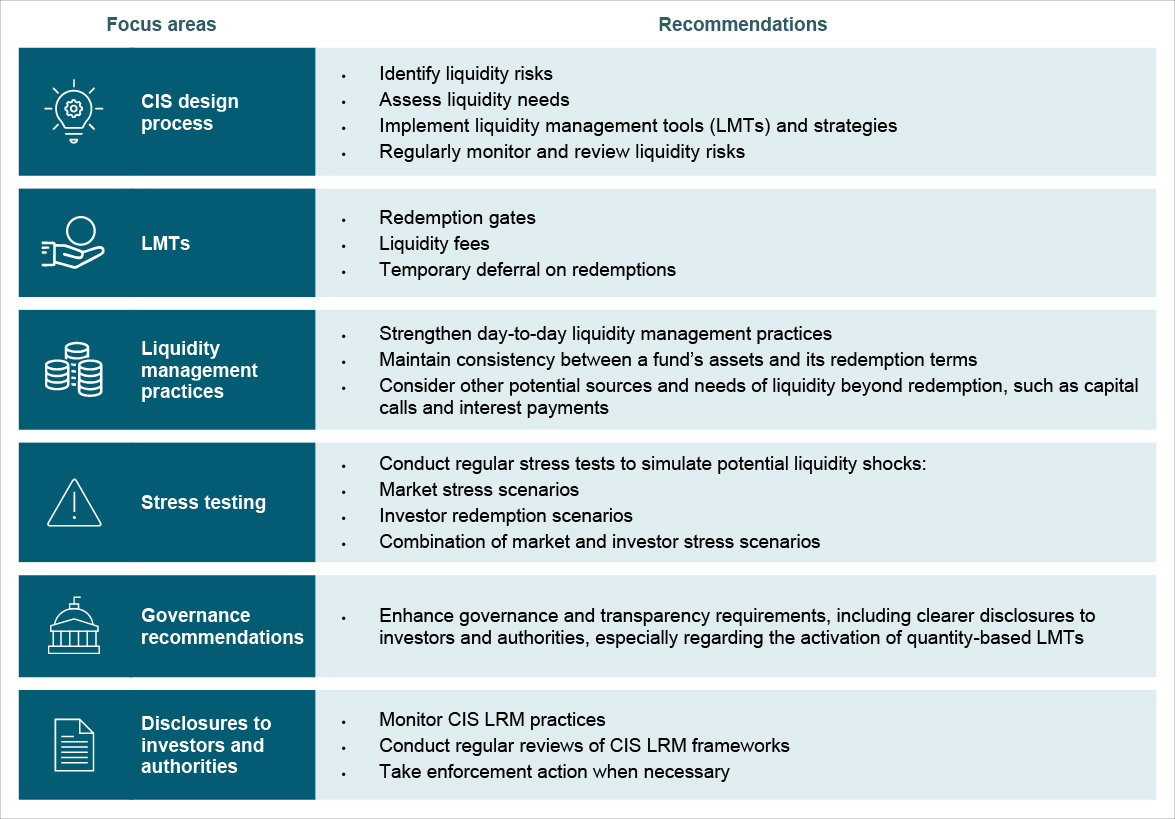
IOSCO’s latest recommendations strengthen LRM for collective investment schemes (CIS)1
1 https://www.iosco.org/library/pubdocs/pdf/IOSCOPD798.pdf
In response to these recommendations, regulators worldwide are anticipated to strengthen the LRM framework for collective investment schemes (CIS).
This blog covers a comprehensive analysis of LRM across Europe and U.S., including an overview of the regulations in both geographies as well as a comparison of various parameters within the frameworks that are in force in the respective regions.
Today, Europe is more in sync with IOSCO framework than the US
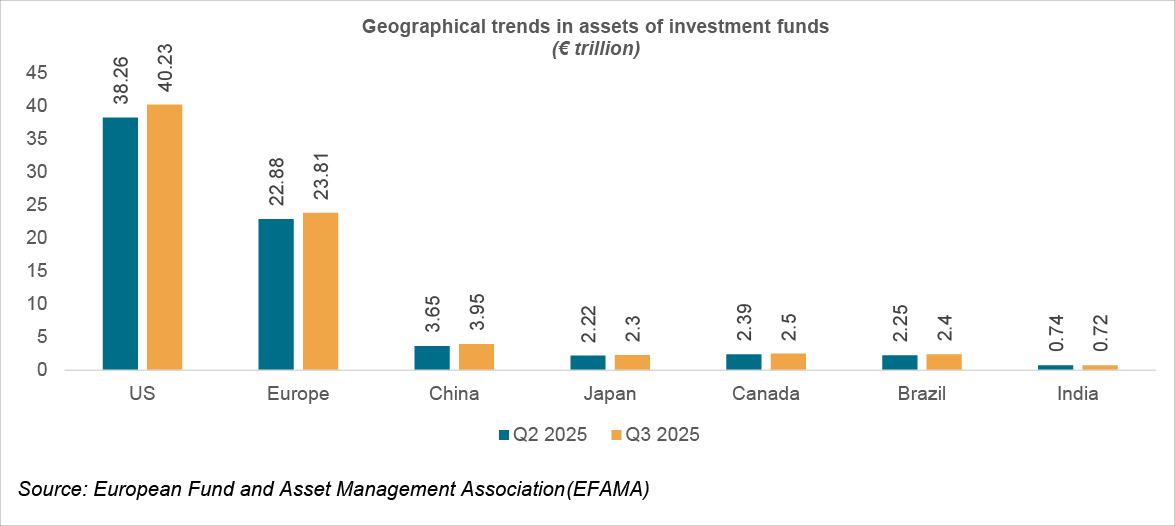
Europe and US together represent more than 70% of global investment assets, revealing a broader trend towards harmonized principles
Below is an outline of the frameworks utilized by Europe and US for LRM
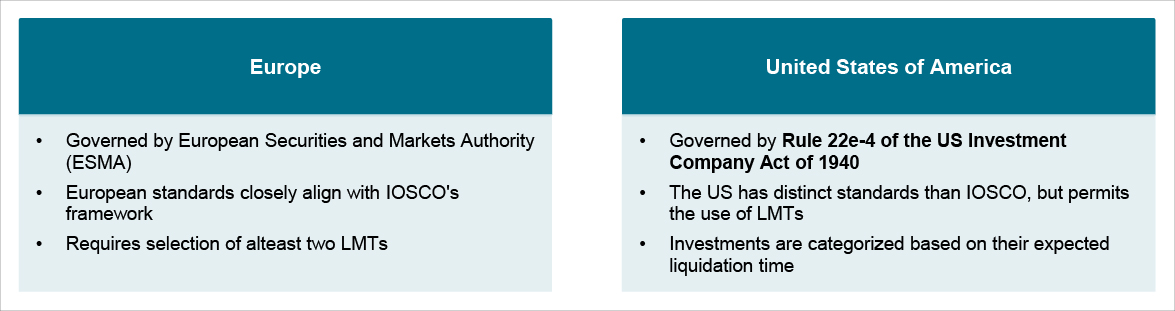
European Securities and Markets Authority technical standards on LMTs
The Draft Regulatory Technical Standards (RTS) released in October 2025 by the European Securities and Markets Authority (ESMA) form the core of its new LMT framework.
These standards supplement the Alternative Investment Fund Managers Directive (AIFMD) and the Undertakings for Collective Investment in Transferable Securities (UCITS) Directive.
They require funds to select and justify at least two LMTs, implement robust LRM frameworks and provide clear investor disclosures. The RTS will apply from April 16, 2026, with a 12-month transition period for existing funds.
Rule 22e-4 of the US Investment Company Act of 1940
IOSCO’s latest recommendations on LRM have not yet been implemented in the US, where Rule 22e-4 of the Investment Company Act of 1940 governs OEFs.
The rule requires open-ended investment companies to establish an LRM program (LRMP) to assess, manage and report on portfolio liquidity risks.
The program involves classifying investments into a four-bucket system on an intra-month basis: highly liquid, moderately liquid, less liquid and illiquid.
This classification is based on the speed of conversion of an asset into cash without significantly affecting its market value and is used to manage liquidity risk.
A comparison of the European and US frameworks