Explore Crisil, a company of S&P Global
Formerly known as Global Research & Risk Solutions
February 23, 2026
 Blog
Blog
Blog
Integration risks lurk for regional banks
February 23, 2026
Blog
Blog
Proactive harmonization key to M&A synergies
 Share
Share



Managing post-merger integration, especially with regard to policies and processes, has become crucial for regional banks in the United States (US) as merger and acquisition (M&A) activity gains pace.
These M&A transactions saw a sharp uptick in 2024 and 2025, driven by risks emanating from geographical and loan book concentration (in inherently risky asset classes such as commercial real estate, or CRE) of regional banks, banks’ pursuit of growth while combating margin compression, slower loan growth, rising compliance costs, and ongoing investments in technology. The surge was also supported by quicker approvals, lower interest rates, and conducive valuations.
In such a milieu, integration becomes crucial not only to derive the value initially envisaged from the transaction but also to remain compliant with regulatory requirements.
An increase in M&As inevitably involves trade-offs. While leveraging synergies can drive growth, even well‑priced deals can eventually fail if integration is not executed effectively.
Therefore, it is essential for banks to proactively harmonize the disparate credit philosophies, risk appetites, processes, policies, and compliance perspectives of the merging entities.
Conducive environment led to increased M&A activity
- Need to mitigate inherent risks by increasing scale and diversification: Regional banks inherently face risks stemming from their small to moderate scale of operations, geographical concentration, and sectoral concentration of their loan portfolio in risky segments such as CRE and small businesses. As a result, they often face high pressure in the form of profitability compression due to a riskier loan book, the need to grow and/or diversify their loan and deposit profile, aging technology systems, and high compliance costs.
By merging, banks can gain access to a broader base of borrowers and depositors and accelerate their technological upgrade. For instance, PNC Financial Services’ acquisition of FirstBank is expected to expand the former’s reach in the Rocky Mountain region and Southwest, mainly Colorado and Arizona. Furthermore, mergers help the elimination of branch overlaps and the consolidation of back-office operations, thereby facilitating cost reductions.
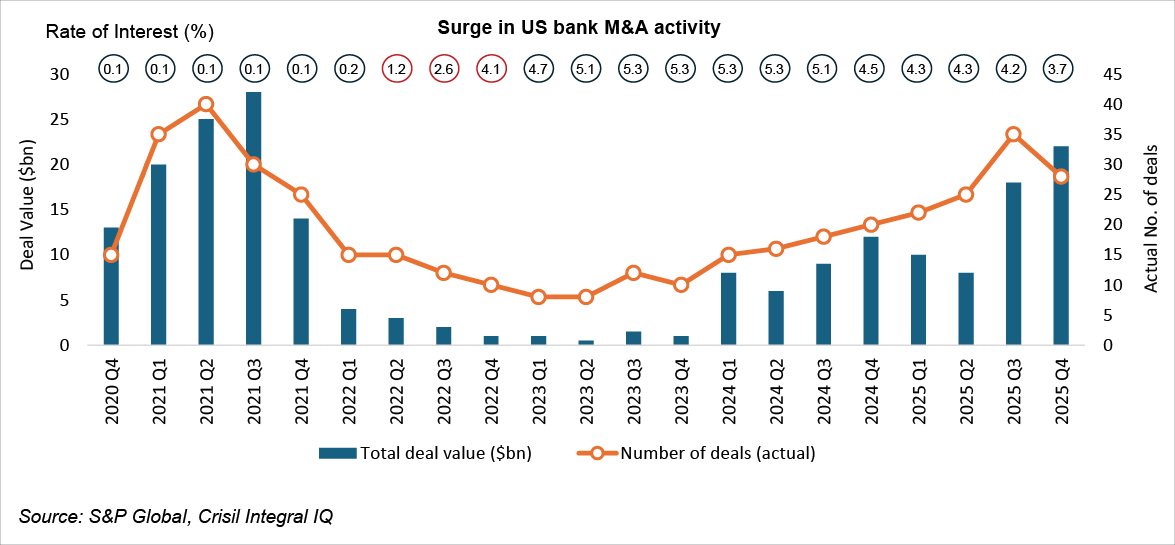
- Economic conditions supporting deal activity: While pressures on profitability, slower loan growth, and rising operating and compliance costs created the need for inorganic path to foster growth, it was the decrease in interest rates starting from the peak of 5.3% (effective federal funds rate) in August 2024 to 3.7% currently, that led to lower financing costs, attractive valuations for potential M&A targets, a decrease in unrealized losses on available-for-sale securities, thereby making the path for M&A easier.
Consequently, 2025 saw a rebound in regional bank M&A, with both deal volume and values rising compared with recent years, as shown below.
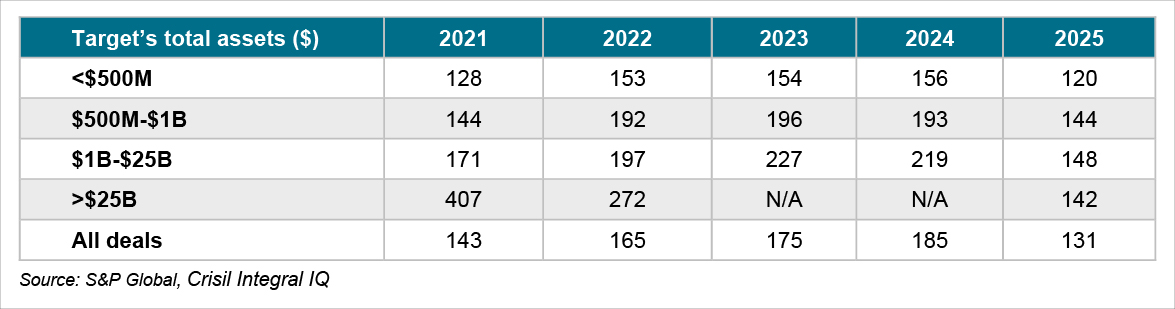
- Regulatory tailwinds: In 2025, regulators made their merger frameworks more predictable and streamlined their review timelines, which encouraged more banks to consider M&A. Federal regulators have clearly taken cognizance of the time-sensitive nature of processes, such as staffing-related planning, scheduling of technology integrations, and transaction closing, with the result visible in the form of lesser number of days for deal completion, as shown below:
Challenges of integrating policies and processes in M&A
While synergies in bank mergers are calculated in terms of scale, efficiency, and strategic expansion, it is the risk emanating from the disparate policies and processes that tends to get ignored during the upcycles. The merging of two banks should not be seen as a mere merging of balance sheets but as the convergence of two distinct operational universes, each governed by its own credit policies, risk appetite, and governance practices.
Policy divergences may lead to stark non-uniformities: One of the most immediate risks arising from disparate policies in a bank merger is credit policy divergence. Even banks operating in similar markets can differ substantially in terms of underwriting standards and risk appetite. For instance, they may have differences involving parameters such as the loan-to-value ratio, the debt service coverage ratio, sponsor concentration limits, and credit rating methodologies and scorecards. When these contradictory methods coexist post-M&A, the combined loan book can quickly become non-uniform in risk composition despite being reported as a single book. Practically, these contradictions become even sharper when unclear post-M&A harmonization of policies leads to higher reliance on the more lenient framework of the two as front-line managers increase the frequency of exceptions and waivers, thus weakening credit standards.
Parallel processes may lead to structural weaknesses: In practice, the expectation of immediate consistency often collides with the reality of parallel operations in the post-merger period. To avoid disruptions, banks frequently allow legacy processes to operate side-by-side while integration is underway. Similar to legacy processes, even divergent data storage attributes and governance mechanisms might exist in parallel for considerable periods of time. While this approach may appear pragmatic, it introduces significant complexity and control risk. Parallel loan booking systems, documentation standards, and credit analysis tools can result in the same transaction being processed differently depending on its legacy origin. This fragmentation increases the likelihood of processing errors and control breakdowns. Therefore, over time, what was intended as a temporary integration bridge can harden into a structural weakness.
Also, differences in banks’ interpretation and execution of the same regulatory requirements pose another significant post-merger risk. These differences are often reflected in compliance thresholds, escalation triggers, documentation standards, and monitoring frequencies. For instance, prior to the merger, one bank may have adopted a conservative approach to interpreting the Bank Secrecy Act or anti-money laundering requirements, fair lending reviews, or Know Your Customer (KYC) due diligence standards, while the other bank may have relied on a more judgment-based or decentralized execution. Lack of timely harmonization of these interpretations may lead to the combined institution developing uneven control environments. This inconsistency not only increases the probability of compliance breaches but also distorts enterprise-wide risk reporting, making it difficult for management to assess the risks accurately, and may eventually snowball into a serious loss of reputation.
As operational complexity increases under parallel processes and legacy policies and frameworks continue to operate side-by-side, decision ownership becomes blurred. It might become unclear which policy governs and which personnel are responsible for making borderline credit decisions, thereby creating an environment for policy arbitrage as business lines gravitate toward the most permissive standard.
Banks need to harmonize disparate policies and processes for unlocking value
The principal risks in bank mergers often emerge not from flawed strategic intent but from weaknesses in post-merger policy alignment and execution. Compounding the challenges explained above is the time- and resource-intensive nature of post-merger integration, which can give rise to integration fatigue. These risks are often underestimated during deal evaluation, where attention is understandably focused on financial synergies, cost savings, and balance-sheet scale.
Unresolved differences in how risk is defined, governed, and controlled can persist long after legal close, quietly eroding oversight and increasing the likelihood of credit deterioration, compliance gaps, and supervisory findings. To tackle these roadblocks, banks should leverage experienced credit risk advisors who help them bring structure, discipline, and independent perspective to post-merger integration proactively, right at the onset of the post-merger journey.
As US regional banks continue to pursue growth through M&A, the ability to harmonize disparate policies, processes, and data sets has become critical to realizing synergies and sustaining long-term value. The merged institutions need to proactively align underwriting standards, risk-rating methodologies, and monitoring practices with the most stringent supervisory standards applicable to the combined organization. This includes conducting portfolio-level credit reviews, strengthening early warning indicators, enhancing stress testing practices, and unifying credit monitoring frameworks to ensure consistency in risk assessment and asset quality management.
Moreover, a comprehensive review of approval hierarchies and governance structures is essential to identify gaps, conflicts, and risk exposures. Harmonizing delegation of authority, committee structures, and monitoring frameworks ensures elimination of conflicting limits and clarity in decision rights and strengthens risk oversight across the post-merger organization. These can be topped up by leveraging technological innovations, such as those offered by generative artificial intelligence or machine learning, which will help the banks to not only realize the promised synergies of a merger but also position themselves to thrive in a rapidly digitizing, regulator‑intensive landscape.
Considering the previously mentioned example of PNC’s acquisition of FirstBank, the post-deal value unlocking would hinge upon systematic harmonization of the policies and processes of the two banks, especially considering the difference in risk appetite, lending operations, and types of loans of FirstBank (which is smaller and more localized) compared with PNC.
To sum up, bank M&As can create meaningful value only when integration is executed with discipline. Banks that standardize credit and risk frameworks, simplify end-to-end processes, align governance and decision rights, and proactively manage regulatory readiness are far more likely to realize promised synergies and build a stronger platform for growth in an increasingly digitized and regulator‑intensive environment.
Our expertise in risk policies, credit methodologies, lending operations, and other banking processes can help banks navigate the critical post-merger integration phase through proactive management of the divergent processes and policies.