Explore Crisil, a company of S&P Global
Formerly known as Global Research & Risk Solutions
March 31, 2026
 Blog
Blog
Blog
 Share
Share




The Bank of England’s (BoE) Monetary Policy Committee (MPC) has cautioned that a prolonged period of inflationary pressure caused by the conflict in the Middle East and the resultant weakening of economic activity could trigger second-round effects in wages and prices.
In a reversal of continued disinflation in domestic prices and wages before the conflict began, global energy and commodity prices have already seen a material increase that would feed into UK inflation directly through household fuel and utility costs and indirectly through business input costs, the MPC noted after its meeting on 19th March 2026.
Thus, though the MPC held the Bank Rate at 3.75%, the March 2026 Monetary Policy Summary should be read not merely as a rate decision but as a risk signal—of an impending restrictive policy stance.
What changed in the narrative
- The BoE has shifted its narrative from primarily disinflation-focused to one acknowledging a fresh external inflation shock
- The minutes explicitly referenced the disruption in shipping through the Strait of Hormuz and targeted energy infrastructure, indicating a broader supply, trade and market volatility shock, and not just an oil-price move
- The challenge is now more complex, covering higher near-term inflation combined with weaker activity, rather than a simple cyclical slowdown
Why this matters for financial planners
- This shock can affect banks through multiple channels simultaneously: market volatility, collateral and liquidity usage, customer affordability, impairments, deposit behaviour, capital consumption, etc.
- Traditional recession-based stress frameworks are unlikely to fully capture the speed, non-linearity and cross-risk interaction of a geopolitical supply shock
- The BoE’s broader stress-testing is expected to combine regular capital stress tests with exploratory work on structural and emerging risks
Our perspective
Banks should treat this event as a trigger to upgrade management stress testing and not just to add another layer of sensitivity into the annual regulatory pack. The right response is an integrated view linking macro scenario, portfolio impact, liquidity, capital, business response and management action.
Impact on different banking business models
This shock does not affect all banks in the same way. The transmission varies materially based on business mix, funding structure and portfolio concentration.
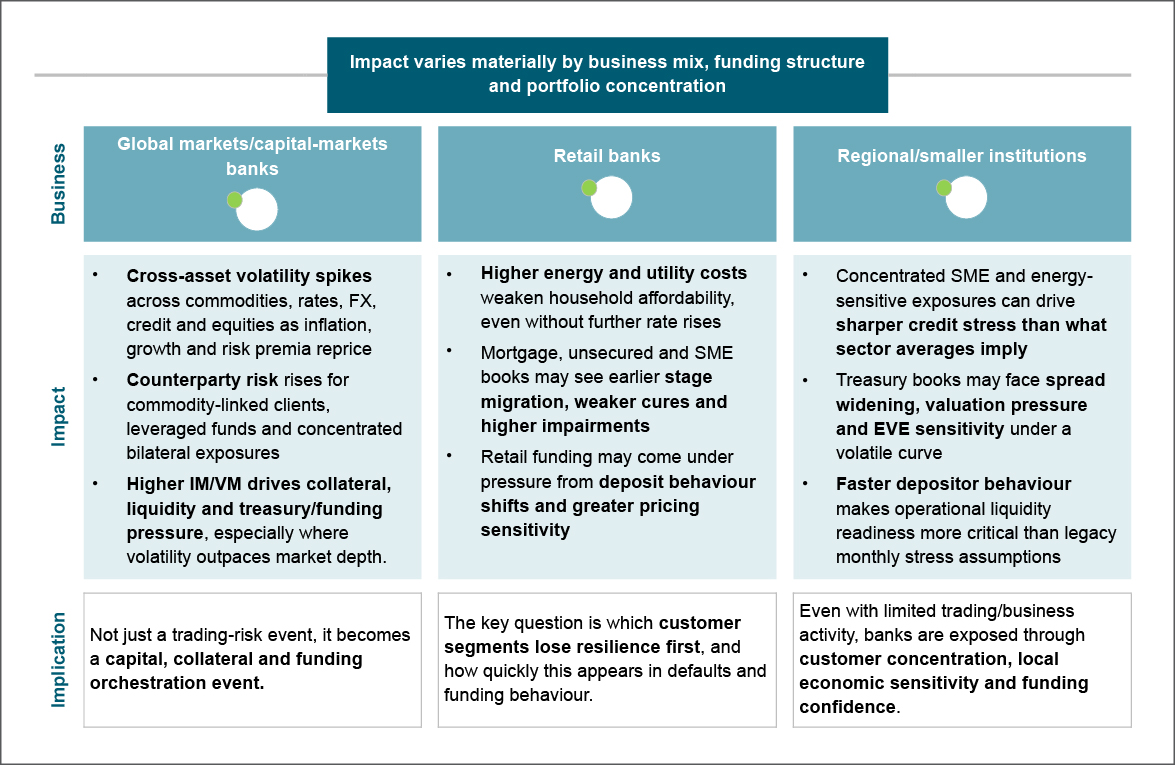
Hour for banks to expand scenario design
The BoE’s March narrative and broader stress-testing framework suggest that banks should move beyond standard macro recession scenarios and build a dedicated geopolitical supply-shock scenario set. The BoE’s 2024 and 2025 stress-testing materials already treat geopolitical tension, commodity spikes, supply disruption and higher rates as part of a coherent severe-but-plausible stress.
Recommended scenario set
1. Elevated energy, controlled persistence
- Energy prices remain materially higher for several quarters, inflation rises in the near term and growth slows but avoids deep contraction
- Coverage: Affordability, ECL migration, SME resilience, deposit behaviour and earnings pressure
2. Prolonged conflict and shipping disruption
- The Strait of Hormuz disruption persists, freight and insurance costs rise, commodity stress broadens and market volatility intensifies
- Coverage: Traded risk, counterparty exposure, collateral calls, treasury monetisation and contingent liquidity stress
3. Rapid de-escalation and whipsaw markets
- Energy prices retrace rapidly, but hedges and client positions unwind unevenly, creating basis risk and P&L whipsaw
- Coverage: P&L volatility and trading book sensitivity, client position unwind dynamics, liquidity, funding and collateral impact
4. Secondary sanctions/trade fragmentation
- Broader sanctions or supply curbs amplify the shock through trade, FX, funding and vulnerable sectors
- Coverage: Cross-border trades, trade finance, SME sectors, treasury funding and prolonged persistence of inflation
Scenario design principles for management
- Link each scenario explicitly from external event → macro path → risk factors → portfolios → management actions
- Extend beyond GDP/CPI/unemployment to include commodities, freight, FX, spreads, deposit behaviour, margin requirements and asset monetisation friction
- Model both the immediate shock and the 12-24-month persistence/recovery path
- Integrate credit, market, liquidity, treasury and earnings rather than running separate stress packs
- Use GenAI to accelerate scenario expansion from external event narratives into coherent scenario families, transmission paths and challenger variants, especially where shocks evolve faster than traditional quarterly scenario refresh cycles
- Use AI/ML challenger analytics to identify non-linear risk-factor interactions, historical analogues and cross-risk dependencies that may be under-captured in conventional macro-only stress design
Banks that continue to rely on siloed credit stress tests or annual macro scenario packs will likely understate the impact of this type of event.
Portfolio risk, P&L and management actions
A robust management stress test should answer one core question: what changes in the bank’s balance sheet, earnings and decision posture if this geopolitical shock persists or worsens?
Portfolio risk
- Identify customer and sector segments most exposed to higher energy costs, weaker real income and supply disruption
- Evaluate whether existing models will understate stress and where management overlays may be required, especially for IFRS 9 and portfolio monitoring
P&L and treasury
- Assess front-office P&L, stressed RWAs, basis risk and counterparty deterioration for traded books
- Reassess NII, EVE, OCI and funding spreads under higher inflation uncertainty and market repricing
- Quantify collateral and liquidity needs, including variation margin, monetisation frictions and contingent funding
Business planning
- Decide where to reprice risk, tighten underwriting, reduce concentration or selectively support clients
- Ensure scenario outputs feed directly into client strategy, treasury posture, sector appetite and capital deployment
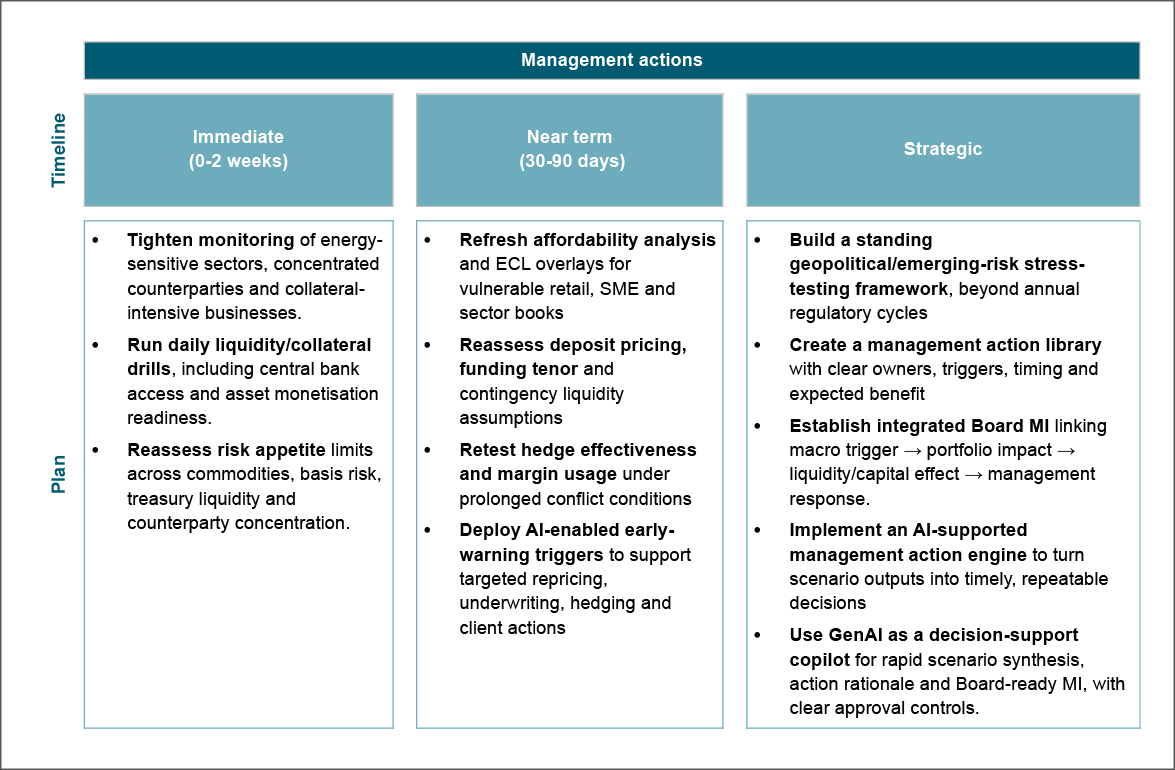
Management actions for geopolitical resilience
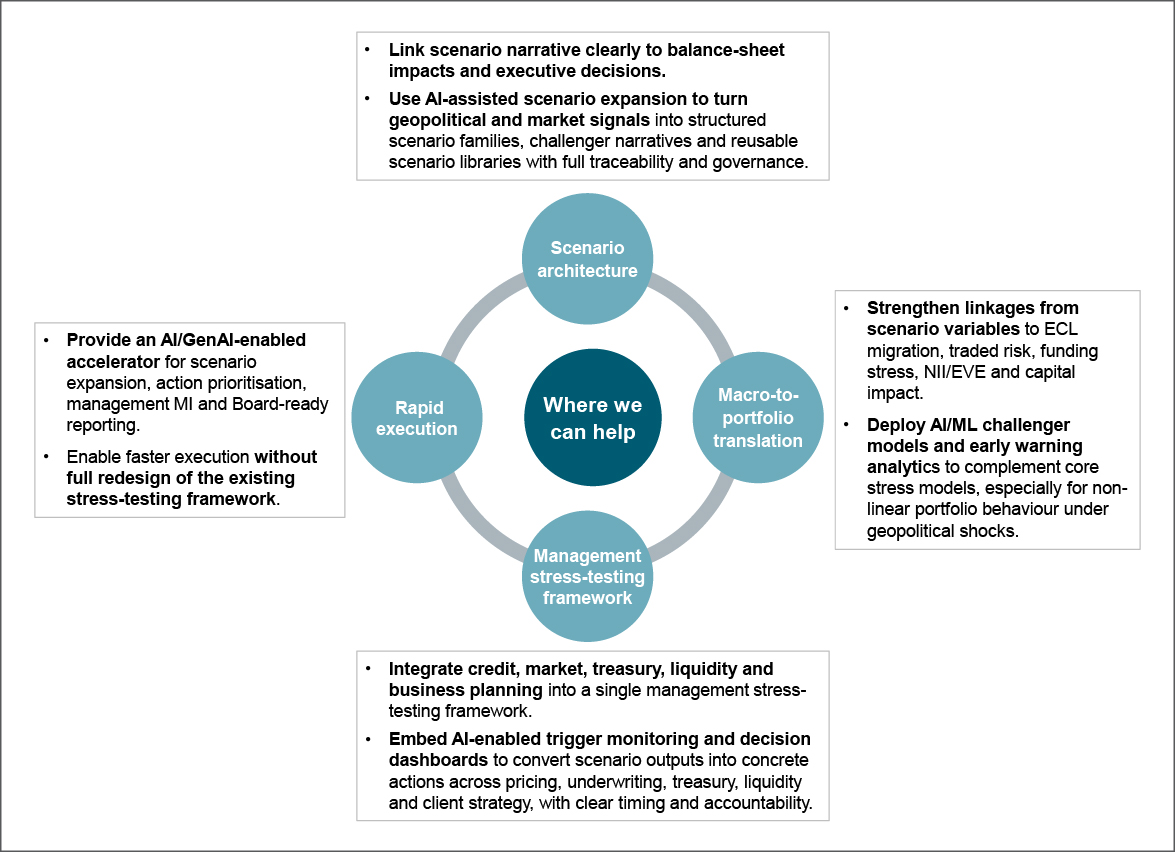
How we can support banks
We can help banks convert the BoE’s March 2026 messaging into a practical management capability, and not just a macro note. Most institutions do not need a full redesign of their regulatory stress-testing framework, in our view, but they require only a targeted uplift in how they handle geopolitical and emerging-risk scenarios.
Conclusion
The outcome of last week’s BoE meeting is best viewed as a prompt to strengthen decision-useful resilience, and not just a reporting discipline. Banks that respond by integrating geopolitical scenarios into portfolio analytics, liquidity readiness and management action governance will be materially better placed to absorb shocks while preserving business flexibility.