Explore Crisil, a company of S&P Global
Formerly known as Global Research & Risk Solutions
 Blog
From growth capital to liquidity engine
Blog
The reinvention of private credit reflects the growing maturity of the asset class
 Share



The structural evolution of private credit
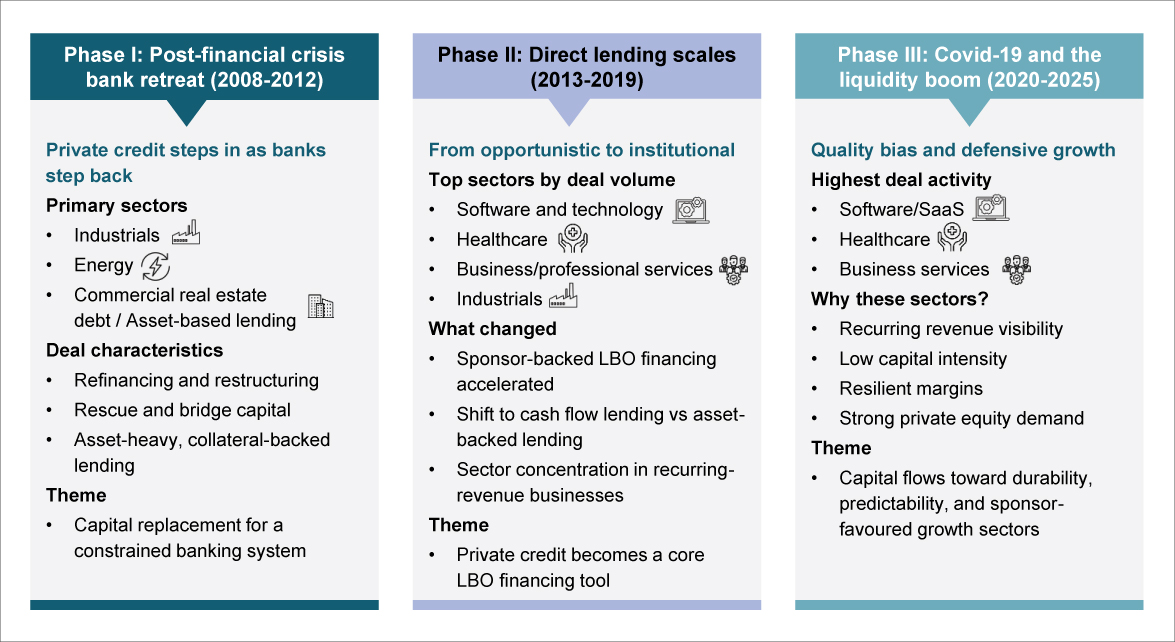
Private credit has become the quiet powerhouse of modern finance. Despite a broad footprint, its core avenue remains sponsor-backed leveraged buyouts (LBOs), which absorb the lion’s share of capital given their structural dependence on leveraged and execution-certain funding. Today, private credit is often the lender of choice in such deals, particularly in the middle market, frequently displacing the broadly syndicated loan (BSL) market. Over time, private credit has evolved from financing asset-heavy, cash flow-stable businesses to backing high-growth technology and funding dividend recapitalisation.
Sector rotation in private credit
Since the global financial crisis, the sector focus of private credit has evolved in line with the broader changes in capital markets and the real economy.
LBO financing: From syndication to specialisation
Share of direct lending in new-issue LBO financing (deal count and deal value)
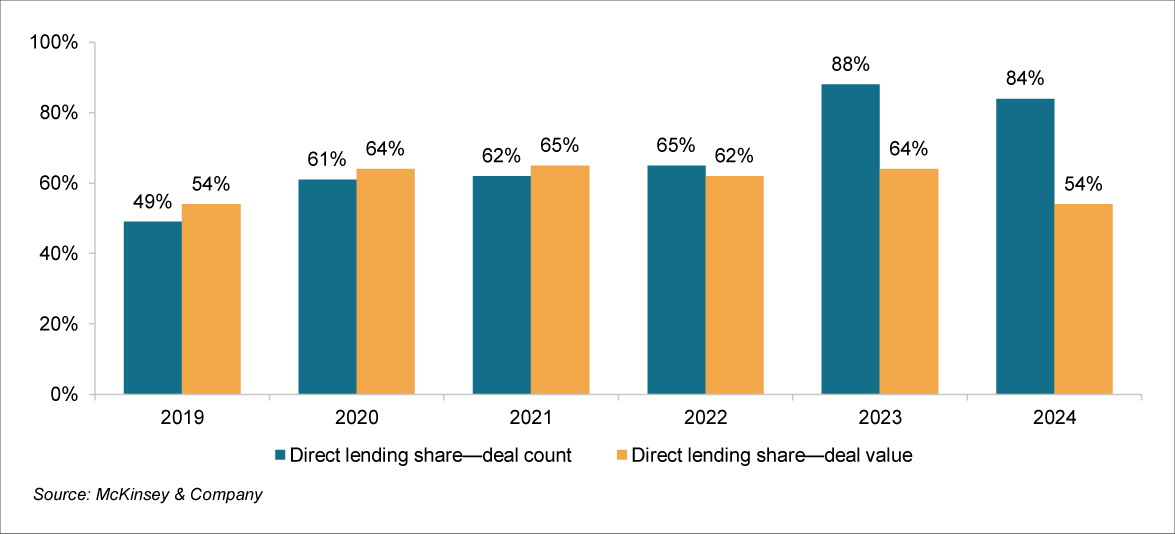
What changed in 2024 (key inflection): Syndicated lenders regained share in value because larger LBOs came back and BSL has more capacity for big tickets. In 2024, BSL provided 46% of the financing value but only 16% of the deals.
The LBO financing market has undergone a structural shift over the past decade, from a syndicated, bank-led model to a more fragmented ecosystem where private credit and BSL actively compete for deal flow. Historically, LBOs were predominantly financed through the BSL market, where banks underwrote loans and syndicated them to institutional investors. This model was particularly suited to large-cap transactions, offering scale, liquidity and pricing efficiency. Today, financing decisions are increasingly shaped by a dual-track market, where sponsors evaluate private credit and BSL options in parallel. This has introduced a competitive dynamic that is reshaping how deals are structured, priced and executed.
Private credit has been steadily gaining market share in LBO financing, particularly in the small- to mid-market, where sponsors often value speed, certainty and flexibility more than a modest pricing advantage.That dynamic has made direct lenders the financing partner of choice for smaller-ticket deals, for which syndication risk can be a meaningful drawback, while execution certainty is often paramount. But the momentum in private credit is no longer confined to its traditional sweet spot. In larger transactions, the asset class has shown it can underwrite sizeable, multi-billion-dollar financings, a clear sign of how much the market has scaled up.Additionally, the growing trend of BSL takeouts by private credit underscores a broader point. Private credit is not just defending its core middle-market position, it is increasingly competing up-market as well.The shift was especially visible in 2024. Against the backdrop of market volatility, tighter bank balance sheets and weak syndication appetite, private credit stepped in and captured a meaningful share, cementing its role as a major force in today’s leveraged finance landscape.
The competitive balance began to shift in 2025, with the BSL market regaining momentum, particularly across larger and more liquid transactions.BSL continues to hold a clear edge in mega LBOs, where deep institutional investor demand and large-scale distribution capacity remain essential. The syndicated market’s ability to assemble and place sizeable financing packages is still a major structural advantage.
That edge has become more pronounced as repricing activity has picked up and spreads in syndicated markets have tightened, making BSL increasingly attractive from a cost-of-capital perspective. As a result, borrowers with access to both channels are finding syndicated markets more competitive than they were a year earlier.
Just as importantly, there are signs of reverse migration, with some borrowers moving from private credit back into BSL to take advantage of improved pricing and stronger liquidity. Together, these trends suggest that while private credit remains a powerful force, syndicated markets have reasserted themselves where scale, liquidity and cost efficiency matter most.
Re-levered returns: The dividend recapitalisation boom
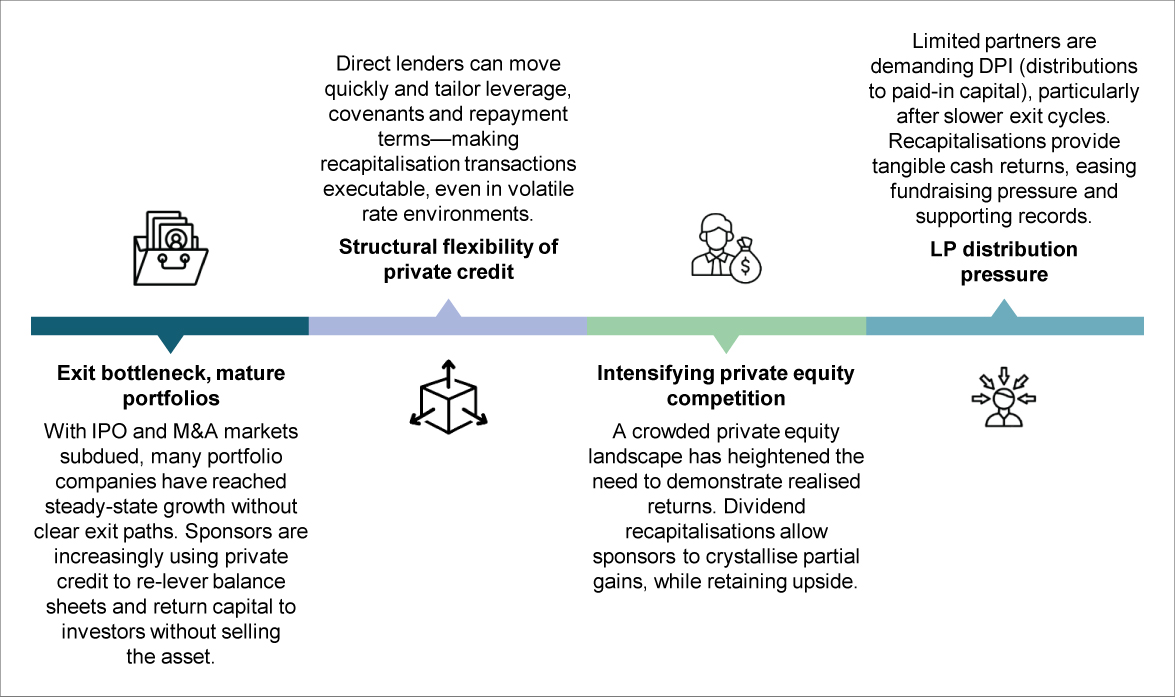
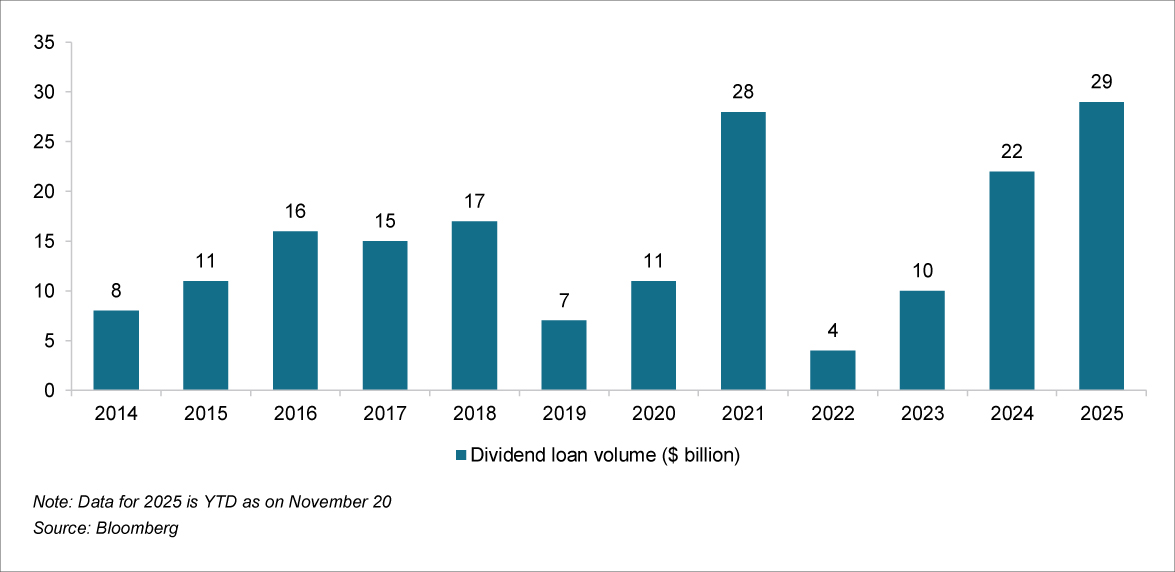
With debt issuance surpassing $30 billion in 2025, the trend of dividend recapitalisation has showed no signs of slowing. As interest rates decline and debt becomes cheaper, leveraging their portfolio companies has become more attractive for private equity firms.
With merger and acquisition (M&A) activity subdued, lenders are accepting more aggressive and risky loans to deploy capital, driven by the need to lend.
Why the surge in dividend recapitalisation
US institutional loan volume ($ billion)
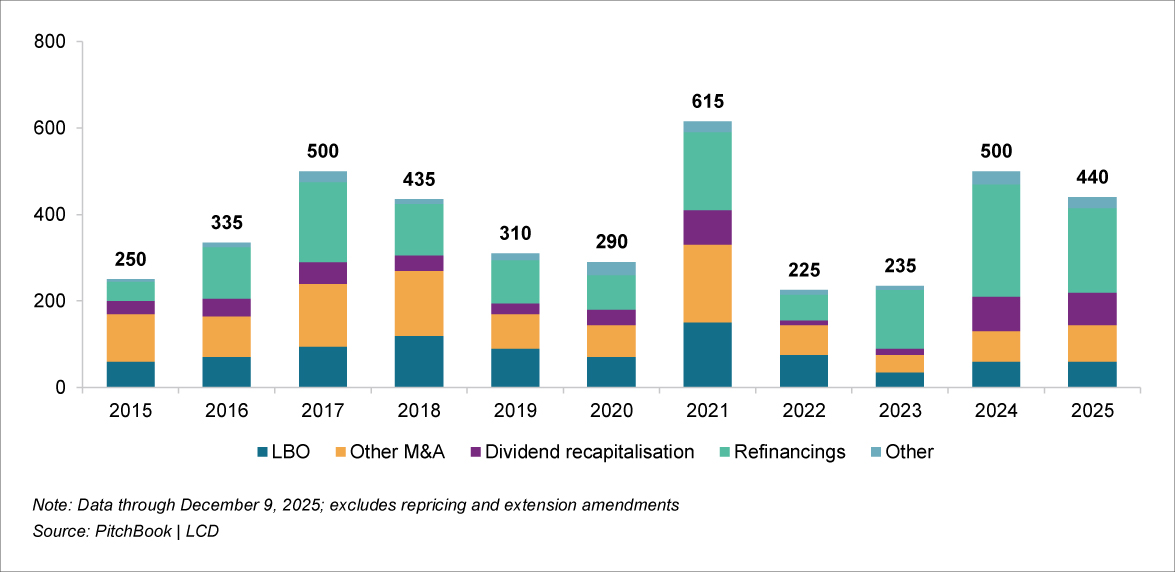
Debt raised by private equity firms to pay dividends
The current landscape
The credit cycle has decisively turned to offensive acquisition financing from defensive refinancing. Liquidity is abundant, underwriting standards are loosening and both banks and private credit funds are re-engaging in size.
The US credit market entered 2026 with momentum not seen in a decade. A powerful mix of multi-billion-dollar M&A deals and a revival in LBOs has pushed primary issuance to record highs.
Following the US Federal Reserve's pivot to a more accommodative stance in late 2025, the ‘higher-for-longer’ rate regime has given way to a 'lower-and-liquid' backdrop, unlocking a backlog of acquisitions and sponsor exits that were frozen during the tightening cycle.
Unlike the refinancing-dominated landscape of 2024, the current issuance wave is driven by new money, with acquisition financing leading the charge. Investment-grade bond supply is projected to reach $1.7–2.0 trillion in 2026, signalling a renewed appetite for growth-oriented capital structures.
However, the speed of this expansion also raises a familiar late-cycle question: Is easing discipline laying the groundwork for future stress?
The 2026 outlook
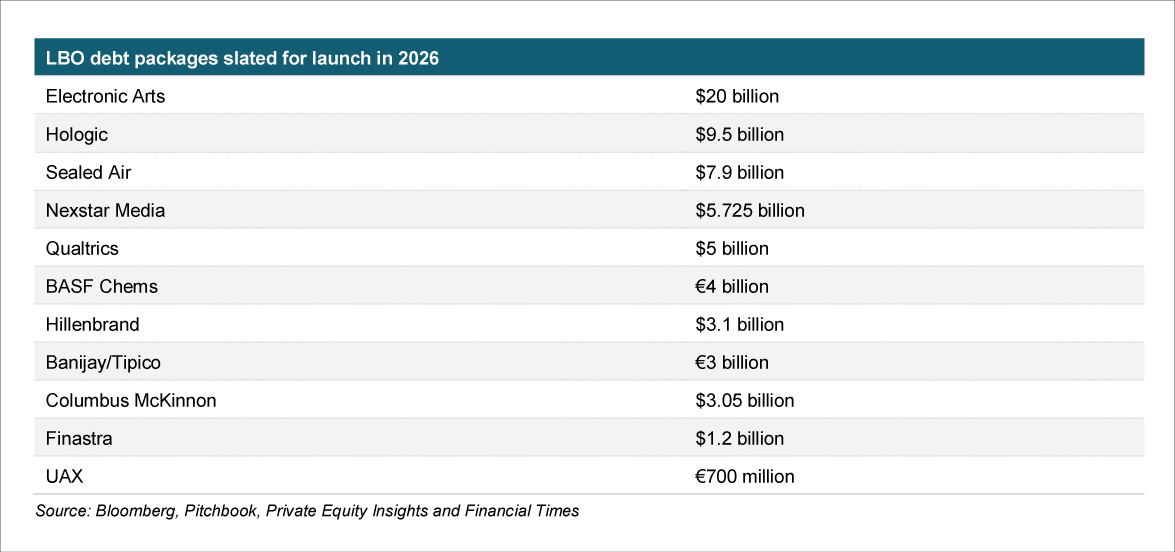
As we move further into 2026, the tone in leveraged finance is shifting to growth deployment from balance sheet repair. LBOs and broader M&A activity are expected to accelerate, supported by stable corporate fundamentals and a more accommodative rate backdrop.
The market is poised for a rebound in event-driven issuance, with sponsor-backed acquisitions and strategic transactions driving a larger share of new-money supply. With volatility and refinancing dominating for two years, capital is now expected to be deployed towards expansionary transactions rather than defensive liability management.
However, refinancing activity will remain a key pillar of the overall volume. A sizeable 2028 maturity wall is shaping issuer behaviour, encouraging companies to opportunistically extend maturities and optimise capital structures while market conditions remain constructive.
Even as M&A-driven issuance rises, refinancing is expected to account for a meaningful portion of leveraged loan activity in 2026, underscoring the market’s focus on initiative-taking balance sheet management.
Meanwhile, dividend recapitalisations are likely to moderate. As acquisition pipelines reopen and exit windows improve gradually, sponsors are shifting their focus to executing strategic transactions and realising value through traditional exits, as against extracting liquidity via recapitalisations.
The leveraged loan market is moving from a liquidity-management cycle towards a renewed growth and dealmaking cycle, marking a structural inflection in credit deployment.
That said, the outlook warrants some caution. As private credit has scaled, documentation has loosened and covenant protection has thinned, reducing lenders’ ability to spot stress early and intervene before value erodes. The market also remains meaningfully exposed to software and SaaS, a sector that helped power the asset class but is now under closer scrutiny as AI disruption, weaker sentiment and liquidity pressures test underwriting assumptions. If the credit cycle turns, those structural vulnerabilities could translate into a sharper rise in selective defaults, restructurings and softer recoveries.
Ultimately, the shift toward growth marks a turning point, but not a reset of risk. Beneath improving activity levels, structural vulnerabilities built up over the past cycle remain embedded in the market. As a result, performance is likely to diverge more meaningfully, with stronger credits benefiting from supportive conditions while weaker borrowers face increasing pressure. The next phase will hinge less on market momentum and more on resilience at the issuer level.