Explore Crisil, a company of S&P Global
Formerly known as Global Research & Risk Solutions
April 23, 2026
 Blog
Blog
Blog
Reshaping product strategy, RWA optimization, enterprise planning
April 23, 2026
Blog
Blog
US 2026 Capital NPR
 Share
Share




The US capital package released on March 19, 2026, represents a meaningful reset of the rules imposed in the aftermath of the 2008 Global Financial Crisis that were meant to help shield against meltdowns.
The proposed framework comprises three linked proposals:
- A revised capital framework for Category I and II banks and firms with significant trading activity
- A revised standardized approach for other institutions
- A Federal Reserve proposal to revise the globally systemically important bank (GSIB) surcharge methodology
The stated aim is to streamline the framework, improve alignment with underlying risk and reduce unnecessary overlap across capital requirements while preserving the resilience of the banking system.
For Category I and II banks, the most significant change is structural and the proposal replaces the current dual-calculation regime with a single expanded risk-based approach (ERBA) and revises the treatment of credit risk, operational risk, market risk and credit valuation adjustment (CVA). Importantly, it includes a proposed exemption for client-facing derivatives from CVA capital and broader recognition of hedge instruments, materially improving the economics of trading and client flow businesses.
For Category III and IV banks, the proposal is more balance-sheet focused, it introduces more granular mortgage treatment, replaces the mortgage servicing assets (MSA) deduction with a 250% risk weight and requires certain large banks that are subject to transition to reflect accumulated other comprehensive income (AOCI) in regulatory capital. These changes directly affect mortgage pricing, securities-book strategy, treasury hedging and capital planning.
Practical effect
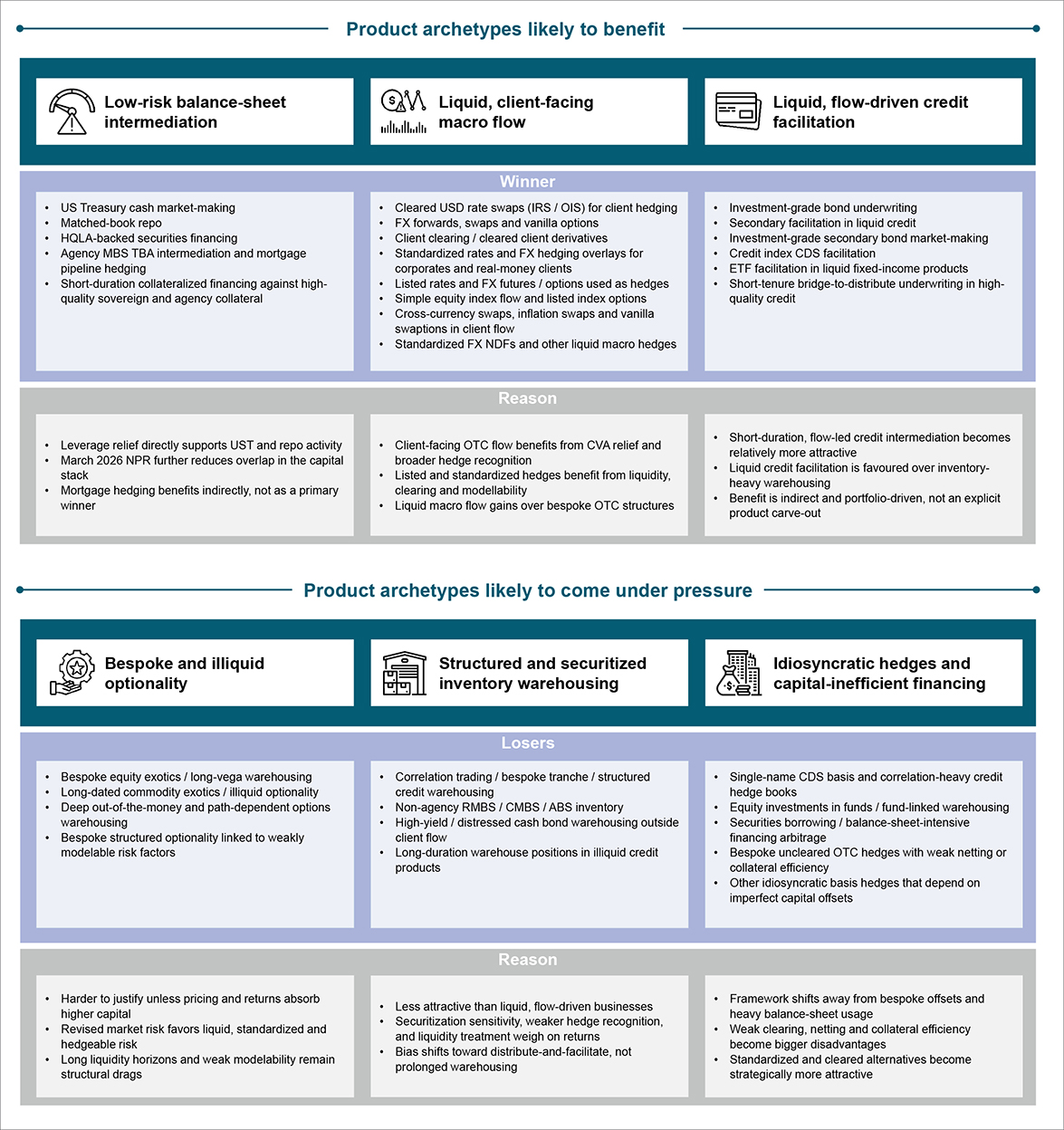
The practical effect is a framework that is relatively more supportive of liquid, client-facing, standardized intermediation and less favorable to illiquid inventory, bespoke structures and products that are difficult to model, hedge or justify, under desk-level capital governance. In product terms, that improves the outlook for US Treasury and repo intermediation, cleared macro derivatives, client clearing, listed hedges and liquid credit facilitation; while leaving exotics warehousing, structured credit inventory, single-name basis books and uncleared bespoke risk transfer under greater pressure.
The March 2026 NPR should be read alongside the November 25, 2025, the final enhanced supplementary leverage rule (eSLR), which explicitly sought to reduce disincentives to lower-risk activities such as US Treasury intermediation and repo financing. Together, these changes make risk-weighted assets (RWA) optimization less of a reporting exercise and more of a business and planning discipline, linking product selection, trade design, capital consumption, stress outcomes, liquidity usage and capital deployment capacity in a single decision loop
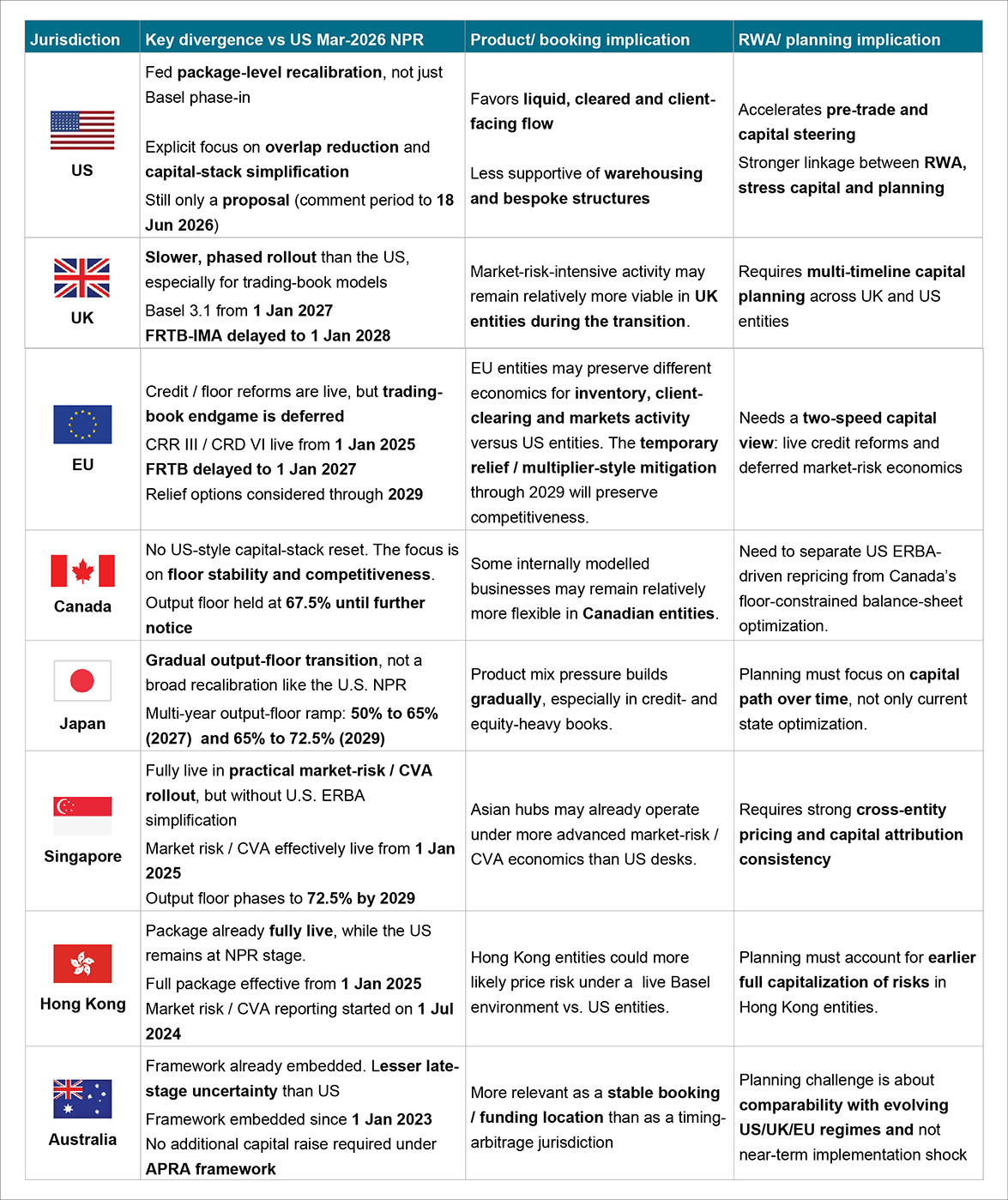
Cross-jurisdiction divergence
US NPR should not be evaluated only against the incumbent US capital rulebook. For internationally active banks, the more relevant benchmark is the timing, calibration and sequencing of final Basel III implementation across other major jurisdictions.
In contrast, several peer jurisdictions, are still managing their Basel endgame through:
- Delayed FRTB go-live
- Phased output floors
- Staggered market-risk / CVA implementation
- Competitiveness-driven deferrals
The divergence matters because a global bank does not choose product mix, hedges and balance-sheet deployment in one jurisdictional silo; it allocates across entities, desks, hubs and client franchises where capital, liquidity and booking economics differ.
What this means for global banks
- A product that becomes relatively more capital-efficient under the US NPR may not carry the same economics in the UK, EU, Canada or Asia if those jurisdictions are delaying FRTB, phasing output floors differently or applying other transitional relief. This affects
- Product mix (what to trade, warehouse or originate)
- Booking location (where to house the exposure)
- Hedge venue (where and how to hedge it)
- Capital attribution (which legal entity carries the burden)
The implication is clear—product strategy, RWA optimization and enterprise planning now need a cross-jurisdiction operating lens and not just a US-only regulatory comparison.
Product winners and losers in US bank portfolios
Our view is that the NPR does not create isolated product winners and losers, rather it creates winning and losing product archetypes.
New RWA optimization agenda in US banks
Instruments
The March 2026 NPR changes not only how much capital banks hold but also how they optimize it. The emerging toolkit is defined more by standardization, liquidity, collateral efficiency and transparency than by bespoke structuring or quarter-end balance-sheet actions.
1. Portfolio optimization
Under the proposed framework, RWA optimization becomes less dependent on model-driven arbitrage and more dependent on the disciplined use of recognized credit protection, collateral efficiency, clearing, standardization and portfolio structuring. The post-NPR RWA optimization toolkit should, therefore, be framed across three linked buckets:
- Credit portfolio optimization instruments: SRT, guarantees, credit derivatives, selective securitization structures and recognized credit risk mitigants
- Counterparty-capital and collateral optimization instruments: Netting-set redesign, CSA optimization, collateralized transactions, haircut-efficient collateral and CCP-cleared exposures
- Market-risk optimization instruments: Cleared IRS / OIS, Treasury futures, listed FX futures / options, macro and index hedges, client-cleared structures and collateral-efficient financing instruments
2. Derivatives and infrastructure optimization
Compression, collateral optimization, netting-set design and clearing choice move from operational housekeeping to strategic capital levers. Banks will increasingly optimize capital not only by changing what they trade, but also by redesigning CSA terms, collateral eligibility, netting architecture, CCP routing and balance-sheet usage—especially in the derivatives-heavy businesses where SA-CCR, CVA, leverage and market-risk charges interact.
3. Tokenization
Tokenization is not a capital shortcut. The March 5, 2026, interagency FAQs make clear that eligible tokenized securities generally receive the same regulatory capital treatment as their non-tokenized form and that the capital rules are technology-neutral. Tokenization may improve collateral mobility and operational efficiency, but it does not create regulatory capital relief by itself.
Architecture
What changes in RWA optimization architecture
The NPR also forces a redesign of the operating model. RWA optimization moves from period-end reporting to pre-trade capital steering. The control point shifts from enterprise-level roll-ups to desk, product, client and trade-level decisioning, as market-risk eligibility, hedge recognition, clearing choice and liquidity-horizon effects are inherently granular.
In practical terms, banks will need:
- Desk-level capital attribution, particularly for trading businesses
- Pre-trade capital calculators embedded into pricing and approval workflows
- Unified market risk, CVA, CCR and collateral views instead of siloed calculations
- Tighter linkage between capital, treasury and product control
Some optimization levers also become less effective. Most notably, for Category I and II banks, the removal of internal models from the credit-risk framework reduces the value of internal-model arbitrage as an optimization tool. Likewise, exotic hedge structures that may make economic sense but do not clear, net or model cleanly will increasingly lose out to more standardized alternatives.
In our view, the net result is clear: the future RWA optimization toolkit is less about structure-led capital engineering and more about capital-efficient product design.
Capital planning in US banks
The March 2026 NPR should not be treated as a narrow Pillar 1 change. The Fed has framed the capital architecture around the interaction of risk-based capital, leverage, stress testing, and the GSIB surcharge, which means banks need to assess the NPR as a change to the broader enterprise planning loop, not just as a regulatory capital update.
If banks shift toward liquid, client-facing flow businesses and away from structured or inventory-heavy warehousing, the loss distribution under stress changes even if starting capital does not move materially.
For Category I and II banks, management buffers and capital capacity will increasingly depend on franchise composition: rates, FX, financing, client clearing and liquid credit facilitation will behave differently under stress than structured inventory and exotic optionality.
For Category III and IV banks, the implications are more balance-sheet centric: the proposed AOCI inclusion ties securities-book volatility more directly to capital, while revised mortgage and MSA treatment changes the economics of origination, servicing and hedging. The OCC’s Fall 2025 risk perspective also noted that unrealized investment portfolio losses had fallen materially from 2023 levels and that liquidity remained sound, supported by deposit growth and contingent funding capacity, reinforcing the need to link ALM, securities positioning, mortgage pricing, capital usage, and liquidity planning in one closed planning loop, spanning product economics, trade design, RWA usage, stress impact, liquidity and collateral, business capacity and portfolio reallocation.
How we can pitch in
Our highest-value role is not rule interpretation alone; it is helping banks build decision-grade capital infrastructure and operating models for the March 2026 NPR.
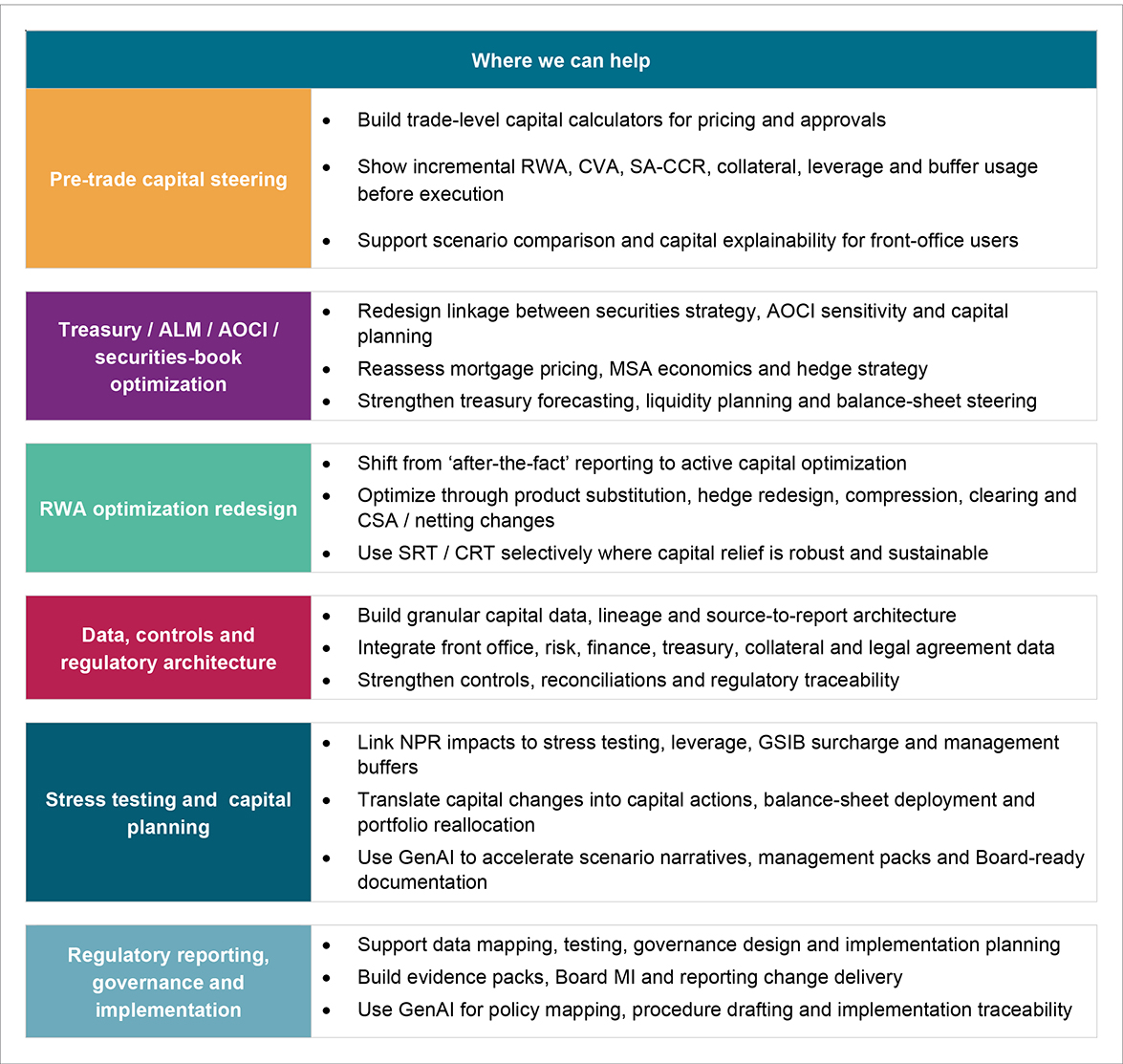
An inflection point for banks and financial institutions
For banks and financial institutions, the March 19, 2026, NPR should not be viewed as a narrow capital rule update. It is a strategic signal about the kind of banking activity the US framework is now prepared to support: more liquid intermediation, more standardized client flow, better collateralized and cleared risk transfer and tighter alignment between product design and capital usage.
The institutions that respond well will not be those that wait to measure the impact at the quarter-end, but the ones that can price capital in real time, redesign portfolios early, and connect capital, liquidity and profitability at the point of decision.
Our view is that the NPR creates a practical agenda for clients across the banking sector to:
- understand where capital efficiency is improving
- act early where product economics are deteriorating
- redesign optimization levers around standardization and transparency
- build the data, control and decisioning architecture needed to steer capital proactively
In that sense, the March 2026 NPR is not just a regulatory event, rather a portfolio strategy and operating model inflection point for banks and financial institutions.