Explore Crisil, a company of S&P Global
Formerly known as Global Research & Risk Solutions
May 05, 2026
 Blog
Blog
Blog
Revisiting leveraged-lending risk
May 05, 2026
Blog
Blog
From reactive to proactive risk management and continuous stewardship
 Share
Share




The leveraged-lending space is shifting its focus from high deal volume and competitive pricing toward a more deliberate assessment of how risk is evaluated, structured and managed over the life of an exposure.
While pricing and volume remain important, geopolitical uncertainties, uneven economic growth and tighter liquidity conditions demand greater emphasis on capital efficiency and structural resilience as well as clear ongoing visibility into portfolio risk—a priority reinforced by regulatory scrutiny across jurisdictions for leveraged-lending portfolios.
To be sure, leveraged lending remains a core funding channel for corporates and sponsors. In the US, outstanding leveraged loans exceeded $1.6 trillion by mid-2025, driven by buyouts, refinancings and take-privates. In Europe, growth has been fueled by competition between banks and non-bank lenders seeking higher returns.
The new paradigm
Historically, lenders providing leveraged financing gauged success by origination volume and spread capture. However, in current market conditions, these metrics are taking a backseat to more critical factors: a leveraged loan’s ability to withstand stress, maintain creditworthiness during business volatility and be effectively monitored across its lifecycle.
Put simply,
- Strong documentation and structure are competitive advantages, not administrative burdens
- Clear portfolio segmentation helps focus attention where risk is most likely to emerge
- Faster escalations and clearer triggers improve decision-making under stress
- Specialist support reinforces end-to-end risk management by bringing consistency, scalability and deeper analytical insight across the credit lifecycle
- Automation and advanced analytics enable real-time monitoring, early risk detection and more consistent decision-making across portfolios
Shape of things to come
The three trends that will define leveraged lending and credit management in 2026 are:
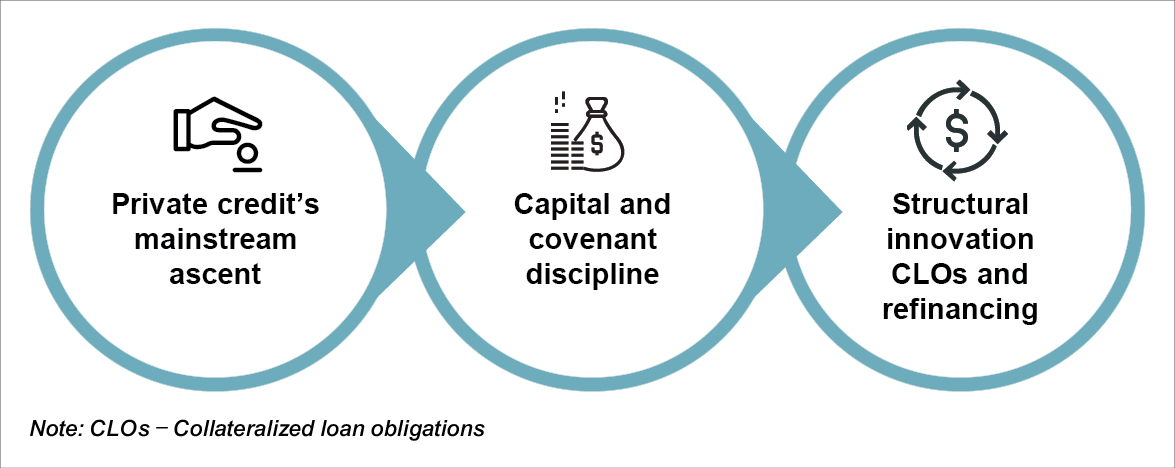
Private credit’s mainstream ascent
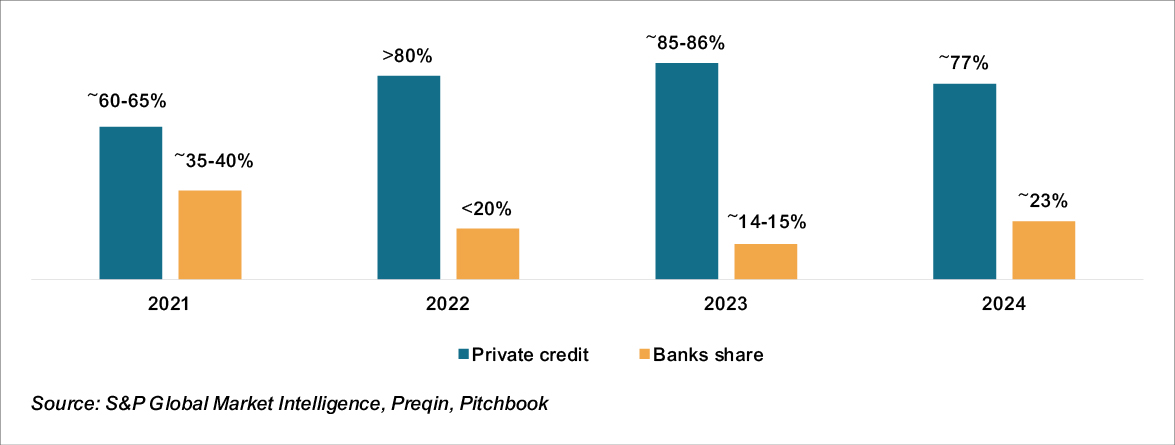
The rise of private credit has reshaped leveraged finance, pivoting the model towards faster execution, bespoke structuring and hold-to-maturity risk management, as opposed to traditional syndicated distribution.
Private players continue to offer greater flexibility in documentation and structure, particularly when banks face balance sheet constraints or challenging market conditions.
A notable example is the ~$5 billion refinancing of Finastra, where a consortium of private-credit lenders replaced broadly syndicated loan markets, underscoring how direct lenders are increasingly stepping in to underwrite large, complex transactions traditionally dominated by banks1.
As a result, competition is no longer defined by price or capital alone. Bank-led desks are increasingly differentiating themselves by how risk is structured, governed and monitored over time.
In response to private credit’s growing share, banks are sharpening their focus on covenant discipline, documentation rigor and post-origination surveillance, where scale and portfolio transparency remain key advantages.
Private credit’s share in global leveraged buyout (LBO) financing
Capital and covenant discipline
Leveraged lending is increasingly shifting toward capital protection and documentation discipline in a volatile environment. Rather than chasing volume, lenders are prioritizing covenant robustness and legal enforceability as core risk controls.
This shift is evident in deal structuring: covenants are tightening, documentation is more precise and triggers are being designed to provide early visibility into stress. At the same time, a modest widening of spreads reflects the higher risk premium demanded by credit committees.
For leveraged-finance teams, stronger covenants are no longer viewed as optional safeguards. These are central to how risk is governed after origination, shaping borrower behavior, enabling early intervention and preserving flexibility in periods of stress.
In the European leveraged-loan market, documentation trends in the first quarter of 2026 show a clear shift toward tighter lender protections. Key developments include stricter EBITDA (earnings before interest, taxes, depreciation and amortization) adjustments, tighter baskets and stronger MFN (most favored nation) protections, as lenders push back after a period of borrower-friendly terms.
This comes alongside more disciplined negotiation of covenant packages and refinancing terms, especially as volatility and geopolitical shocks have disrupted issuance.
Structural innovations
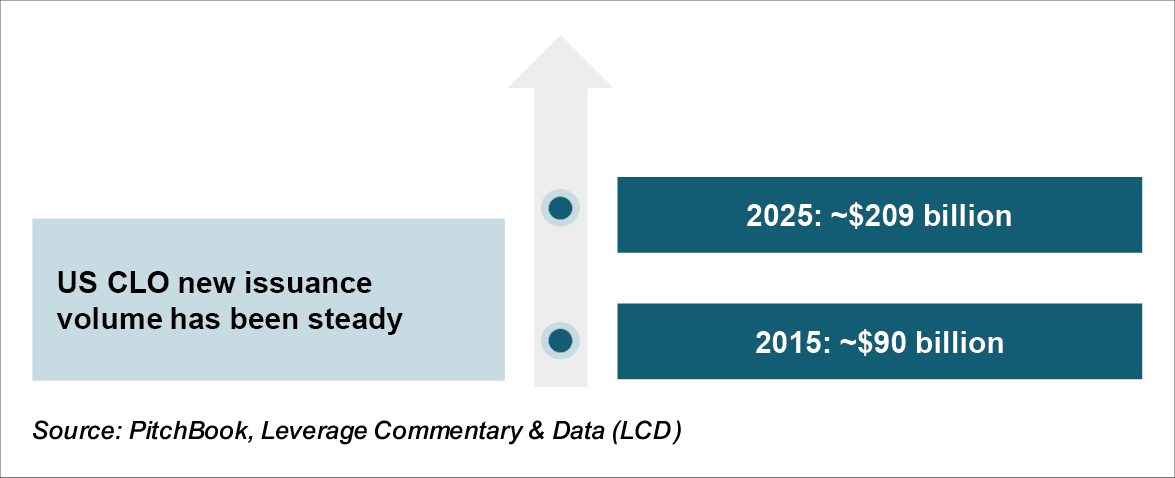
CLOs continue to anchor demand for leveraged loans, particularly in the US, even as issuance dynamics evolve. In 2025, CLO activity was driven by refinancing and repricing, rather than new-money deals, as lenders focused on portfolio optimization and risk management.
Notable examples include2:
- In April 2025, Benefit Street Partners refinanced its $500 million CLO (CLO XXXI), replacing existing debt tranches without adding new assets
- In October 2025, Audax executed a comprehensive CLO refinancing, redeeming and replacing existing debt tranches (Classes A-D) with new debt
- In 2025, Sound Point refinanced 14 CLOs over a six-month period, extending reinvestment periods and lowering funding costs across its portfolio
This shift places greater emphasis on the quality of underlying credit, with investors and arranger banks prioritizing downside resilience and structural consistency over yield alone.
As financing structures evolve, so does the nature of risk—becoming more dynamic, opaque and continuous. The focus must now shift to how banks embed risk discipline across the credit lifecycle.
Leveraged finance in transition: Building a risk-disciplined ecosystem
First line of defense – origination and credit teams
- Institutionalizing automated monitoring, real-time dashboards and centralized covenant tracking by leveraging third-party platforms/tools such as nCino and Covenant Guard to create a single execution layer across origination and monitoring
- For banks still transitioning, standardizing workflows within such platforms ensures trigger-based discipline is built into deals upfront and consistently applied across portfolios
Second line of defense – risk control and oversight
- Embedding next-level oversight in the second line of defense by integrating artificial intelligence (AI)-enabled early warning systems, dynamic covenant analytics and platform-based transparency to actively challenge, monitor and intervene across the portfolio lifecycle
- Linking origination assumptions to live performance and enabling proactive, portfolio-level intervention are critical for banks moving from fragmented controls to centralized, risk-led governance
Bank leadership and executive committees
- Winning banks will treat risk discipline as a strategic capability, aligning incentives, embedding monitoring rigor and investing in AI-enabled infrastructure to sustain portfolio resilience at scale
1 Source: PR Newswire
2 Presale: Benefit Street Partners CLO XXXI Ltd./Be | S&P Global Ratings Audax Private Debt | Creditflux: Audax slashes cost of debt with two-year-old reset Sound Point Meridian Capital Semi-Annual Report dated Sep 2025
Our take
The next phase of leveraged finance will be defined by how effectively institutions combine technology with domain judgment to move from reactive oversight to embedded risk control. This is where integrated, data-led platforms come into play, bringing together origination, covenant tracking and portfolio monitoring into a single, consistent view of risk.
By enabling real-time covenant visibility, automated monitoring and early warning signals, lenders can detect stress early, respond faster and make more informed credit decisions. The use of generative AI (GenAI) further amplifies this capability by surfacing insights from large, complex datasets, linking underwriting assumptions to live performances, and enhancing risk foresight.
Equally important is the ability to standardize workflows and enforce discipline at scale, ensuring consistency across deals, teams and geographies. In an environment where refinancing cycles dominate and risks evolve continuously, this shift toward proactive, insight-driven risk management can be a key differentiator in preserving portfolio resilience and optimizing outcomes.