Explore Crisil, a company of S&P Global
Formerly known as Global Research & Risk Solutions
June 30, 2026
 Blog
Blog
 Share


Year of checkered signals
The global market for senior housing has had a mixed outing this past year. Though fundamentals such as occupancy and absorption have improved amid muted new supply, high profile sales at a loss and broader rationalization of weaker assets have underscored operating and financing risks, especially for leveraged, service heavy assets.
Capital return has been seen selectively, underwriting remains disciplined amid labor and insurance cost inflation and a still evolving interest rate environment.
Against this backdrop, investors need to evaluate markets and operators with precision, prioritize durability in cash flows and assume variability by product type and metro.
A marquee realty check shows Blackstone has been unwinding a senior housing bet of roughly $1.8 billion, pressured by floating rate debt, rising costs and operational complexity. It has reportedly incurred losses of >$600 million, with some properties sold at >70% below their original purchase prices. This is a visible reminder that execution risk in senior housing is real and can overwhelm a demographics only thesis.
Fundamentals have continued to improve across the sector. Data from the National Investment Center for Seniors Housing & Care (NIC) shows US senior housing occupancy reached 89.5% in the first quarter of 2026, marking the 19th consecutive quarter of growth, up from 88.7% in the third quarter of 2025. This reflects a sustained recovery trajectory, with occupancy rising ~80 basis points (bps) over two quarters and ~2.2 percentage points through 2025. Quarterly gains are steady at roughly 40 bps, supported by strong absorption and historically low supply growth. The sector is now approaching the 90% stabilization threshold widely viewed as indicative of normalized operating conditions.
Investor surveys are tilting cautious to constructive. JLL and CBRE see more respondents expecting cap rate compression during 2026 compared with earlier in 2025, but with an emphasis on quality, operator strength and below replacement cost opportunities.
Demand, supply and rents
Occupancy and absorption rise: Occupancy in the US reached 89.5% in the first quarter of 2026 across the 31 primary markets, with NIC citing 19 consecutive quarterly gains. Absorption continued to outpace new deliveries and active adult occupancy stabilized near ~92%.
Supply is tight: Construction as a percent of inventory hovered around ~2.4% during the quarter, well below pre pandemic norms, while rolling four quarter starts ran at <1% of inventory. Combined with muted pipelines, the dynamic supports further normalization in occupancy.
Rent growth normalized ~4% on-year: Asking rents rose 4.3% on-year during the quarter, aiding net operating income (NOI) recovery as operators chipped away at agency staffing reliance. Investors underwrote 3–7% rent growth for 2026 across independent living, assisted living and memory care.
Capital markets see a cautious reopening
Commercial real estate investment activity in the US is expected to accelerate meaningfully in 2026, building on a recovery that began in 2025. CBRE estimates investment volumes grew ~10% in 2025 to ~$437 billion, as capital markets gradually stabilized following the dislocation during prior years. The momentum is set to strengthen further, with investment activity projected to rise ~16% in 2026 to ~$562 billion—bringing volumes close to pre-pandemic averages. Cap rates are expected to compress modestly by 5–15 bps across most property types, but returns will remain predominantly income-driven, favoring asset selection and operational execution over multiple expansion. This progression from a gradual recovery in 2025 to a stronger rebound in 2026 underscores improving liquidity, narrowing bid-ask spreads, and renewed investor conviction—albeit with continued emphasis on asset quality and cash flow durability.
Debt availability has been selective and pricier. Debt availability is improving but remains selective and structurally tighter than pre-pandemic levels. Entering 2026, capital markets are reopening in a more disciplined manner, with lenders prioritizing asset quality, operator track record and stabilized cash flows. While debt availability has expanded relative to 2024–2025, spreads remain elevated and financing structures are more complex, often involving layered capital stacks (senior debt, mezzanine and preferred equity). Banks continue to be cautious, particularly on construction lending, while alternative lenders and debt funds remain active. Government-supported enterprise programs (Fannie Mae and Freddie Mac) continue to play a critical role, with loan purchase caps raised to ~$176 billion for 2026, supporting liquidity in the sector. Importantly, refinancing and recapitalization are expected to drive near-term activity, as lenders favor existing assets over new development. Overall, the environment reflects greater liquidity but tighter underwriting, with cost of capital still a key constraint on growth.
Transactions have accelerated but skewed smaller. Transaction activity has continued to accelerate, though skewed toward smaller deals. The sector saw a record high of 871 publicly announced merger and acquisition transactions in 2025. In the 12 months through to mid-2025, the number stood at 733. Early 2026 activity remains robust, with 231 deals in the first quarter alone, putting the market on pace to match or exceed prior peaks. However, transaction sizes remain smaller on average, reflecting portfolio breakups, selective capital deployment and persistent financing constraints. driven by numerous small transactions and portfolio breakups. The dollar volume rose but remained below the mid 2010s peak.
Sectoral realty check
Blackstone’s piecemeal exit from its ~$1.8 billion senior housing portfolio is a high-profile case study, but it is not an isolated event. Rather, it reflects a broader pattern of operational, financial and capital structure challenges playing out in the senior housing sector.
Large operators are actively reshaping portfolios. Brookdale, the largest US senior housing operator, has spent years divesting underperforming assets and plans to sell ~29 communities (~$200 million), many below its target occupancy thresholds.
More broadly, Brookdale’s footprint has declined from over 1,100 communities in 2014 to ~500 today, reflecting a deliberate multi-year rationalization of weaker assets.
This suggests that asset-level performance dispersion is significant and even scaled operators must actively prune portfolios to maintain returns.
Bankruptcies across operators underscore persistent distress
The sector has also seen consistent financial distress beyond individual portfolios. Industry data indicates that senior care companies have experienced 10–15 bankruptcy filings annually in recent years, with dozens of operators entering restructuring or liquidation since the pandemic.
Between 2021 and 2024 alone, over 50 senior care companies filed for bankruptcy, driven by rising costs, labor shortages and debt pressures.
This underscores that challenges in senior housing are structural rather than episodic, affecting operators across size and geography.
Capital impairment not limited to investors
In certain segments, particularly continuing care retirement communities, financial distress has extended beyond investors to residents.
Bankruptcies in this segment have resulted in hundreds of millions of dollars in lost entrance-fee deposits, with some residents recovering only a fraction of their initial payments. For example, in cases like Harborside (New York), residents reportedly lost 67–75% of their deposits following restructuring.
These examples highlight deeper business model vulnerabilities, particularly in structures reliant on upfront resident fees to sustain operations.
Market repricing and discounted transactions
Transaction activity also points to a repricing of risk across the sector. Recent deals, including Brookdale’s acquisitions, have occurred at discounts to estimated replacement cost, reflecting both seller distress and buyer caution.
This dynamic suggests that the market is undergoing a valuation reset, not simply reacting to isolated distressed sales.
Even within institutional portfolios, performance outcomes are diverging. While some healthcare real estate investment trusts are seeing strong growth supported by improving occupancy, others are facing tenant defaults, credit losses and margin compression tied to operator performance.
This widening dispersion reinforces a core point: Senior housing behaves less like traditional real estate and more like an operating business, where returns depend heavily on execution.
Headwinds to underwriting...
Operating costs (labor, taxes and insurance): Running senior housing communities is getting more expensive. Operators say they are being squeezed by higher wages, healthcare benefits, property taxes and insurance bills. Even though they’re using fewer costly temp staffing agencies than before, insurance claims—especially from resident falls—continue to push premiums up.
Staffing realignment, not a short term shortage: NIC projects the sector will need ~660,000 additional workers by 2033. Winning labor share requires improved schedules, career ladders and tech enabled workflows—not wages alone.
Debt maturities and cap stack resilience: While liquidity is improving, lenders remain selective on refinancing and new construction. Recapitalizations and value add business plans are more common than ground up projects
Affordability and middle market: Middle income seniors—too affluent for Medicaid yet stretched for private pay—remain under served, requiring product and service innovation to expand addressable demand.
...offsetting tailwinds to monitor
Demographic demand is finally visible in the data. PwC/ULI’s Emerging Trends 2026 highlights senior housing as a leading niche, with the oldest Boomers turning 80 in 2026, coinciding with near record occupancy and the lowest on-year inventory growth since NIC began tracking.
Investor sentiment is improving, with discipline. JLL and CBRE surveys show most participants plan to maintain or increase exposure and expect modest cap rate compression, but with pronounced spreads by asset quality and market.
Active adult occupancy is comparatively resilient. Active adult (55+) communities remain about 92% full on average. They operate more like regular apartments with fewer care services, making them an attractive, lower cost option for Boomers who want community living but don’t yet need daily care.
Strategy implications for 2026 (neutral, risk aware)

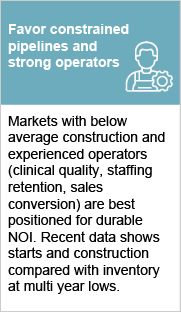


Four aspects to keep eyes peeled on
1. Occupancy crossing 90% at the national level if demand continues to outpace limited
2. Cap rate drift vs rates: Surveys point to modest compression, but execution quality and local supply will drive spreads
3. Insurance and labor cost trajectories: Persistent increases could limit margin recapture even with higher rents
4. Debt maturities and refinancing outcomes: Expect more granular lender selectivity and emphasis on operator capabilities
The bottom line
The 2026 senior housing story is neither uniformly bullish nor bearish. Sector level data shows improving occupancy and steady rent growth, supported by muted supply and demographic tailwinds. At the same time, high profile losses reveal how leverage, operating complexity and rate risk can derail returns
For allocators, the prudent course is selective growth: lean into under supplied submarkets and best in class operators, structure capital stacks for resilience and budget conservatively for labor and insurance.