Explore Crisil, a company of S&P Global
Formerly known as Global Research & Risk Solutions
 Blog
Alternatives knock on 401 (k) doors
Blog
With diversification benefits come risks
 Share



The opportunity landscape
The retirement system in the United States (US) is undergoing its most substantial overhaul since the introduction of 401(k) plans in 1978.
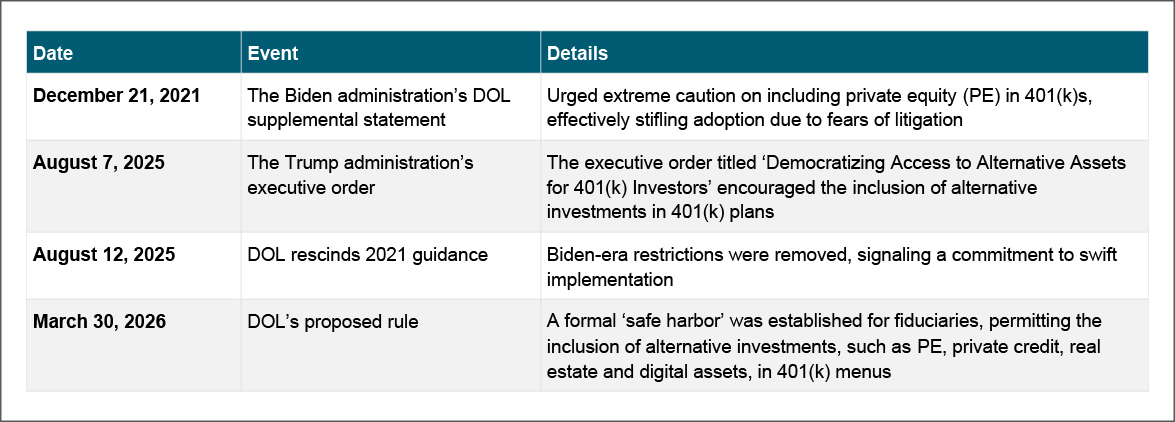
An August 2025 executive order and a March 30, 2026, proposed rule from the Department of Labor (DOL) are paving the way for private credit and alternative investments to enter mainstream retirement accounts, previously accessible only to institutional investors and the ultra-wealthy.
Against this backdrop, we examine the regulatory timeline, key provisions, opportunities and challenges for asset managers (AMs) and other implications for the AMs offering 401(k) plans.
Timeline of regulatory milestones
The path toward integrating alternative assets into 401(k)s has been shaped by key regulatory milestones:
Note: Regulatory timelines and details are subject to change. The above details are for informational purposes only.
Source: Regulatory announcements
Key provisions of the DOL’s proposed rule
The DOL’s proposed rule represents a fundamental shift in how 401(k) fiduciaries can approach alternative investments. It establishes a process-based ‘safe harbor’ that protects plan sponsors from litigation, provided they follow a prudent, documented evaluation process or framework.
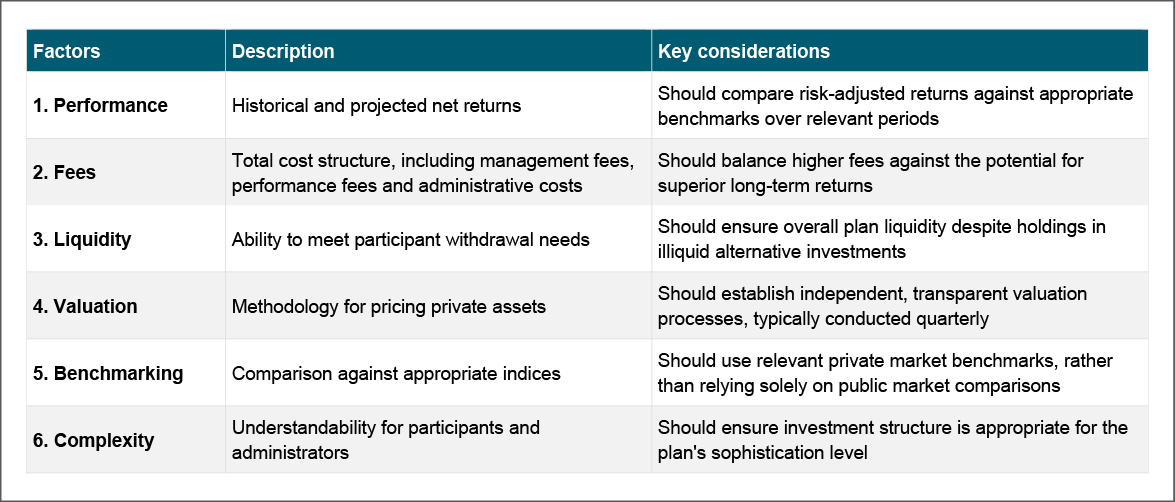
- Six-factor fiduciary framework: Under the proposed rule, plan fiduciaries must evaluate alternative investments based on the six-factor fiduciary framework outlined below. Fiduciaries are required to evaluate these aspects thoroughly when selecting alternative investments, ensuring their decisions align with the best interests of plan participants
Source: DOL, March 30, 2026
- ‘Safe harbor’ provision: According to the rule, fiduciaries that document their evaluation process using these six factors will be protected from opportunistic lawsuits, even if the alternative investment underperforms. This addresses the primary barrier that has prevented the widespread adoption of alternatives in 401(k)s, i.e., the fear of Employee Retirement Income Security Act (ERISA)-related lawsuits
A $1.4-trillion opportunity for alternative AMs
The inclusion of private credit and alternative investments in 401(k) plans presents a significant opportunity for alternative AMs. It opens access to a vast pool of retirement capital, potentially unlocking trillions of dollars in new investment.

* DC plan assets are ~30% of total US retirement market assets. About 60% of US households (more than 80 million), had DC plan accounts in 2025. Source: Investment Company Institute (ICI), Statistical Report - Quarterly Retirement Market Data, First Quarter 20261
**According to data from the 2026 PLANSPONSOR Defined Contribution Plan Benchmarking Survey2, only 2.9% of plan sponsor respondents offered investment options that included alternatives
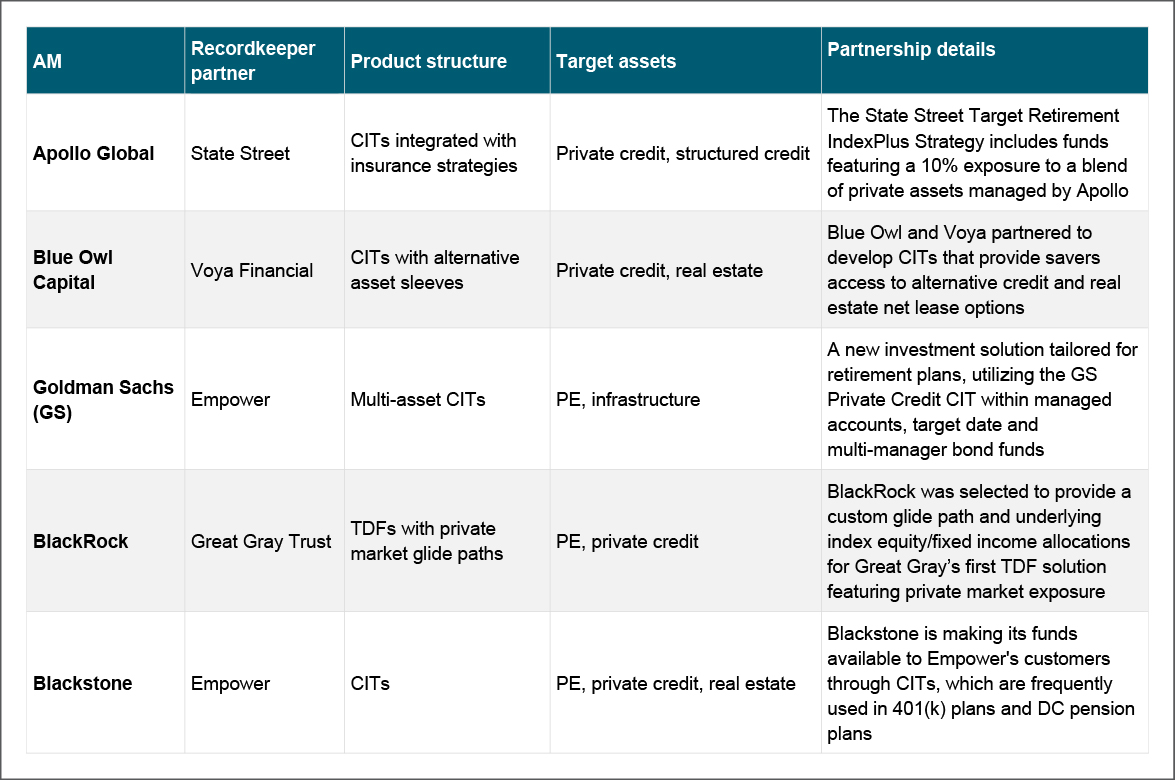
Major alternative AMs, including Blackstone, Apollo Global Management and BlackRock, are expected to benefit as they expand their private credit platforms and form strategic partnerships with recordkeepers such as Empower, Voya and State Street.
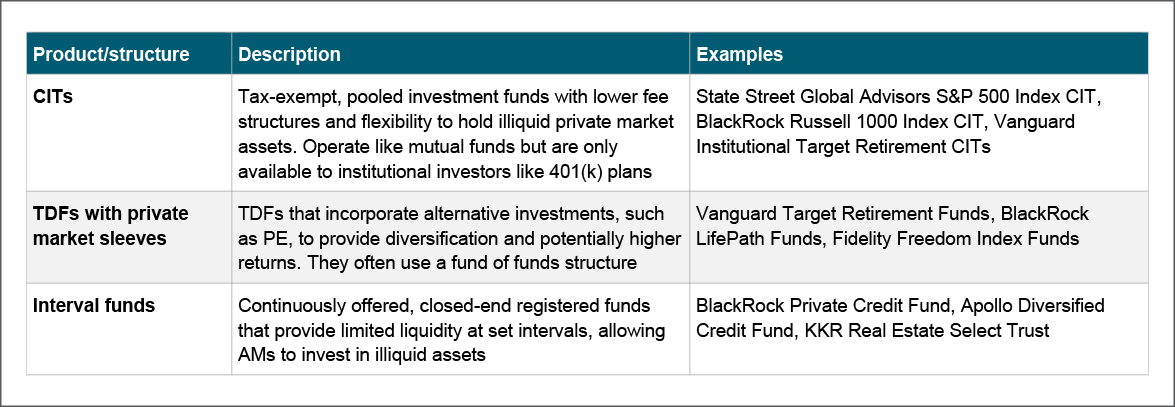
These collaborations are driving the development of innovative structures and products, including collective investment trusts (CITs), target date funds (TDFs) with private market sleeves, and interval funds, all designed to facilitate the integration of private assets into retirement plans. These structures leverage the long-term, ‘sticky’ capital profile of retirement accounts, which is well-suited to the illiquid nature of private investments.
Unlocking opportunities in the defined contribution market
The defined contribution (DC) market presents a significant opportunity for alternative asset managers (AMs) to innovate and grow their revenue. By adapting their products and workflows to meet the unique needs of defined contribution plans, AMs can tap into this massive market and help improve retirement outcomes.
Alternative investments, such as private equity and private credit, are entering 401(k)s through diversified, packaged structures, rather than standalone menu options. This expands AMs' addressable markets, unlocking massive fees and revenue streams while prompting new product development designed to navigate strict liquidity, valuation, and ERISA fiduciary standards.
The following table outlines the top three fund structures in use and provides access to alternatives in 401(k) plans
Source: Industry data
TDFs are emerging as a popular investment option in 401 (k) plans to tap into private markets: According to a June 2026 research paper by the Investment Company Institute (ICI)3, TDFs are emerging as a popular investment option in 401 (k) plans, after being approved for inclusion in retirement plans as a qualified default investment alternative (QDIA) in 2007, with total net assets increasing from $129 billion at the end of 2006 to $4.9 trillion at the end of 2025. TDFs provide investors access to diversified portfolios that automatically rebalance for comparatively low costs, with asset-weighted average expense ratios falling from 0.65% to 0.27% between 2010 and 2025. In 2023, 89% of 401(k) plan participants in the Employee Benefit Research Institute (EBRI)/ICI 401(k) database were in plans that offered TDFs, and 71% held TDFs. Besides, at the end of 2023, 42% of 401(k) plan assets were invested in TDFs, highlighting their prominent role in DC plans.
Meanwhile, CITs are pooled, tax-exempt investment funds maintained by banks or trust companies offering a transparent, low-cost structure, making them attractive to plan sponsors amid increased scrutiny around 401(k) fees and litigation. CITs accounted for ~54% of TDF assets at the end of 2025, while mutual funds ~46%. While interval funds are also occasionally used to introduce private assets (like private equity or real estate) into 401(k) plans, their widespread adoption remains highly restricted due to the liquidity constraints of interval funds.
Major industry partnerships (2025-2026): Partnerships between alternative AMs and recordkeepers are reshaping the 401(k) landscape, driven by efforts to democratize access to private markets for individual investors. These partnerships focus on using CITs and TDF structures to integrate private credit, private equity and real estate into retirement accounts, often with the goal of lower volatility and higher income.
Source: Industry data
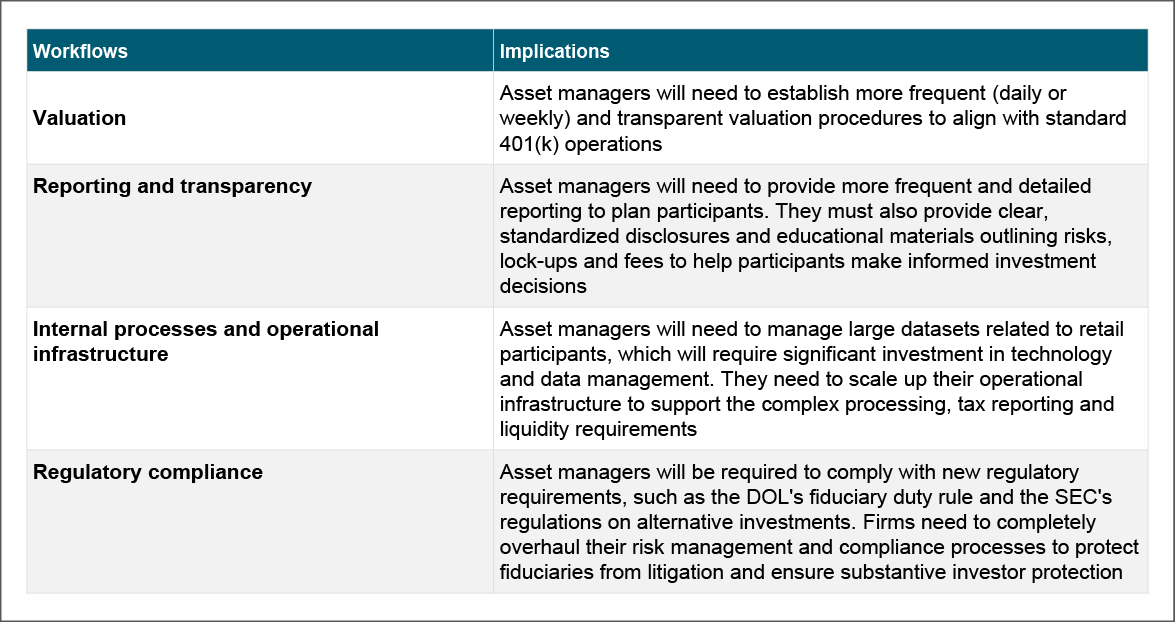
Adapting workflows to support the defined contribution market
The inclusion of alternative investments in 401(k) plans presents significant opportunities and challenges for private asset managers. To effectively participate in this market, they must implement key workflow changes to meet the unique needs of defined contribution plans and provide a seamless investment experience for participants.
Source: Industry data
Conclusion
The integration of private markets into 401(k) plans marks a significant shift in the retirement landscape, presenting both opportunities and challenges for asset managers. As regulatory barriers ease, private market investments are poised to become more accessible to individual investors, potentially unlocking trillions of dollars in new assets under management. For asset managers, this trend necessitates innovation and adaptation, particularly in product development, valuation methodologies, and regulatory compliance. By leveraging structures like CITs, TDFs and interval funds, asset managers can provide diversified portfolios that include private assets, potentially enhancing long-term returns and improving retirement outcomes.
From an asset manager's perspective, the inclusion of alternative investments in 401(k) plans requires a fundamental transformation of their workflows and operational infrastructure. As the industry evolves, asset managers that successfully navigate these challenges will be well-positioned to capitalize on the growth of private markets in 401(k) plans, ultimately driving innovation and improving retirement outcomes. With estimates suggesting that private capital could account for 6% (~$1.1 trillion)4 of total US defined contribution plan assets by 2030, asset managers have a significant opportunity to shape the future of retirement investing and reap the benefits of this emerging market. By embracing this trend and adapting to the changing regulatory landscape, asset managers can play a critical role in democratizing access to private markets and creating a more inclusive and sustainable retirement system.
1 Statistical Report: Quarterly Retirement Market Data, First Quarter 2026
2 Plansponsor.com
3 ICI Economic Analysis of the Department of Labor’s Designated Investment Alternatives Proposal June 2026
4 Deloitte’s FSI Predictions 2026 report