Explore Crisil, a company of S&P Global
Formerly known as Global Research & Risk Solutions
July 24, 2026
 Blog
Blog
 Share





Summary
The UK Prudential Regulation Authority's (PRA) Consultation Paper CP9/26 proposes a series of targeted refinements to the Fundamental Review of the Trading Book Internal Model Approach (FRTB-IMA), while retaining the planned implementation date of January 1, 2028.
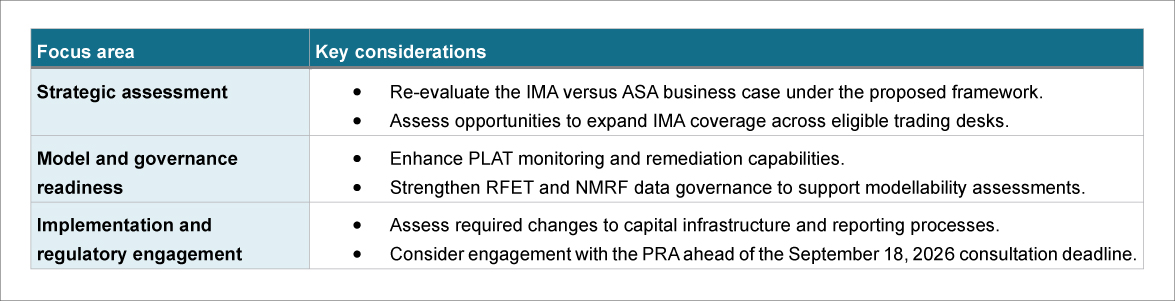
The proposals aim to reduce operational and capital disincentives that have limited IMA adoption by easing requirements around the profit and loss attribution test (PLAT), risk factor eligibility test (RFET), non-modellable risk factors (NMRFs), portfolio aggregation and collective investment undertakings (CIUs), while preserving the overall prudential calibration. Together, these changes could improve the business case for IMA adoption and expand the range of trading desks eligible for internal modelling. Firms should assess the impact on their market risk capital frameworks, implementation roadmaps and model approval strategies, particularly as the consultation closes on September 18, 2026.
The PRA estimates annual benefits of £1.8-60 million, driven by greater IMA adoption and changes to the NMRF framework. Overall, the proposals aim to improve capital efficiency, support firms' ability to provide hedging solutions and enhance the competitiveness of UK capital markets while maintaining prudential standards.
PRA's journey to FRTB-IMA implementation
The UK PRA's approach to implementing Basel 3.1 has evolved significantly since the initial consultation in 2022, reflecting changes in global implementation timelines and ongoing industry engagement.
CP9/26 marks the next stage in this evolution, introducing seven targeted proposals to enhance the practicality, proportionality and attractiveness of the IMA framework while preserving the underlying objectives of the Basel standards.
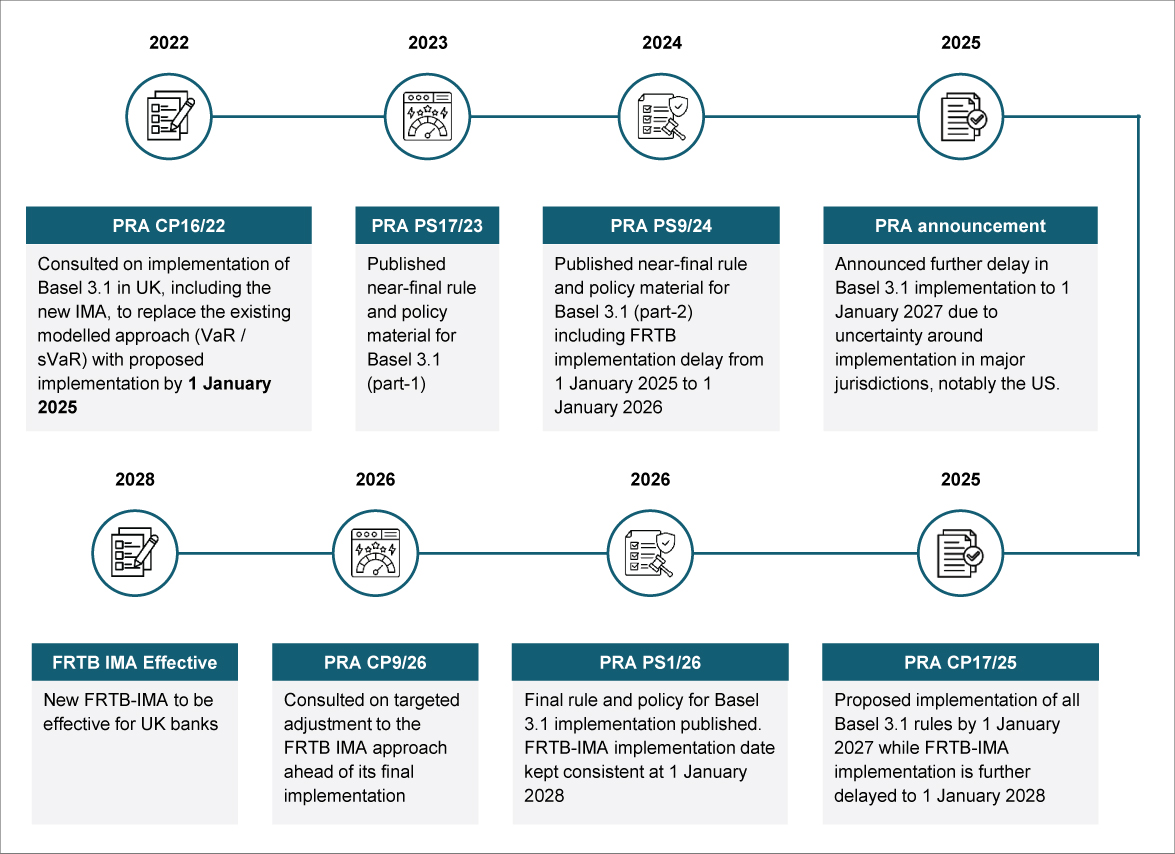
Overview of the PRA’s proposals
The PRA proposed seven targeted enhancements to the FRTB-IMA approach to simplify implementation, improve capital efficiency and encourage broader adoption while maintaining robust prudential standards
Proposal | Key changes | Impact assessment |
P1 - Extend PLAT monitoring period | Proposes extending the existing PLAT monitoring period from one year to three years. During the monitoring period, firms using IMA would continue to report their profit and loss data in accordance with the PRA reporting requirementsKey takeaway: The three-year monitoring window shields desks already inside IMA from automatic ASA reallocation. It is not an entry gate into IMA, and the three-year window clock starts from its official implementation date (1 January 2028). | · Reduces risk of desks losing IMA eligibility prematurely due to short-term PLAT· Reduced capital volatility· Lower operational burden· Better alignment with long-term model performance |
P2 - Revised RFET | Proposes reducing the verifiable price threshold from 24 to 16 observations for risk factors with liquidity horizons >20 daysIntroduces pro-rata eligibility assessment for newly issued instruments during their first 12 months to reflect limited observation history | · Facilitates broader IMA adoption across trading desks· Improved capital efficiency· Broader IMA applicability· Enhanced support for new product issuance |
P3 - Simplify the NMRF framework | Introduces two categories of NMRFs:Type 1: Risk factors that fail the quantitative RFET verifiable price test but meet qualitative data standards can remain in the ES model, subject to an additional NMRF capital charge to capture residual model risk.Example: An emerging market government issues USD-denominated 5-year, 7-year and 10-year bonds. While the 5-year and 10-year bonds easily meet the RFET threshold, the less frequently traded 7-year bond falls short despite being issued by the same sovereign and having similar risk characteristics. Under the proposed Type 1 NMRF regime, the 7-year bond could remain within the ES model with a proportionate capital add-on rather than being treated as fully non-modellable.Type 2: Risk factors that fail both quantitative and qualitative RFET tests are excluded from the model and capitalised under the existing NMRF framework. | · May reduce NMRF-driven capital and improve model coverage· Simplified management of less liquid risk factors· Lower risk of risk-factor exclusion due to limited price observations |
P4 - Facilitate gradual IMA adoption | Proposes aggregation adjustment for FRTB-SA and IMA portfolios, preserving diversification and hedging benefits across modelled and non-modelled positions.Total market risk capital calculated as:IMA capital + [SA (All positions) − SA (IMA positions)]Allow firms with PRA permission to cap total market risk capital at the equivalent full FRTB-SA level in exceptional cases where IMA-based capital outcomes are disproportionately high | · Preserves diversification and hedging benefits across portfolios· Reduces capital inefficiencies from combining FRTB-SA and IMA· Mitigates risk of disproportionately high IMA capital outcomes· Encourages broader adoption of IMA |
P5 - Simplify CIU treatment | Allows CIU positions in IMA to be modelled at an aggregate look-through level where at least 90% of underlying holdings are identifiable quarterly, with the residual portion capitalised under ASA
| · Expands IMA eligibility for CIU positions· Reduces modelling complexity through aggregate look-through treatment· Simplifies treatment of index-tracking CIUs· Reduces operational burden from modelling individual underlying positions |
P6 - Clarify IMA operational requirement | Introduces an alternative coverage test allowing a reduced risk factors set subject to PRA notification, provided it delivers coverage broadly equivalent to the existing 75% variability requirement.Allows eligible GIRR internal hedging desks to use the same stress period and reduced risk factors set as other IMA positions, while maintaining standalone capital requirements | · Reduces modelling burden through use of a reduced risk factor set· Simplifies IMA implementation and ongoing model maintenance· Lowers computational and operational costs· Provides greater flexibility for GIRR internal hedging desks |
P7 - Align reporting and disclosure requirements | Proposes to update the reporting and public disclosure requirements to reflect the changes being introduced to the FRTB-IMA framework. | · Reporting and disclosure framework updates· Changes to regulatory submissions and controls· Moderate implementation effort |
Source: CP9/26 - Basel 3.1: Adjustments to the internal model approach (IMA) for market risk
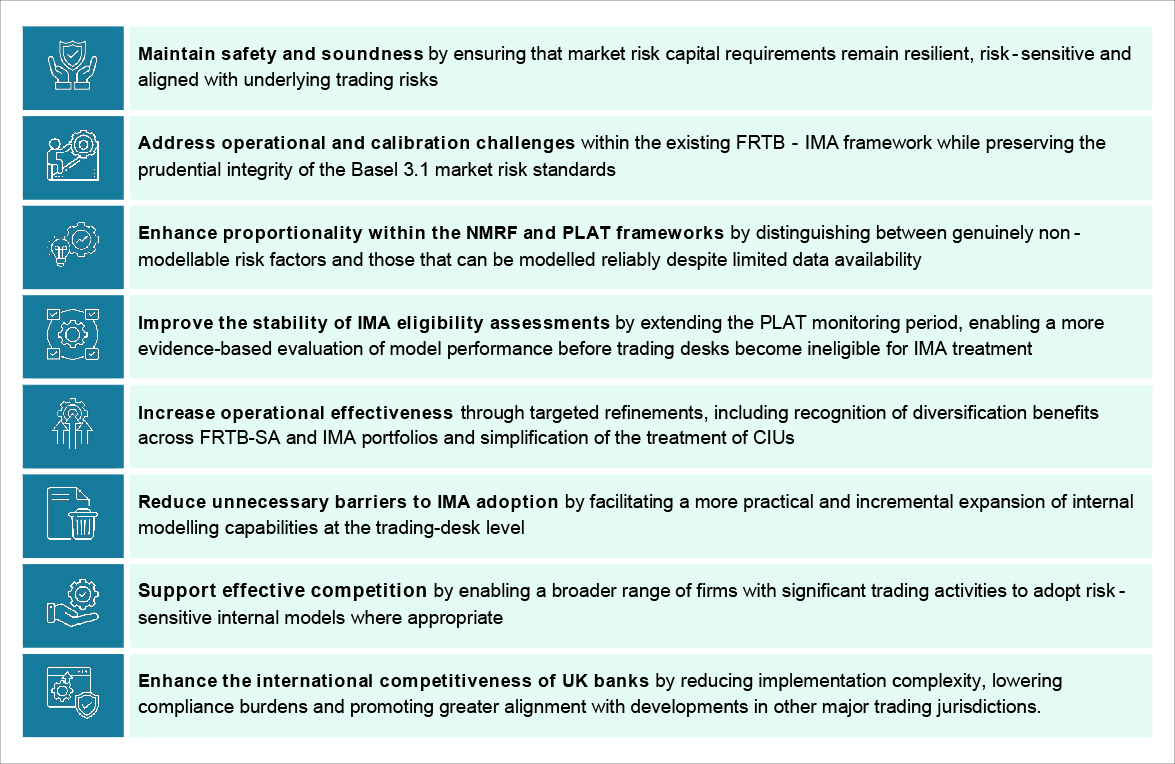
Key objectives driving PRA CP9/26
The PRA's proposals seek to make the FRTB-IMA more practical, proportionate, and internationally aligned while preserving the overall robustness of the market risk framework and maintaining appropriate capital standards.
What Firms Should Do Next
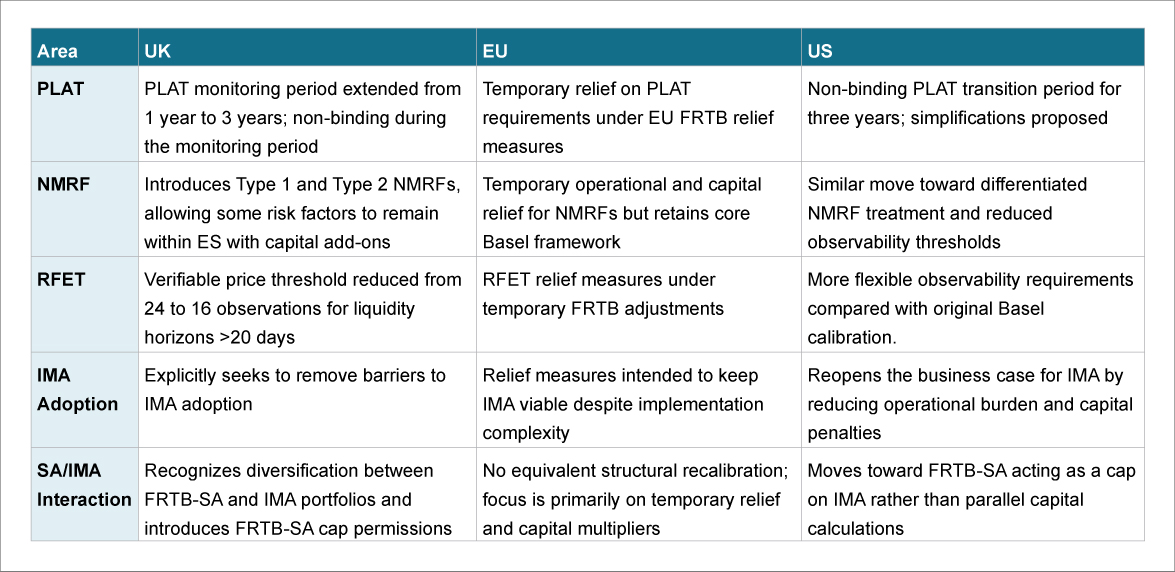
Cross-jurisdiction comparison on FRTB-IMA
While the UK, US and EU remain committed to Basel 3.1 and FRTB, all three are moving toward a more practical and proportionate implementation of IMA. CP9/26 positions the UK between the US's more aggressive simplification agenda and the EU's more cautious, temporary-relief approach, seeking to preserve prudential standards while improving competitiveness and IMA usability.
Our take
CP9/26 represents a pragmatic refinement of the FRTB-IMA framework, aimed at reducing barriers to internal model adoption while maintaining prudential standards. The proposed two-tier NMRF regime is particularly noteworthy, as it provides a more proportionate treatment of risk factors that are difficult to observe but remain modellable. The extension of the PLAT monitoring period and the revised SA/IMA aggregation approach should also provide firms with greater stability and improve the economics of phased IMA adoption.
While the proposals are broadly positive, firms should carefully assess the impact of the Type 1 NMRF correlation assumptions and continue to monitor developments around PLAT calibration. Overall, the consultation has the potential to improve the attractiveness of IMA and strengthen the business case for broader adoption across trading desk.
Related topics