Explore Crisil, a company of S&P Global
Formerly known as Global Research & Risk Solutions
August 12, 2026
 Blog
Blog
Blog
 Share
Share





Executive summary
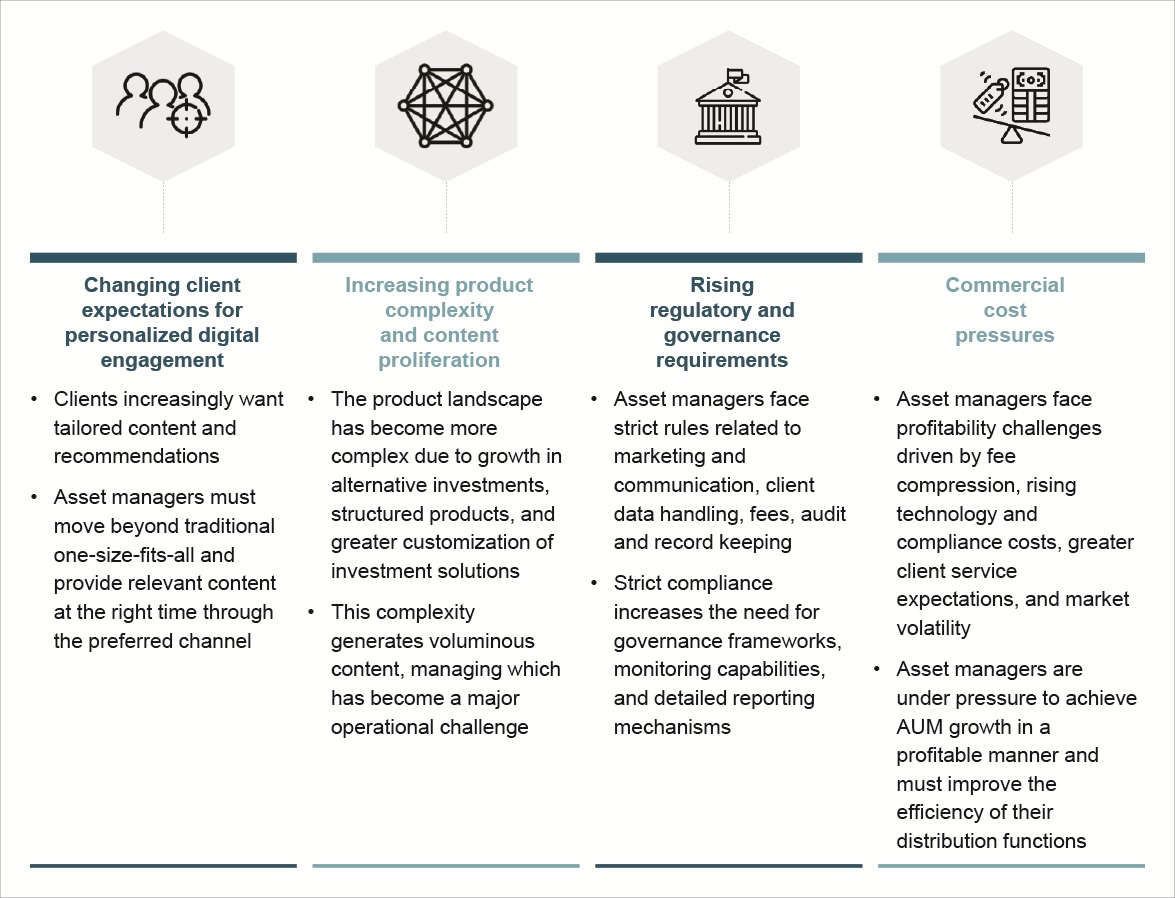
Investment performance alone is no longer sufficient to drive sustainable growth. Asset managers (AMs) are increasingly competing on the effectiveness of their distribution organizations. From a distribution standpoint, asset managers face the challenges of changing client expectations for personalized digital engagement, increasing product complexity and content proliferation, increasing regulatory and governance requirements, and commercial cost pressures to achieve AUM growth profitably.
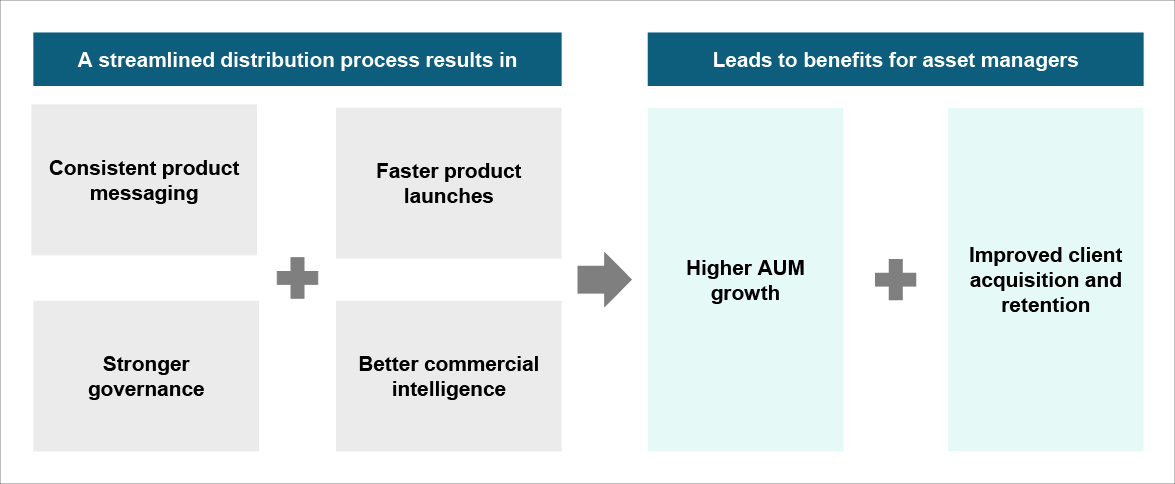
In response to mounting distribution pressures, asset managers are transforming their distribution by shifting from a fragmented model characterized by teams operating independently to a centralized Distribution Center of Excellence (CoE) that supports strategic alignment, scale, and commercial excellence across the firm.
Distribution COEs centralize commercial content, standardize sales enablement, strengthen governance and leverage AI to deliver personalized content at scale. Partnering with a specialist provider enables asset managers to achieve these outcomes while retaining strategic ownership.
Crisil has supported global asset managers through enterprise content management, multilingual publishing, website migration, RFP/DDQ support, marketing collateral creation, thought leadership development, and scalable commercial operations.
Asset managers derive significant benefits from Crisil’s distribution CoE such as greater distribution efficiency and productivity, more scalable sales and client support, improved market intelligence and commercial insights, better cost control and operating leverage, and improved decision-making.
Why building distribution capability is important
Distribution excellence connects investment capabilities with investors through the right channels at the right time, enabling commercial alpha, sustainable AUM growth and profitability. Changing client expectations and increasing complexity across channels, products and geographies warrant scalable, data-driven distribution organizations. Our market conversations suggest that distribution excellence (measured by an asset manager’s ability to consistently generate sales alpha above and beyond those that are the result of product strategy and investment performance) accounts for ~30-40% of growth for asset managers.
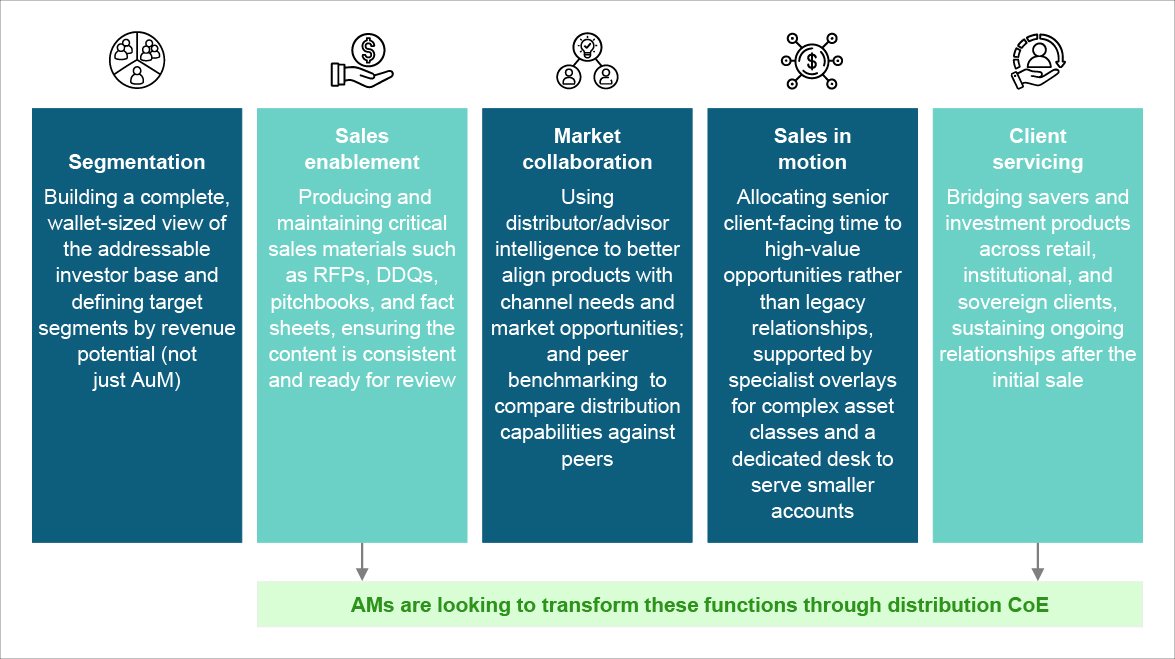
Distribution value chain
The distribution value chain comprises several key activities as outlined below:
Key industry challenges shaping distribution
Distribution has come into sharp focus in recent years. According to the latest FE Fundinfo Asset Managers Report (June 2026), ~28% of the surveyed AMs stated that distribution access and platform requirements was one of the biggest challenges facing their business in the next three years, and ~30% of the AMs identified changing investor demand and distribution models as one of the biggest threats to the asset management industry over the next three years. Within distribution, limited access to third-party distribution platforms, data fragmentation and siloed systems, barriers to cross-border distribution, and meeting platform due diligence and data requirements were identified as the four biggest challenges by AMs.
The key industry challenges influencing distribution operating models include:
How asset managers are adapting to industry challenges
Facing growing distribution challenges, AMs are transforming distribution from a fragmented, relationship-led activity into a scalable, industrialized, and data-driven enterprise capability. They are moving from decentralized or fragmented teams working independently to a centralized Distribution Centre of Excellence (CoE) that supports strategic alignment, scale, and commercial excellence across the firm. The is fundamentally a shift from distribution as a relationship-led activity to distribution as a coordinated enterprise capability—one that fuses channel strategy, data, technology, sales enablement, product alignment, and disciplined execution into a repeatable commercial engine.
The distribution operating model an asset manager adopts is a function of its scale, product breadth, channel complexity, geographic reach, ownership structure, and growth ambition. It has been observed that, in general, as an asset manager increases its AUM, product breadth, channel count, and geographic footprint, the economic pressure to move from fragmented autonomy toward centralized commercial governance intensifies.
Comparison of fragmented and CoE distribution models:

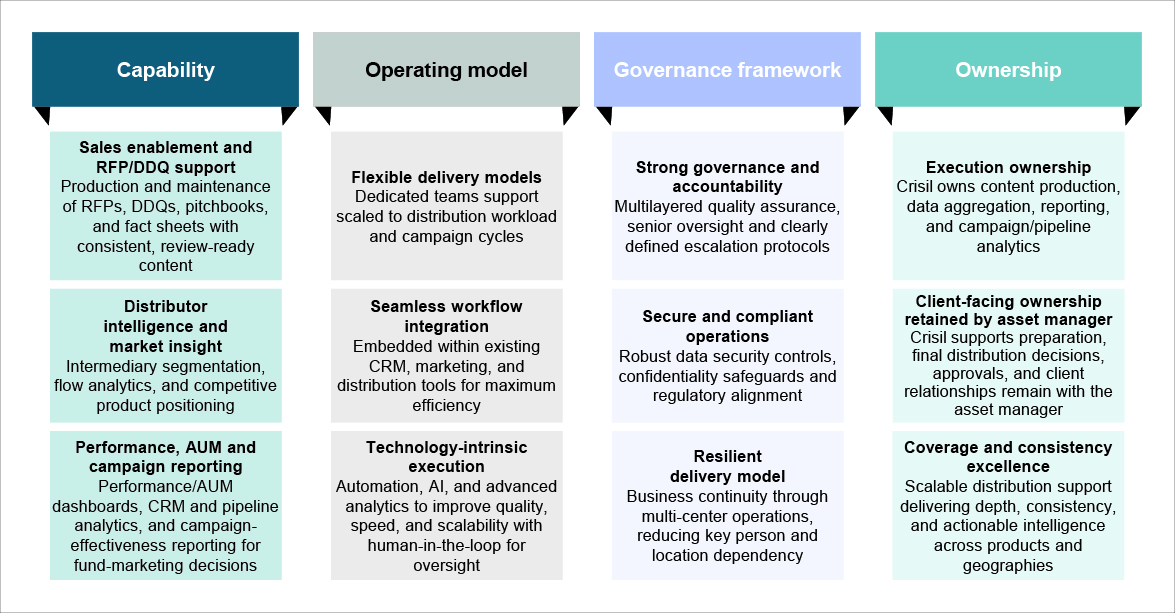
Key elements of Crisil’s Distribution CoE
Capability |
The capability pillar of Crisil’s Distribution CoE helps AMs strengthen core distribution activities by centralizing sales enablement, market intelligence, and reporting support. It ensures that sales teams have consistent, high-quality materials for client engagement, while also providing deeper insights into distributors, advisors, fund flows, and competitive positioning. In addition, performance, AUM, CRM, pipeline, and campaign reporting help AMs make more informed distribution and marketing decisions across products, channels, and geographies. |
Operating model |
The operating model provides AMs with a scalable and integrated support structure that can flex with business needs. By combining dedicated or shared resources with integration into existing distribution workflows, the CoE helps reduce operational friction and enables faster, more consistent execution. The use of automation, AI, and analytics further strengthens the model by improving output quality, turnaround time, and the ability to scale support across products, regions, and campaigns. |
Governance |
Governance is a core feature of Crisil’s Distribution CoE, ensuring that distribution support is delivered with consistency, control, and accountability. Quality assurance layers, senior review, and defined escalation paths help maintain reliability, while data security and compliance safeguards protect sensitive client and business information. The multi-center delivery structure also enhances resilience, ensuring continuity of service even when there are location-specific or personnel-related disruptions. |
Ownership |
The ownership element clearly separates execution support from client ownership. Crisil manages the operationally intensive tasks such as preparing content, aggregating data, producing reports, and generating campaign and pipeline analytics, while the asset manager retains control over approvals, distribution decisions, and client relationships. This ensures that AMs benefit from specialist execution capability without losing control of their brand, commercial judgment, or client engagement model. |
Client success stories
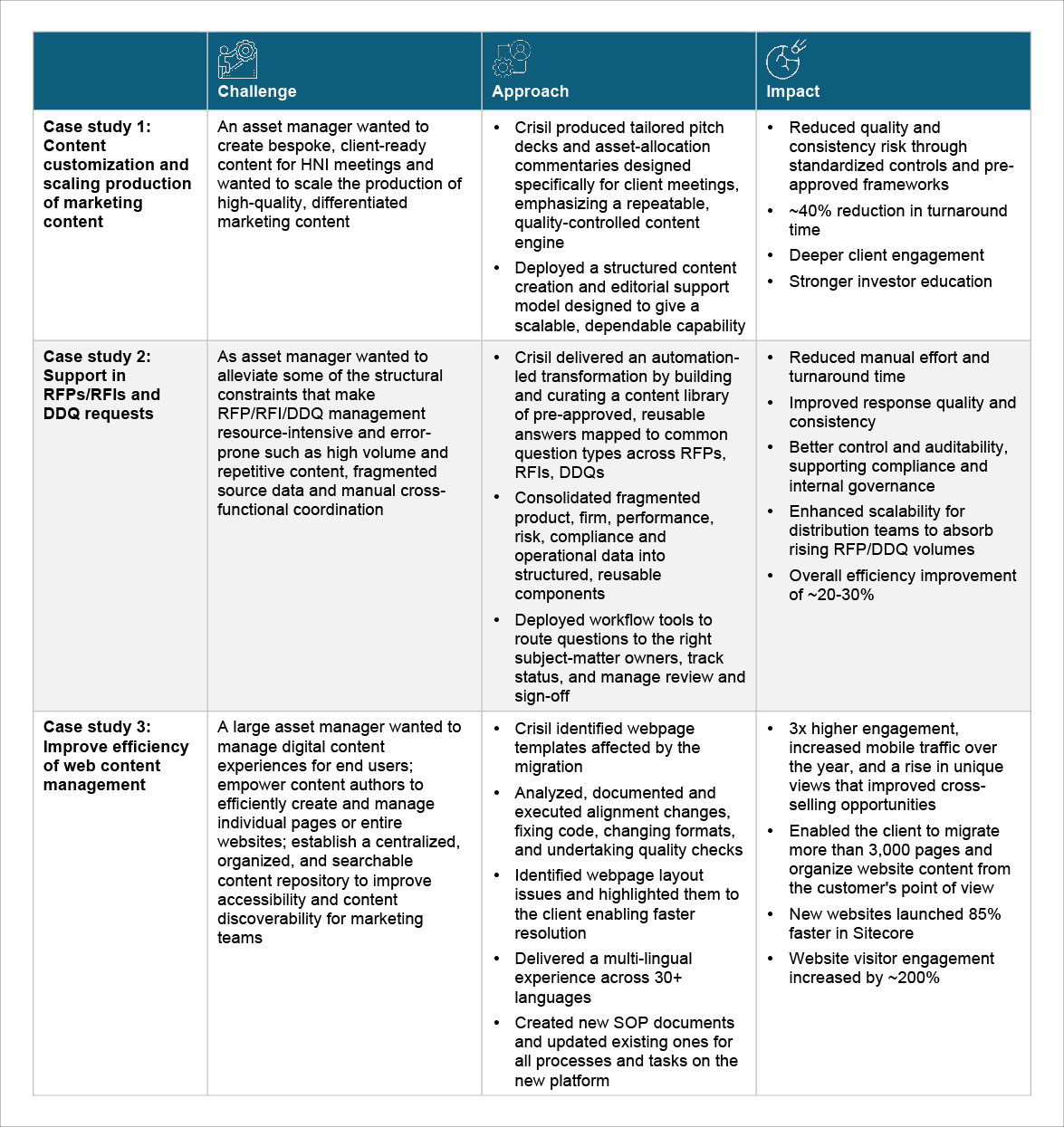
The following case studies highlight how Crisil’s CoE has partnered with global AMs to address evolving challenges in distribution
Conclusion
AMs can realise several benefits from Crisil’s distribution CoE, including:
- Achieve greater distribution efficiency and productivity by reducing manual, repetitive work (30–50% reduction in content production effort and 20-40% faster RFP/DDQ turnaround), thus allowing front-office distribution teams to spend more time on high-value client engagement and business development
- Enable more scalable sales and client support by standardizing processes and creating reusable delivery models, allowing AMs to support more markets, products, and client segments without adding internal headcount
- Improve market intelligence and commercial insights by tracking competitor activity, fund flows, advisor behaviour, investor preferences, and product demand trends, which strengthen sales planning, product positioning, campaign design, and go-to-market strategy
- Achieve better cost control and operating leverage by converting fragmented local processes into a more efficient shared capability, which helps support lower unit costs and reduced duplication as business scales
- Support better decision-making by creating a more consistent view of clients, channels, products, flows, and market opportunities, enabling AMs to prioritize the right segments and growth pockets, and make more evidence-based distribution decisions
Distribution excellence is emerging as a critical competitive differentiator for AMs rather than just a support function. A centralized Distribution CoE enables governance, scalability, consistency, commercial agility, and AI-enabled operations while allowing business teams to focus on growth. Crisil Integral IQ combines deep asset management expertise with managed services to help AMs design, build, operate and continuously enhance next-generation Distribution Centres of Excellence.