Explore Crisil, a company of S&P Global
Formerly known as Global Research & Risk Solutions
September 21, 2026
 Blog
Blog
 Share




Asset-based lending (ABL) is becoming an increasingly important financing option for companies with significant working-capital assets, providing access to liquidity that scales with receivables and inventory rather than being constrained primarily by earnings. For seasonal, cyclical or cash-flow-constrained businesses, this can provide greater borrowing capacity and flexibility than conventional cash-flow lending.
For banks, the appeal is equally clear. Collateral-backed structures provide greater control over exposure and enable lending across a broader range of operating and credit profiles. Risk-adjusted pricing, together with fees and tighter collateral controls, can also support attractive returns while providing additional downside protection.
Recent market activity underscores the relevance of ABL as a financing tool. According to LSEG data, syndicated ABL issuance rose 32% quarter-on-quarter to $38.1 billion—across 66 transactions—in the second quarter of calendar year 2026. This growth was driven by accelerated refinancing activity and strong lender demand. DLA Piper notes the global ABL market has crossed $1 trillion, reflecting the rising demand for flexible, collateral-backed financing solutions. The milestone also highlights the significant expansion of the ABL market over recent years and its growing role as a mainstream financing tool.
As ABL portfolios grow in size and complexity, the controls that underpin the product become equally critical. In addition, heightened regulatory and supervisory expectations around credit risk management, collateral validation and portfolio oversight have reinforced the need for robust control frameworks within ABL programs. Weak collateral oversight can result in overstated borrowing availability, delayed recognition of credit deterioration, inaccurate risk assessments and higher loss severity when borrowers face financial stress.
The credit protection provided by an ABL structure depends not only on the collateral, but also on the lender’s ability to determine its eligibility, monitor its performance, validate its value and respond to changes in these characteristics. This makes ABL more operationally intensive than conventional commercial lending and thus, requires greater effort and due diligence through continuous portfolio monitoring and independent loan review.
For regional banks expanding their ABL franchises, the question is not just whether they have sufficient underwriting capacity, but if their loan review infrastructure has developed at the same pace as the portfolio it will evaluate.
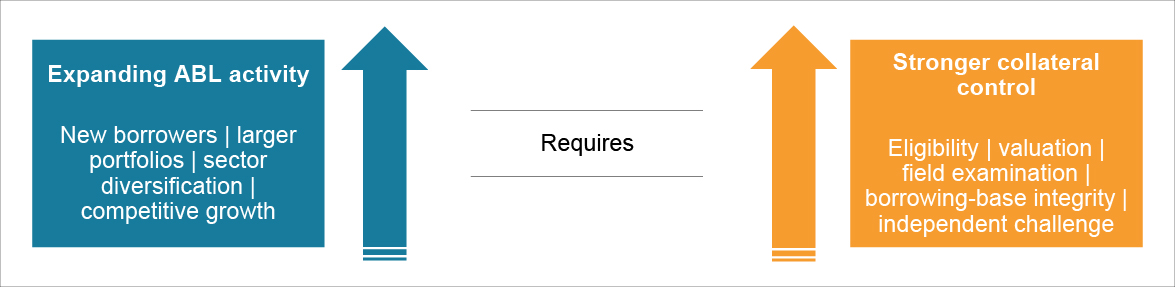
ABL changes what is required from loan review
The fundamental difference between ABL and conventional commercial lending is not simply that one is secured and the other may not be. It is the extent to which repayment capacity and exposure management depend on the continuing quality and realizability of specific assets.
Accounts receivable and inventory are dynamic. Receivables age, customer concentrations shift, dilution varies and disputes can affect collectability. Inventory moves through production cycles, becomes obsolete and can realize materially different values depending on the sector and liquidation environment.
The borrowing base is designed to translate these changing characteristics into lending availability. Consequently, the integrity of the borrowing-base calculation is central to the lender’s control framework.
For independent loan review, this changes the analytical requirement
Confirming borrower financial performance and covenant compliance is necessary, but not sufficient. The review needs to assess whether the lender’s controls provide reasonable assurance that eligibility criteria and advance rates are applied properly, reserves capture relevant risks and material exceptions or over-advances are identified and escalated.
This is especially relevant when changes in operating conditions affect working capital assets more quickly than financial performance. Supply chain disruption, slower customer payments, inventory accumulation or shifting demand can alter collateral protection before their full impact becomes visible through EBITDA (earnings before interest, tax, depreciation and amortization), leverage or covenant performance.
The analytical focus, therefore, needs to extend beyond borrower creditworthiness to the integrity of the collateral control structure itself.
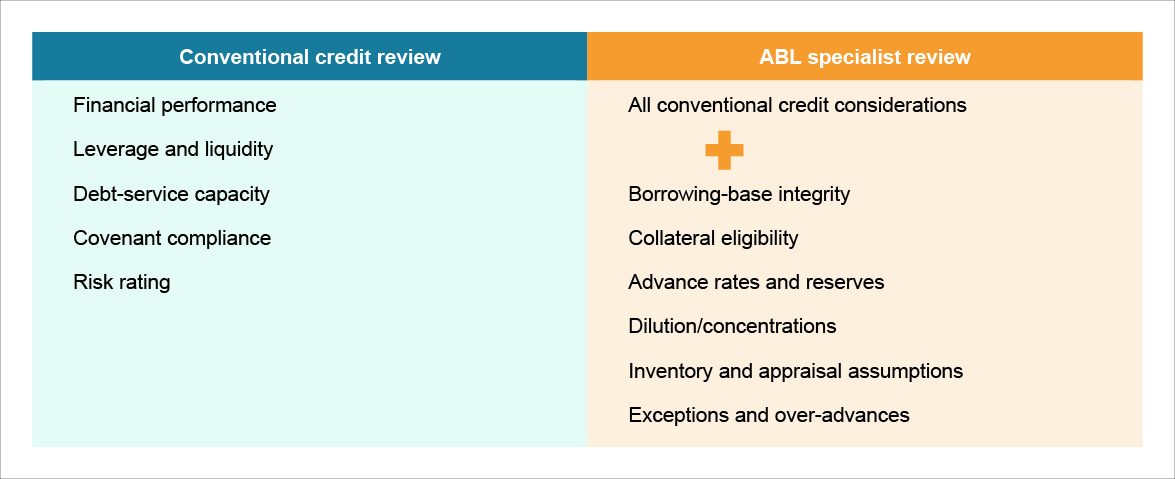
ABL does not replace conventional credit analysis but adds an additional layer of control that requires independent challenge.
Collateral control is becoming more complex
The need for specialist review becomes more pronounced as collateral is exposed to a wider range of operating and market variables.
Accounts receivable illustrate this challenge. Deterioration may occur through longer collection periods, increasing dilution, customer concentration or a growing share of balances moving outside the eligibility parameters. None of these necessarily means immediate borrower default, but each can reduce the quality of collateral available to support advances.
Inventory presents a different analytical problem. Eligibility alone does not ensure recoverability. Product mix, seasonality, obsolescence, location, work-in-progress and liquidation assumptions can influence realizable value. These considerations vary across manufacturing, retail, healthcare, technology and other sectors.
The implication for loan review is clear: collateral assessment cannot be standardized solely around a borrowing-base template.
Reviewers need sufficient sector knowledge to challenge whether eligibility rules, advance rates, appraisal assumptions and reserves are suitable for the assets being financed.
The OCC, in its December 2025 guidance, reinforced the importance of collateral characteristics and controls in distinguishing well-controlled ABL facilities from other higher-risk lending. Among the characteristics highlighted were liquid collateral, appropriate margins, efficient valuation processes and the lender’s ability to monitor and protect collateral from deterioration.
The regulatory message is consistent with the underlying credit principle: collateral protection is only as strong as the controls used to establish and preserve it.
Borrowing base integrity
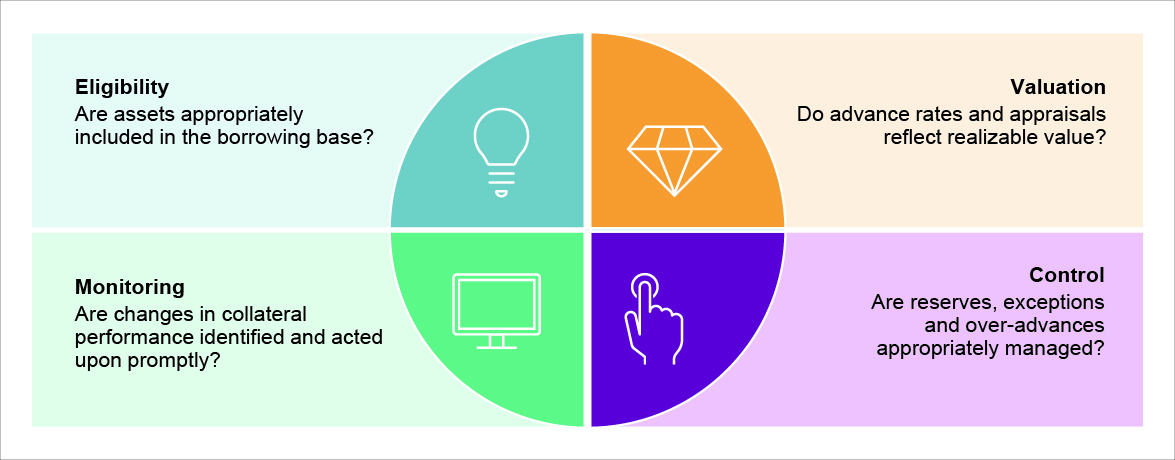
Independent review should test, not replicate, the control framework
A specialist loan review function should not duplicate the work done by relationship management, portfolio management or collateral-monitoring teams.
Its value lies in providing an independent evaluation of whether the controls are operating effectively and whether the resulting risk assessment is appropriate.
That requires review across several dimensions.
- Borrowing-base certificates should be assessed not only for mathematical accuracy, but also for the consistency of eligibility treatment and unusual movements between reporting periods
- Field-examination findings should be evaluated for recurring weaknesses and whether corrective actions have been implemented
- Appraisals need to be considered in the context of changes in inventory composition and market conditions
- Exceptions, waivers and over-advances need to be assessed cumulatively rather than as isolated approvals
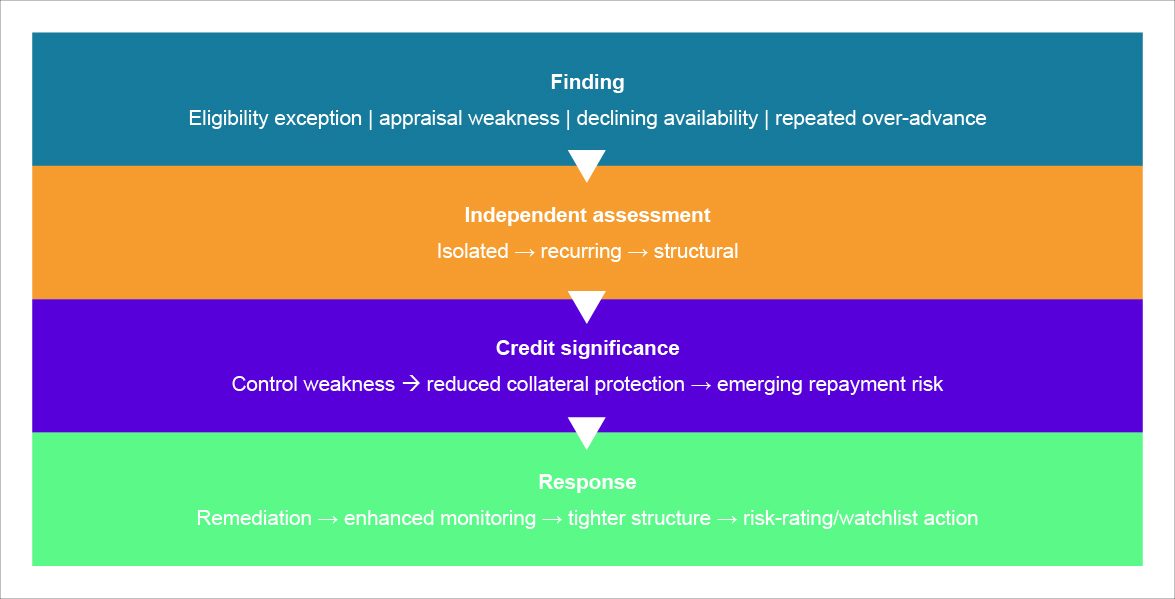
Importantly, the review should connect collateral findings back to the overall credit assessment.
Repeated eligibility exceptions, declining availability or weakening collateral values may warrant tighter controls without necessarily changing the risk rating. More persistent deterioration, especially when accompanied by weaker liquidity, operating performance or sponsor support, may have broader implications for classification, watchlist status or exposure strategy.
This distinction means effective ABL review is not about finding more exceptions, but about determining which exceptions change the credit risk.
From collateral finding to credit action
Scaling up ABL requires the review infrastructure to grow with it
For regional banks, this is a question of capability as much as capacity.
An expanding ABL portfolio can increase the number of borrowing-base certificates, field examinations and appraisals requiring oversight. More importantly, expansion across industries increases the breadth of collateral expertise required to challenge those inputs.
A reviewer experienced in healthcare receivables, for example, may face fundamentally different eligibility and concentration considerations from one reviewing manufacturing inventory or technology receivables. Scaling up the portfolio without ensuring corresponding depth in the review infrastructure can create inconsistency precisely where independent challenge is meant to provide assurance.
The OCC’s June 2026 Lending and Loan Portfolio Risk Management handbook places loan review within the broader framework of independent credit risk review and emphasizes the importance of effective ongoing supervision across the lending life cycle. For banks expanding specialist lending businesses, this reinforces the need for the independent review framework to evolve alongside the underlying portfolio.
The appropriate model will differ by institution. Banks with sufficient portfolio scale may maintain specialist ABL expertise internally. Others may supplement internal teams with external domain expertise or technology-enabled analytical support. The operating model is secondary to the main requirement: review depth, frequency and expertise should be commensurate with the complexity of the portfolio.
That is becoming increasingly important as competition for ABL assets continues.
Growth without matching investment in collateral oversight can weaken the very controls that make the product attractive.
The road ahead
ABL can be an effective mechanism for banks to lend against identifiable and measurable assets. Its strength, however, does not arise from collateral alone. It comes from the discipline with which that collateral is evaluated, margined, monitored and independently challenged throughout the life of the facility.
As regional banks expand their ABL franchises, conventional loan review frameworks will need to evolve. Financial analysis and risk-rating validation are essential, but they need to be complemented by specialist assessment of borrowing-base integrity, collateral valuation, eligibility controls and the effectiveness of ongoing monitoring.
The strategic question is no longer simply whether ABL is an attractive area for growth. It is whether institutions can scale up collateral governance, independent review and risk oversight at the same pace as the portfolios they are building.