Explore Crisil, a company of S&P Global
Formerly known as Global Research & Risk Solutions
September 04, 2026
 Blog
Blog
Investment research workflow, amplified
September 04, 2026
Blog
Blog
Artificial intelligence can cut through clutter, transform decision-making through enhanced judgement
 Share





The intelligent investment workflow
Artificial intelligence (AI) has evolved rapidly from an experimental technology into an indispensable component of the investment management toolkit. Across the industry, it is helping analysts accelerate financial modelling, earnings analysis and the drafting of research reports, fundamentally transforming how information is gathered, analysed and translated into investment insights.
As AI adoption accelerates, however, the conversation is shifting from what AI can do to where it can create the greatest value. The real advantage lies in understanding how different AI tools can enhance specific stages of the investment process without compromising the judgement, critical thinking and domain expertise that underpin high-quality investment research.
Today, investment professionals have access to an expanding ecosystem of AI solutions, including Microsoft Copilot, ChatGPT Pro, Claude, Claude for Excel, AlphaSense and model context protocol (MCP) connectors such as Daloopa. Each addresses distinct aspects of the research workflow. Organisations derive the greatest benefit when they deploy these complementary capabilities across the investment lifecycle, integrating them seamlessly into existing processes rather than relying on a single platform.
Three high-impact AI workflows
The debate over which AI model is superior often misses the broader point. What matters most is how effectively AI can enhance day-to-day investment workflows. By automating routine activities and accelerating information processing, AI enables analysts to devote more time to higher-value work, including critical thinking, insight generation and investment decision-making.
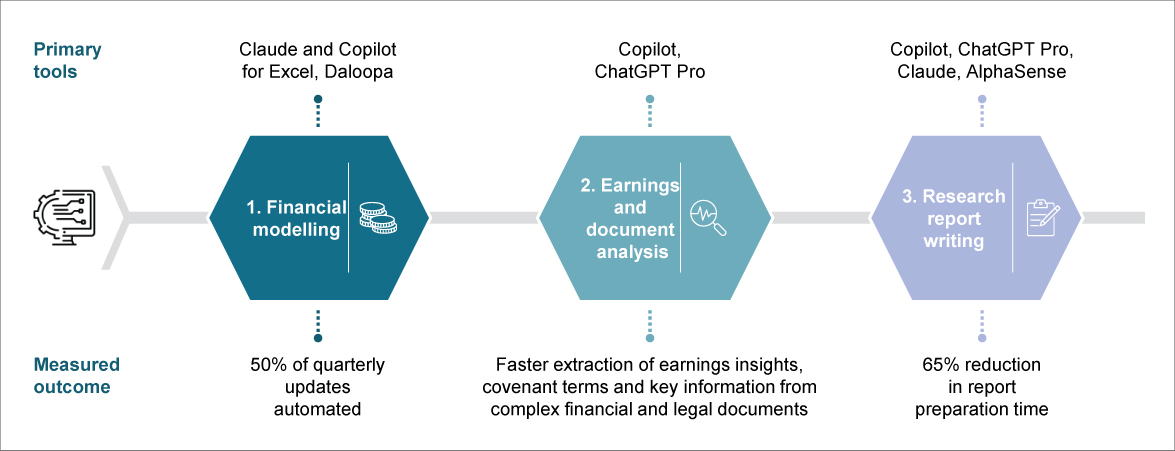
At Crisil Integral IQ, three workflows have consistently emerged as areas where AI is delivering the greatest impact in the investment research process:
The Crisil Integral IQ AI research stack
1. Financial modelling
Financial modelling remains one of the most time-consuming elements of investment research. It requires frequent updates to financial statements, formulas and assumptions, much of which is repetitive and therefore well suited to AI-enabled automation.
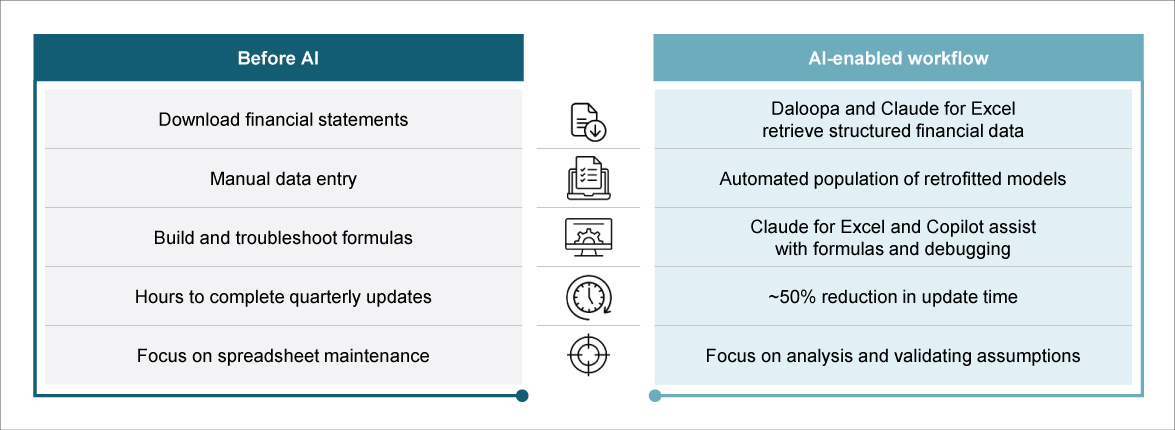
Tools such as Claude, Microsoft Copilot for Excel, ChatGPT Pro and MCP connectors including Daloopa, Canalyst and Fiscal. AI enable analysts to streamline model maintenance by importing structured financial data, reducing manual data entry, assisting with formulas and supporting initial forecasting and scenario analysis. Their value becomes particularly evident during earnings season, when analysts must update multiple company models within compressed timeframes.
In developing forecasting assumptions, Crisil Integral IQ teams estimate a success rate of approximately 60% when using ChatGPT Pro and Microsoft Copilot for Excel to identify risks, assess macroeconomic conditions and evaluate their potential impact on individual companies.
This experience aligns with broader industry adoption. Morgan Stanley1 Equity Research uses Daloopa to support analysts during earnings seasons, enabling faster model updates and quicker access to structured financial data. Although not directly related to investment research modelling, UBS2 has reported that applying AI within its finance transformation programme accelerated the sourcing and transformation of financial data for financial and regulatory reporting by approximately 50%, highlighting AI's potential to streamline complex finance workflows beyond investment research.
Despite these advances, analyst oversight remains essential. Large, highly customised models, complex capital structures, one-off events and management guidance continue to require significant expertise and judgement, making end-to-end automation challenging. While AI can accelerate the mechanics of financial modelling, the development of differentiated forecasts and investment views remains firmly a human endeavour.
Before and after AI: Financial modelling at Crisil Integral IQ
2. Earnings and document analysis
For equity and credit research teams, informed investment decisions require the analysis of far more than quarterly earnings results. Analysts routinely review earnings transcripts, investor presentations, annual reports, bond prospectuses, credit agreements and covenant packages to assess both financial performance and the protections available to creditors.
AI can significantly accelerate this process by analysing large volumes of unstructured information, summarising management commentary, identifying changes in guidance, extracting key covenant terms and highlighting critical clauses such as debt-incurrence limits, restricted payments, change-of-control provisions and security structures. By cutting through hundreds of pages of documentation, Crisil Integral IQ analysts estimate time savings of approximately 80%, enabling them to focus more on evaluating credit quality, refining forecasts, conducting valuations and making investment decisions.
Industry adoption reflects a similar trajectory. JPMorgan3 Asset & Wealth Management's SpectrumIQ enables investment professionals to search more than 22 million documents across 90,000 securities, reducing research-to-insight time by approximately 80%. Likewise, Morgan Stanley4 Research has used AI to analyse more than 10,000 earnings-call transcripts, leveraging GPT models to identify themes related to productivity, financial impact, innovation and operational improvements. These examples illustrate how AI is helping research teams process vast quantities of corporate disclosures and extract insights at scale.
Yet interpretation remains critical. Business restructurings, nuanced management commentary, complex legal language and bespoke covenant structures often require careful assessment. While AI can rapidly identify relevant information, judging its significance and incorporating it into a coherent investment thesis still depends on human expertise.
3. Investment note drafting
Producing high-quality research reports requires more than gathering information. It demands the ability to connect disparate evidence into a clear, coherent and differentiated investment thesis.
AI helps streamline this process by accelerating information discovery, summarising disclosures and earnings transcripts and generating structured first drafts. Tools such as Microsoft Copilot, ChatGPT Pro, Claude and AlphaSense complement one another by supporting research, drafting, editing and content refinement. As a result, Crisil Integral IQ analysts have achieved time savings of approximately 65% compared with pre-AI workflows, allowing them to devote more attention to insight generation and client value.
Industry adoption tells a similar story. Schroders Capital5, for example, uses its Generative AI Investment Analyst (GAiiA) platform to accelerate due diligence and produce first drafts of investment summaries and investment committee memoranda. The tool has already supported more than 40 investment cases. Similarly, Man Group6 is embedding AI into investment research by using it to analyse broader datasets and synthesise financial, risk and textual information into research outputs for portfolio teams.
Even so, the quality of the final product continues to depend on analyst expertise. As AI assumes a greater share of the drafting workload, Crisil Integral IQ teams observe that standardised outputs often lack nuance, company-specific context, the ability to connect disparate insights and the distinctive writing style expected in client-facing research. Evaluating context, challenging assumptions, developing an investment or credit thesis and communicating differentiated insights remain inherently human responsibilities.
AI adoption across the financial services industry
Our experience mirrors a broader transformation unfolding across the financial services sector. Asset managers, investment banks and financial institutions are increasingly embedding AI into investment research, portfolio management and operational workflows, not only to improve efficiency but also to strengthen decision-making throughout the investment lifecycle.
On the buy side, AI adoption is moving well beyond general productivity tools and becoming embedded within the investment process itself. Capital Group7, for instance, is applying generative AI to decades of proprietary research, investment models and historical decisions, while also exploring agentic AI applications that combine public and proprietary datasets.
AI is also becoming more deeply integrated into fundamental research. Wellington Management8 has described using AI and quantitative techniques to develop proprietary metrics that help identify emerging trends and test insights derived from company research. Generative AI is also being used to search and synthesise research produced across the firm's investment platform. These developments illustrate how AI is increasingly being connected to firms' proprietary knowledge bases and accumulated investment expertise, rather than simply processing publicly available information.
As foundation models become more widely accessible, the technology itself is unlikely to offer a sustainable competitive advantage. What may matter more is an organisation's ability to connect these models to its proprietary research ecosystem, including historical investment decisions, internal research and alternative datasets. By making institutional knowledge easier to retrieve, connect and apply, AI has the potential to amplify the value of a firm's existing research platform.
Enhanced judgement, a more valuable outcome than speed
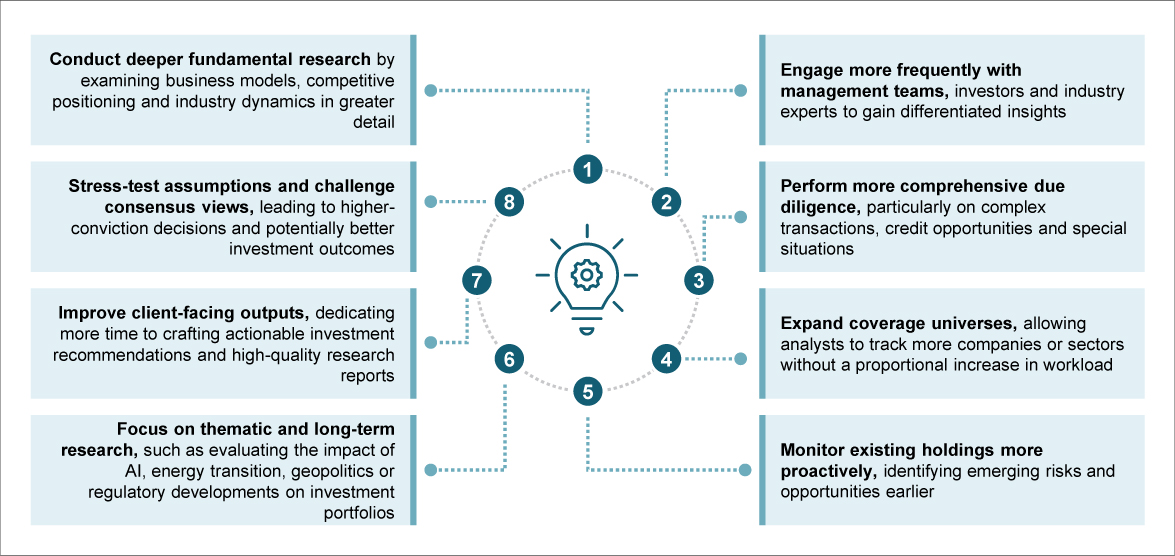
The greatest value AI brings to investment research is not simply faster execution but the opportunity to redirect analyst capacity towards higher-value work. Leading firms such as JPMorgan Chase3 are embedding AI into everyday workflows, allowing analysts to spend less time searching for information, summarising documents and performing repetitive tasks, and more time understanding businesses, industries and market dynamics.
The most significant efficiency gains are often realised in highly structured processes. Jupiter Asset Management9, for example, has reported productivity improvements equivalent to 42 minutes per day through AI-assisted workflows. Crisil Integral IQ has similarly helped clients reduce financial-model update times by approximately 50%.
AI is also enabling analysts to process large volumes of unstructured information more effectively. Platforms such as Hebbia10 can rapidly analyse earnings transcripts, credit agreements, bond prospectuses and due-diligence materials. Beyond efficiency improvements, AI is helping research teams scale their capabilities, absorb larger volumes of information and respond more rapidly to evolving market conditions.
Value created by AI-driven efficiency
The future of investment research
The future of investment research is unlikely to be defined by AI alone. Rather, it will be shaped by how effectively investment professionals use these capabilities to uncover opportunities, evaluate risks and generate differentiated insights. In that environment, the combination of technology, expertise and intellectual curiosity will remain a powerful driver of success.
As investment markets become increasingly complex and data-intensive, AI can help research teams operate with greater breadth, depth and agility. Firms that successfully embrace these capabilities will be better positioned to respond to changing market conditions, evaluate opportunities and navigate uncertainty with confidence.
How can we support
At Crisil Integral IQ, we help financial institutions harness AI across the investment lifecycle, from research and due diligence to portfolio surveillance, pricing analytics and risk management. As markets become more data-intensive, AI enables investment teams to process information faster, identify risks and opportunities more effectively, and make more informed decisions.
By combining deep domain expertise with advanced AI capabilities, we help clients transform structured and unstructured data into actionable insights. Whether accelerating research, streamlining financial analysis, enhancing forecasting and valuation, or strengthening portfolio monitoring, our solutions are designed to improve efficiency and deliver measurable value. Crucially, we view AI as an enabler of human expertise, empowering investment professionals to focus on what matters most: critical thinking, judgement and decision-making.
Appendix
- Get the most out of Daloopa
- Innovation and AI at UBS
- Letter to Shareholders from Mary Callahan Erdoes, Annual
- Mapping AI's Rate of Change: Where the Rubber Meets the Road
- Schroders Capital expands pioneering AI toolkit with virtual ‘investment committee agent’
- What AI Can (and Can't Yet) Do for Alpha
- Beyond 2026: Future industry and market trends
- Accelerating the future of active management
- Jupiter Asset Management Annual Report and Accounts 2025
- Hebbia Matrix Transforms Knowledge Work: How Financial Giants Process Millions of Documents in Minutes
3 Letter to Shareholders from Mary Callahan Erdoes, Annual
4 Mapping AI's Rate of Change: Where the Rubber Meets the Road
5 Schroders Capital expands pioneering AI toolkit with virtual ‘investment committee agent’
6 What AI Can (and Can't Yet) Do for Alpha
7 Beyond 2026: Future industry and market trends
8 Accelerating the future of active management