Explore Crisil, a company of S&P Global
Formerly known as Global Research & Risk Solutions
September 17, 2026
 Blog
Blog
Private credit opportunity set expands
September 17, 2026
Blog
Blog
Sector pressures, portfolio diversification and disciplined growth in an evolving market
 Share





Private credit has evolved from a niche financing solution into a significant source of capital for acquisitions, business expansion, infrastructure and other complex transactions. While this growth is prompting asset managers to explore new opportunities, portfolios remain heavily concentrated in software, healthcare and business services, sectors favoured for their recurring revenue streams, resilient demand and strong cash flow visibility.
However, these traditional areas of strength are facing mounting pressures. Software companies are grappling with AI-driven disruption, healthcare providers are contending with reimbursement uncertainty and labour shortages, and business services firms are navigating softer client spending and execution challenges. Together, these trends are reshaping the risk landscape across established private credit markets.
At the same time, intensifying competition in traditional middle-market lending is driving asset managers towards areas such as asset-backed finance, consumer credit and infrastructure. While these segments can diversify portfolios and create new sources of return, they also introduce distinct collateral, borrower, project and regulatory risks. As the market evolves, asset managers will need to pair deep sector expertise with disciplined underwriting and continuous portfolio monitoring to pursue growth without compromising portfolio resilience.
Sector diversification
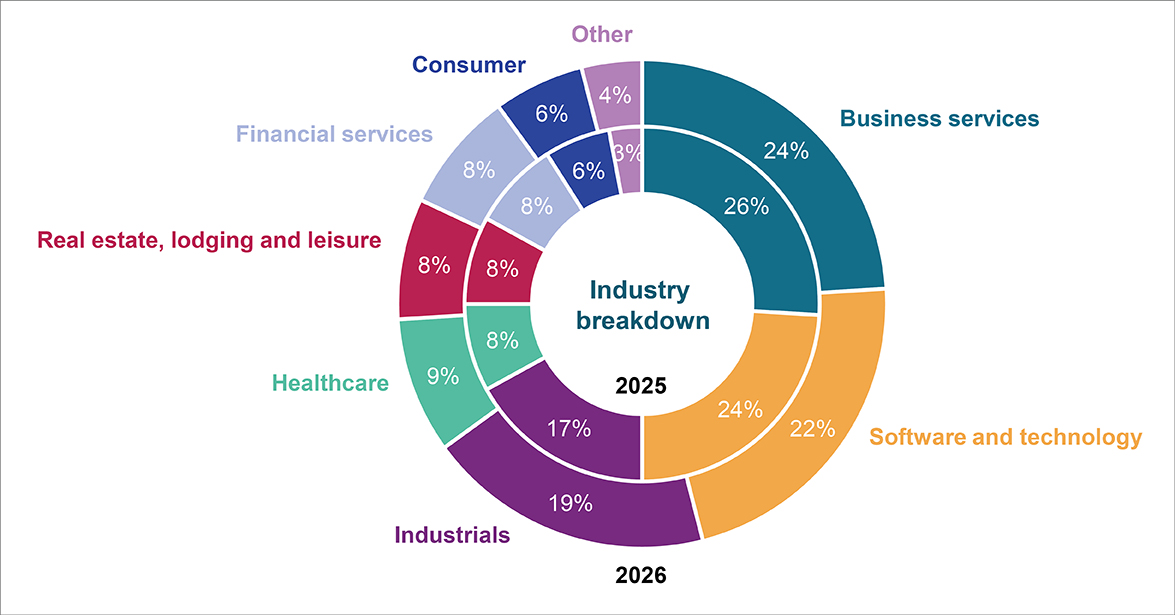
Source: Houlihan Lokey BDC Spring Monitor 2025 and 2026
Core sectors, the foundation of portfolios
Software, healthcare and business services form the backbone of many private credit portfolios because they combine predictable revenue streams, recurring customer relationships, strong cash conversion, defensible market positions and relatively low sensitivity to economic cycles. High customer retention and modest capital expenditure requirements also provide lenders with greater visibility into future cash flows and debt-servicing capacity than businesses exposed to commodity price volatility, discretionary consumer spending or project-based revenues.
Each sector, however, presents a distinct mix of resilience and risk. The profiles that follow highlight the segments lenders favour, the characteristics they value and the key indicators they monitor to assess credit quality and portfolio performance.
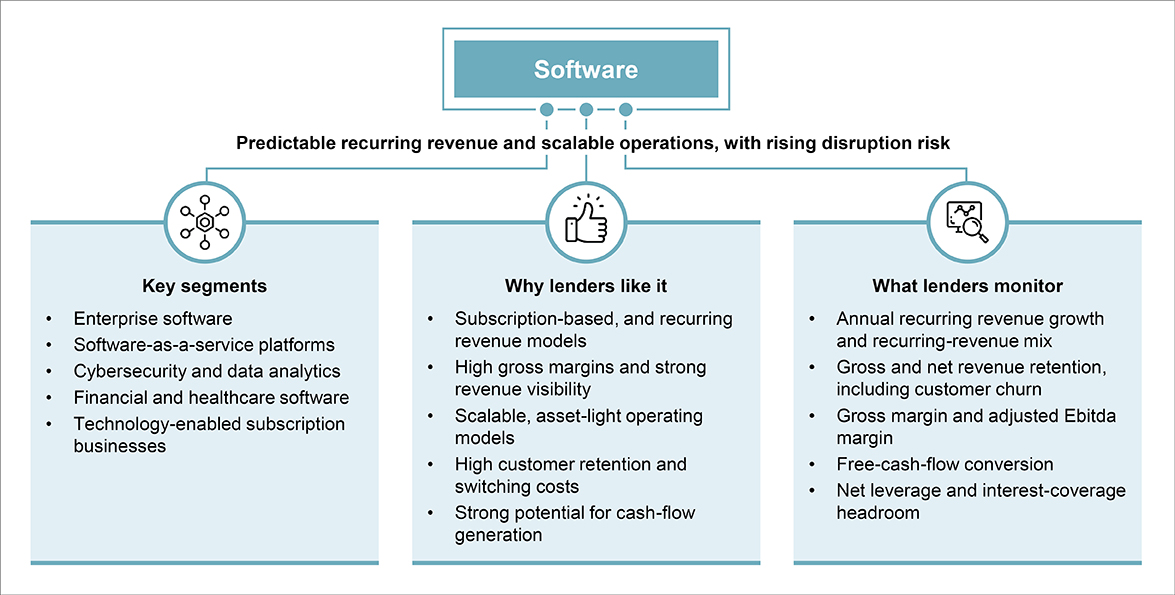
AI disruption meets a weakening software credit cycle
These attributes have made software a cornerstone of private credit portfolios, but the sector is now facing greater scrutiny than the other core segments. AI is reshaping borrower performance, risk assessment and portfolio strategy, intensifying the trade-off between growth and risk.
Analysis by PitchBook LCD of the largest publicly traded business development companies (BDCs) shows that software exposure remained elevated through the first quarter of 2026. While software was not disproportionately represented among distressed assets, loan valuations in the sector were declining faster than those in the rest of the portfolios.
Non-accruals were also increasing, PIK loans recorded the steepest markdowns, and more than one-third of the combined loan book is scheduled to mature by 2028. PitchBook does not attribute this deterioration solely to AI. However, the technology could amplify these pressures by lowering development costs, accelerating product substitution and eroding the pricing power and renewal assumptions that underpin many SaaS lending models.
Software vs ex-software valuation marks
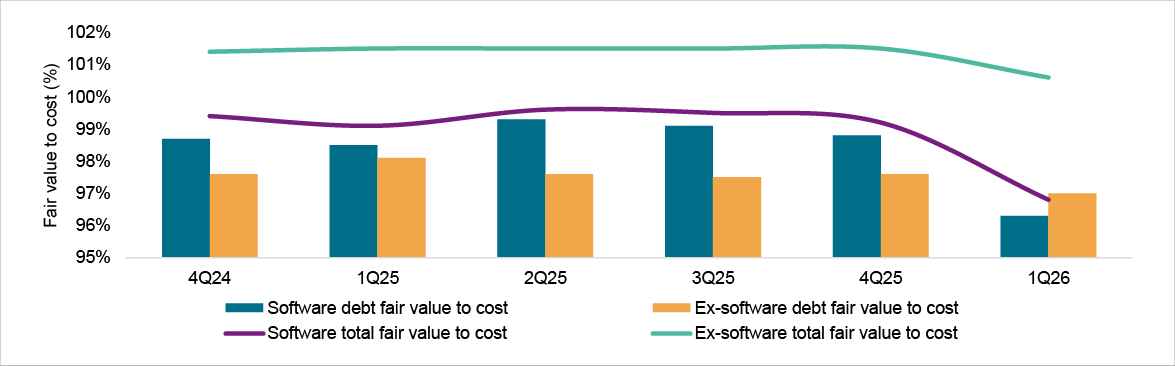
Note: Data through March 31, 2026. Total includes debt, equity, and everything else such as warrants and units as defined by BDCs. Fair value to cost ratio taken from positions for which both cost and fair values were reported.
Source: PitchBook | LCD
These pressures are already influencing investor behaviour. Blue Owl has said concerns about AI-driven disruption in the software sector have weighed on sentiment towards software credit. In the first quarter of 2026, its technology-focused vehicle, Blue Owl Technology Income Corp, received tender requests equivalent to 40.7% of its outstanding shares, but repurchased only the contractual limit of 5% on a pro-rata basis.
These were contractual liquidity constraints rather than outright redemption freezes, but they underscore a fundamental mismatch in the asset class. Investors can seek liquidity immediately, whereas marked-down software loans may take years to mature and, if sold earlier, may need to be disposed of at a discount. AI may yet create a new generation of software winners. However, for weaker, highly leveraged incumbents, and the private credit funds financing them, it could amplify credit stress precisely when liquidity is under greatest strain.
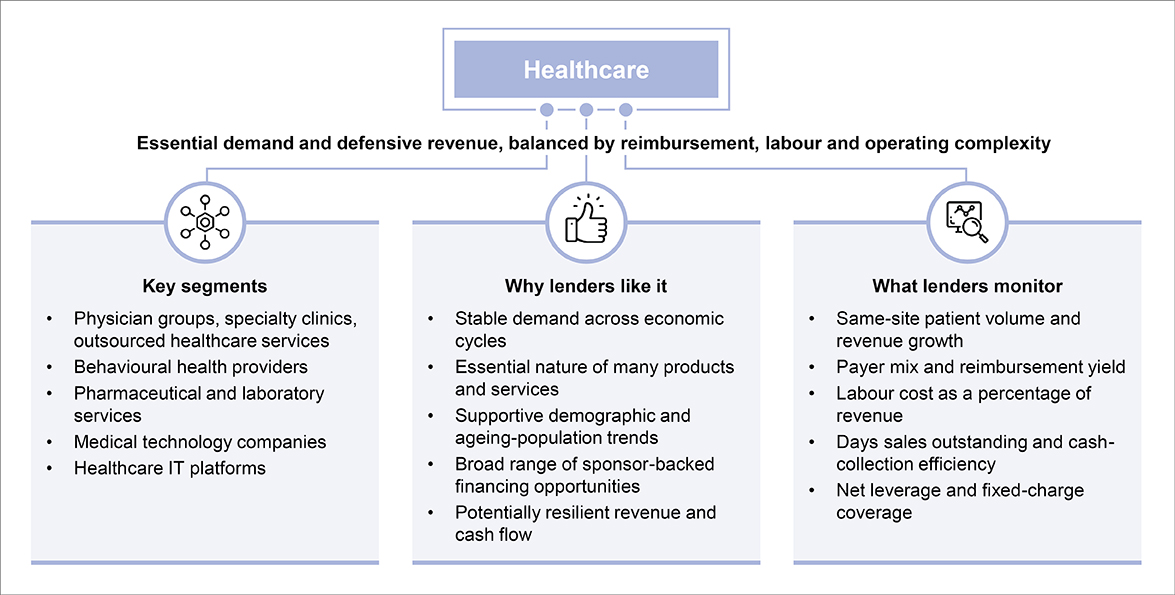
Healthcare demand remains strong, profitability harder to sustain
Healthcare has long been viewed as a defensive sector because demand for services tends to remain stable regardless of economic conditions. However, resilient patient demand does not always translate into predictable cash flows. In its March 2026 Costs of Caring report, the American Hospital Association (AHA) noted that hospitals are treating more patients with increasingly complex conditions while continuing to face rising labour, drug, supply and administrative costs. The AHA also found that more than half of hospital costs are tied to service lines where reimbursement fails to cover the full cost of care. Claims denials, prior authorisation requirements and payment delays can place additional pressure on margins and weaken cash conversion.
Many healthcare platforms are also pursuing growth through acquisitions, which often require sustained investment. As the AHA notes, acquired or employed physician practices may need ongoing support for technology, billing, compliance, cybersecurity and payer administration. If these costs persist or expected synergies are delayed, leverage may remain elevated and financial flexibility may weaken, limiting the ability to absorb operational stress and meet debt obligations.
Recurring demand being tested by budget pressures, execution risk
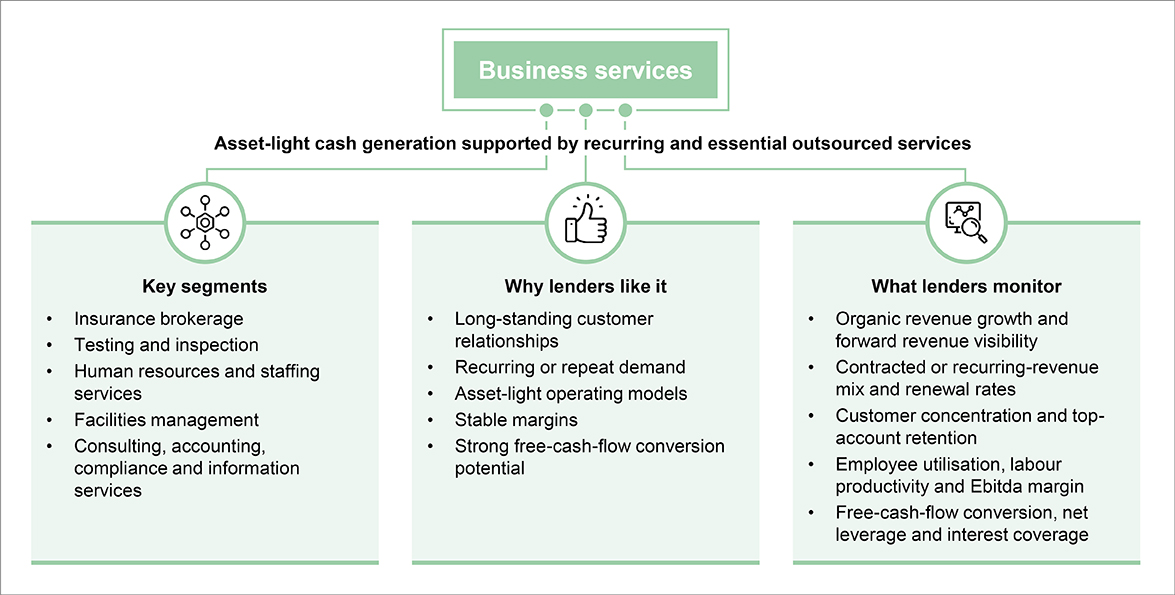
Business services remain attractive to private credit investors because many providers are asset-light and deeply embedded in their customers' day-to-day operations. However, the quality of recurring revenue varies considerably across the sector. During periods of economic uncertainty, demand for discretionary services such as consulting, staffing and project-based engagements can weaken, while contract renewals may face greater scrutiny over pricing, scope and demonstrated value.
Labour-intensive businesses also remain vulnerable to wage inflation. According to the U.S. Bureau of Labor Statistics, average hourly earnings across professional and business services rose to $45.68 in July 2026 from $44.40 a year earlier, representing growth of approximately 2.9%. When pricing adjustments fail to keep pace with rising employee compensation, margins can come under pressure even if revenues remain relatively stable.
Acquisition-led growth adds another layer of complexity. Integration challenges and execution missteps can disrupt service delivery, delay anticipated synergies and weaken cash conversion, even when reported earnings appear stable. As a result, lenders must look beyond headline performance to assess how much revenue depends on customer spending patterns, renewal rates, pricing power, labour utilisation and consistent operational execution.
The broadening landscape of private credit
Taken together, these sector-specific pressures, alongside intensifying competition in traditional middle-market lending, are pushing private credit managers towards asset-backed finance, consumer credit, infrastructure and other specialised strategies. These markets can offer differentiated deal flow, new sources of return and diversification beyond corporate earnings. However, they also introduce unfamiliar risks, making specialist expertise and closer portfolio monitoring increasingly important.
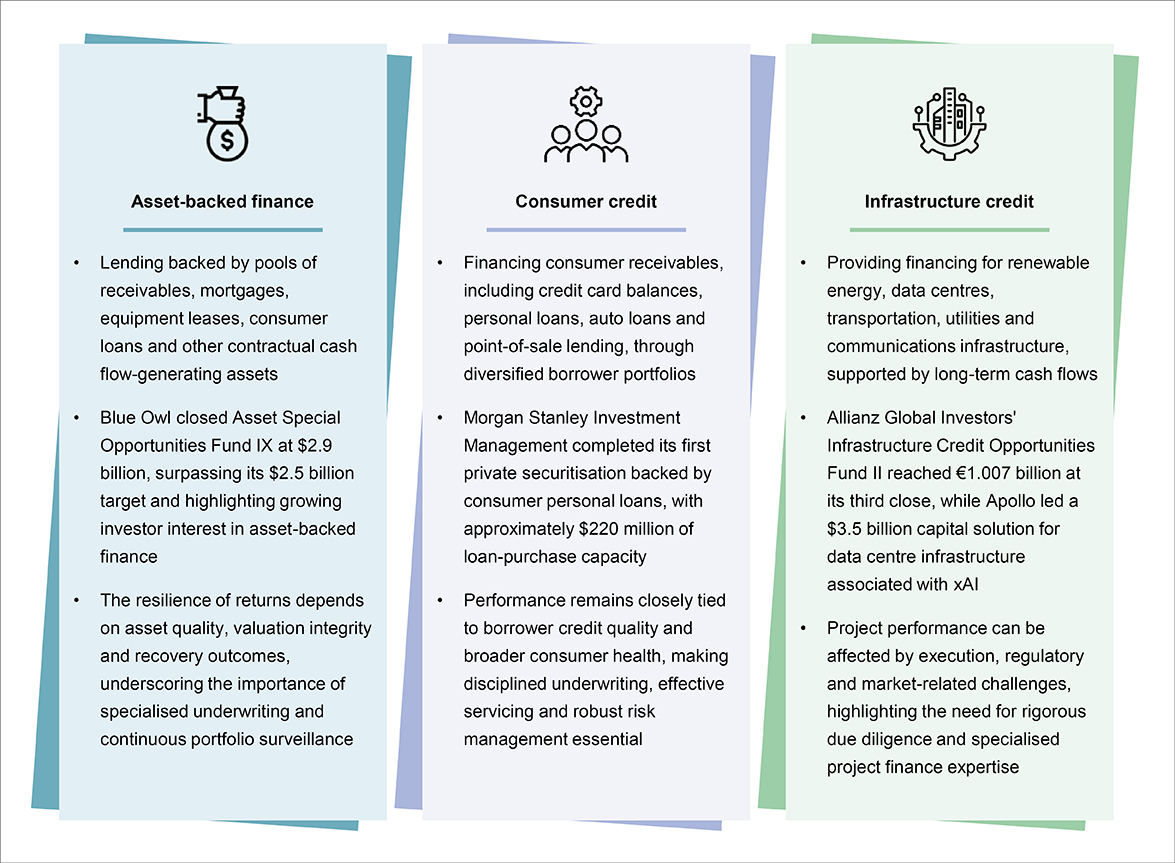
The opportunities are compelling, but they also serve as a reminder that in private credit, growth and risk inevitably go hand in hand.
Balancing growth and risk
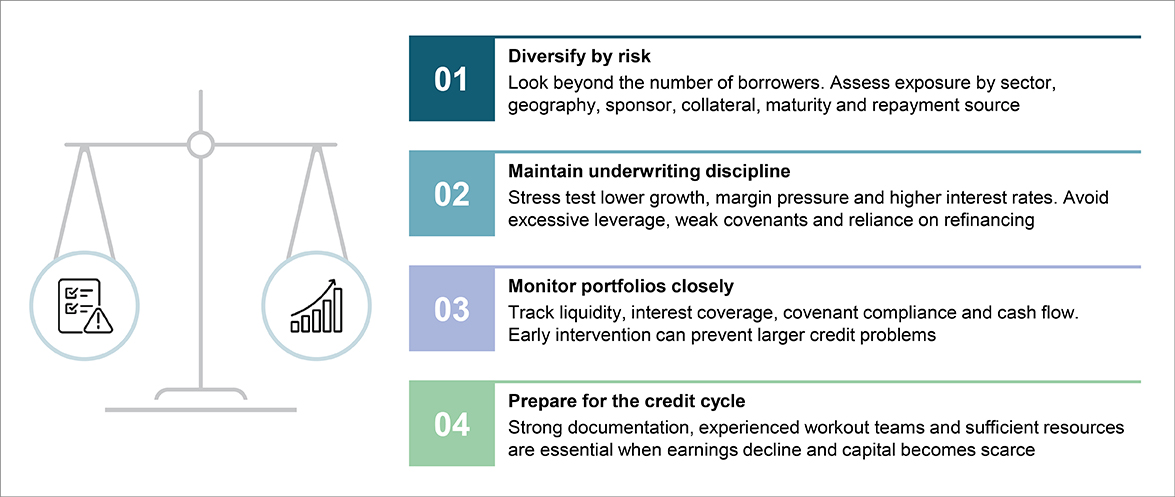
The next phase of private credit will demand more than growth. Asset managers will need to be highly selective, balancing return potential with prudent risk management. Success will depend on diversification, disciplined underwriting, close portfolio monitoring and the ability to respond early as market conditions change.
Conclusion
Private credit is no longer a niche corner of finance. Software, healthcare and business services still anchor many portfolios, while asset-backed finance, consumer credit and infrastructure are opening new avenues for growth. But expansion brings new pressure—from technology disruption, reimbursement and labour costs, and softer corporate budgets to collateral, borrower, project and regulatory risks. The challenge is simple to describe but difficult to execute: Grow without chasing every deal, diversify without moving beyond proven expertise, and work closely with sponsors without depending on them to rescue weak borrowers. The strongest performers will not be those that deploy the most capital, but those that allocate it wisely and protect it when the cycle turns.
How we can support
Meeting the current challenges requires stronger underwriting, deeper sector expertise and continuous portfolio oversight, particularly as private credit expands beyond traditional direct lending into asset-backed finance, consumer credit and infrastructure. We support private credit managers throughout the investment lifecycle with industry research, portfolio monitoring, covenant surveillance, stress testing and AI-powered risk analytics.
Our specialist teams assess emerging risks, identify lending opportunities, track portfolio performance and strengthen investment decisions. By combining deep domain expertise, advanced analytics and scalable operating support, we help investors build resilient portfolios, improve risk-adjusted returns and navigate an increasingly dynamic credit landscape.