Explore Crisil, a company of S&P Global
Formerly known as Global Research & Risk Solutions
October 08, 2026
 Blog
Blog
Blog
The AI debt supercycle
October 08, 2026
Blog
Blog
How hyperscaler issuance is reshaping fixed-income markets
 Share
Share





Hyperscaler issuance and credit market dynamics
The financing of hyperscaler-led artificial intelligence (AI) buildouts is evolving from a cash-funded technology cycle into a structurally debt-driven capital markets event.
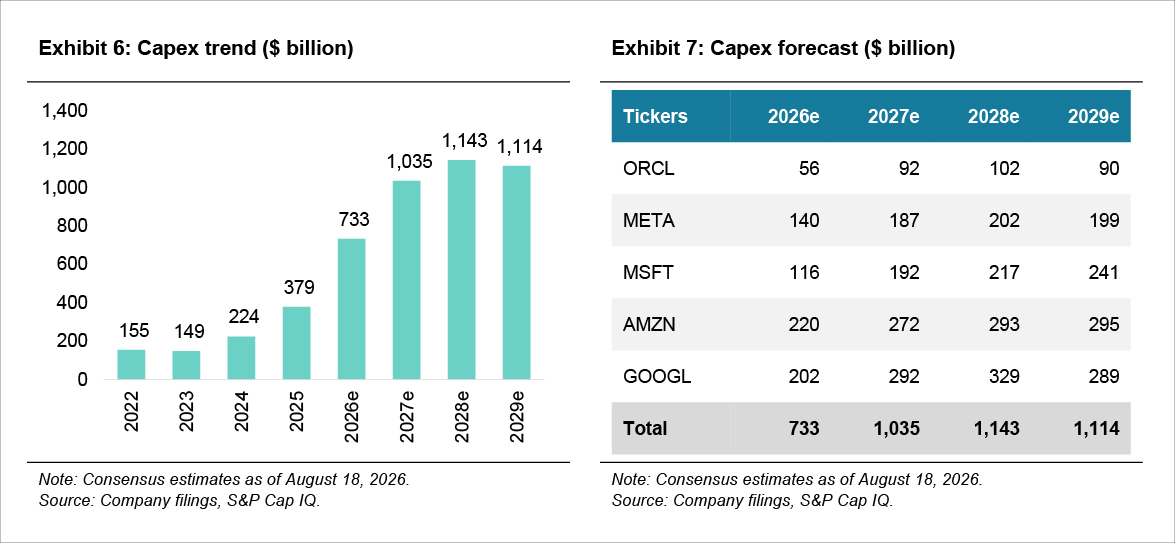
Hyperscalers are significantly increasing investments in data centers, computing infrastructure, power capacity, and network investment. In 2026 year-to-date, debt issuance has already reached approximately $218 billion, while aggregate capital expenditure (capex) is projected at about $733 billion and is expected to surpass $1 trillion in the coming years.
The scale of AI investment is well established. The more pressing question is how these investments will be financed efficiently and how risk will be distributed across the global credit ecosystem.
For fixed-income portfolio managers and institutional investors, hyperscaler credit can no longer be analysed in isolation. It requires a system-level view of AI infrastructure financing, where market absorption capacity, cross-asset exposure, and refinancing dynamics become as important as issuer fundamentals.
The core challenge is threefold. First, issuance concentration is increasing duration and spread risk in investment-grade (IG) markets, with a small group of frequent issuers driving supply pressure and requiring new-issue concessions, or additional yield, to attract investor demand.
Second, the scale of capex is compressing free cash flow (FCF) trajectories, increasing leverage sensitivity and reducing ratings headroom across the hyperscaler cohort.
Third, financing structures are becoming more complex. Funding obligations are increasingly spread across unsecured bonds, leases, joint ventures, vendor financing arrangements, and private credit structures, making true leverage and cross-asset exposure more difficult to identify and measure.
Against this backdrop, market participants are adapting underwriting and portfolio-management frameworks. Investors are increasingly stress-testing multi-year funding requirements, incorporating capex-driven leverage scenarios, and monitoring rating migration risk across major hyperscalers and related issuers.
Asset managers are also broadening exposure mapping across public credit, credit default swaps (CDS), private credit, and structured products to capture hidden correlation and concentration risks.
On the primary side, banks and arrangers are managing larger and more frequent transactions through deeper syndication processes, while private credit and structured-finance markets are absorbing an increasing share of infrastructure-related funding.
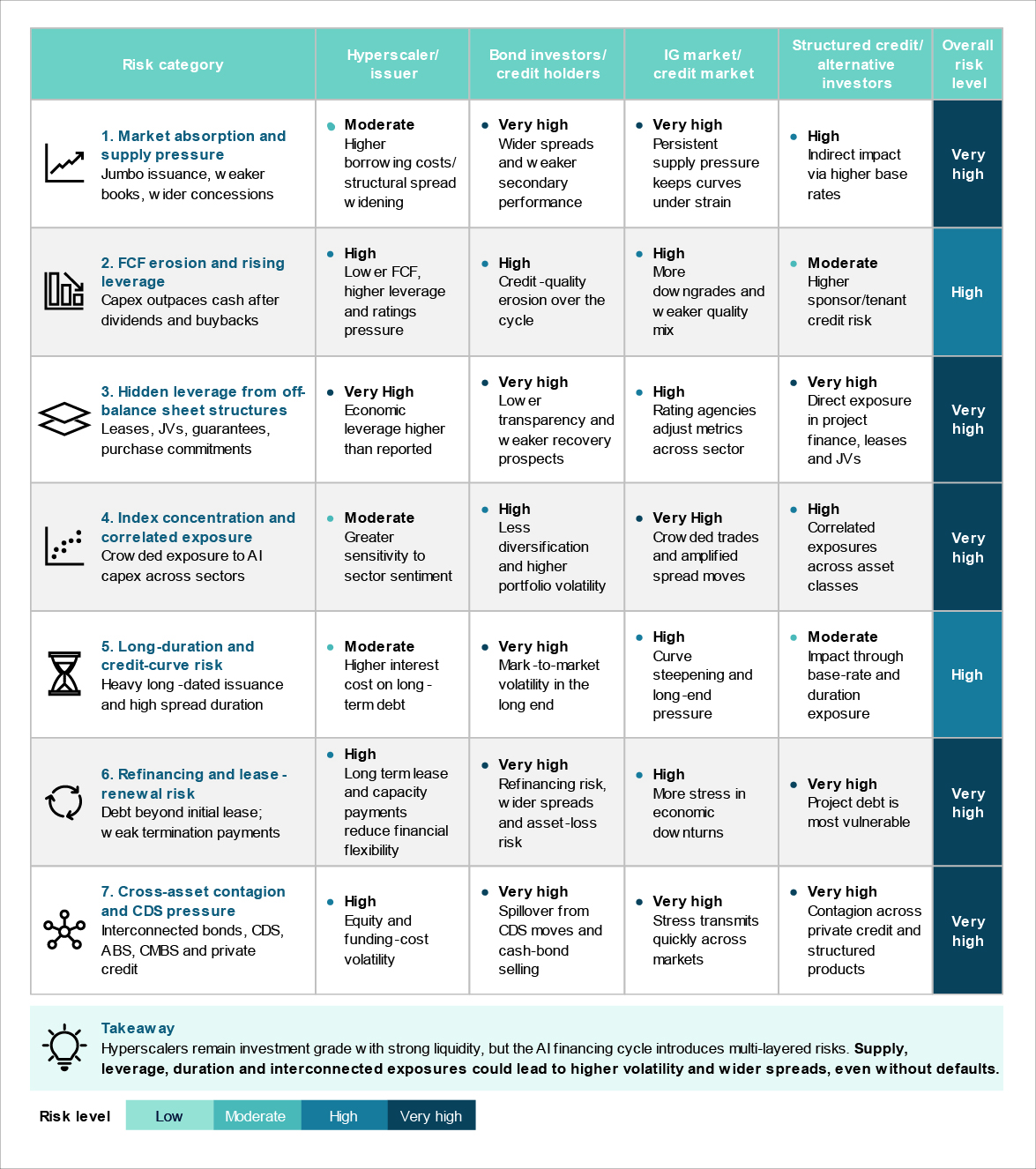
How AI financing risks affect key stakeholders
A historic increase in bond issuances
For years, the largest technology companies were known for their enormous cash balances and limited reliance on debt markets. That landscape is changing rapidly.
The emergence of generative AI and the race to expand cloud and data-center capacity have fueled one of the largest borrowing waves the technology sector has ever seen.
As hyperscalers increasingly tap bond markets to finance massive capex requirements, their influence on bond supply, pricing, and portfolio-allocation decisions across fixed-income markets has become impossible to ignore.
In this blog, we examine five hyperscalers, Amazon, Alphabet, Meta, Microsoft, and Oracle, that have reshaped fixed-income markets in 2025 and 2026 year-to-date through a historic increase in debt issuance.
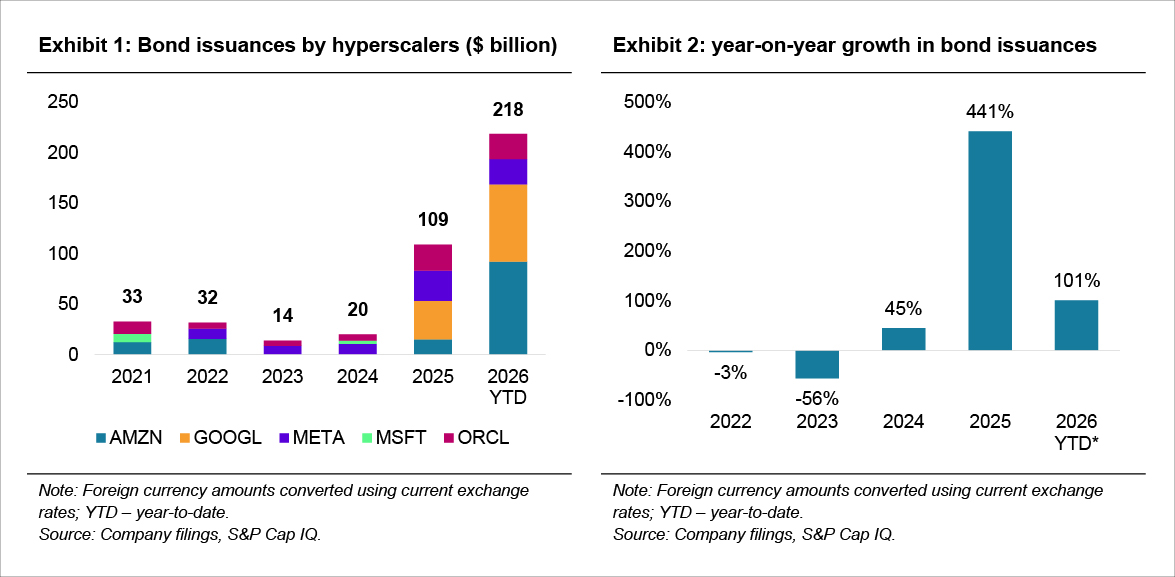
These companies issued approximately $109 billion of debt in 2025 and have shown no signs of slowing, raising another $218 billion on a US dollar-equivalent basis in 2026 year-to-date, including foreign-currency and floating-rate issuances.
This pace represents a remarkable departure from recent years, when the group issued an average of roughly $25 billion annually between 2021 and 2024.
Amazon accounted for about 32% of cumulative issuance between 2021 and 2026 year-to-date and nearly 42% of all debt raised in 2026 year-to-date. Alphabet accounted for roughly 27% of cumulative issuance and 35% of 2026 year-to-date volume.
Meta and Oracle each represented about 11% of 2026 year-to-date issuance, while Microsoft, despite being a comparatively infrequent borrower, accounted for 3% of cumulative issuance.
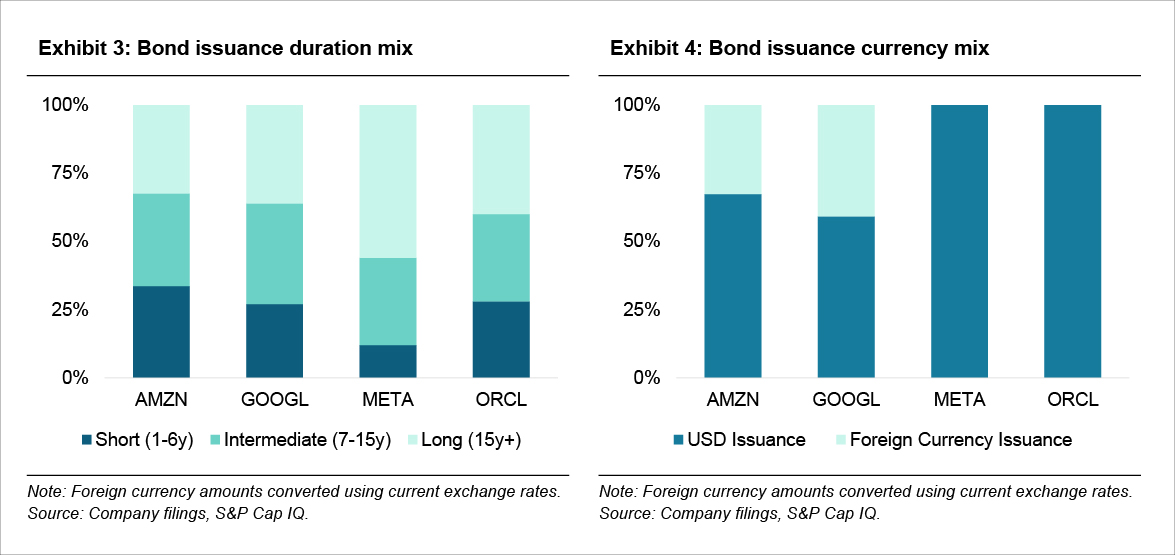
Another notable feature of this issuance wave is its breadth across the maturity curve. Approximately 28% of 2026 year-to-date issuance has been in the one-to-six-year segment, 35% in seven-to-fifteen-year maturities, and 37% in bonds maturing beyond 15 years.
Amazon's issuance profile is relatively balanced across maturities, while 56% of Meta's issuance and 40% of Oracle's issuance has been concentrated at the long end of the curve.
The US dollar accounted for approximately 72% of 2026 year-to-date issuance, with the remaining 28% issued in other currencies.
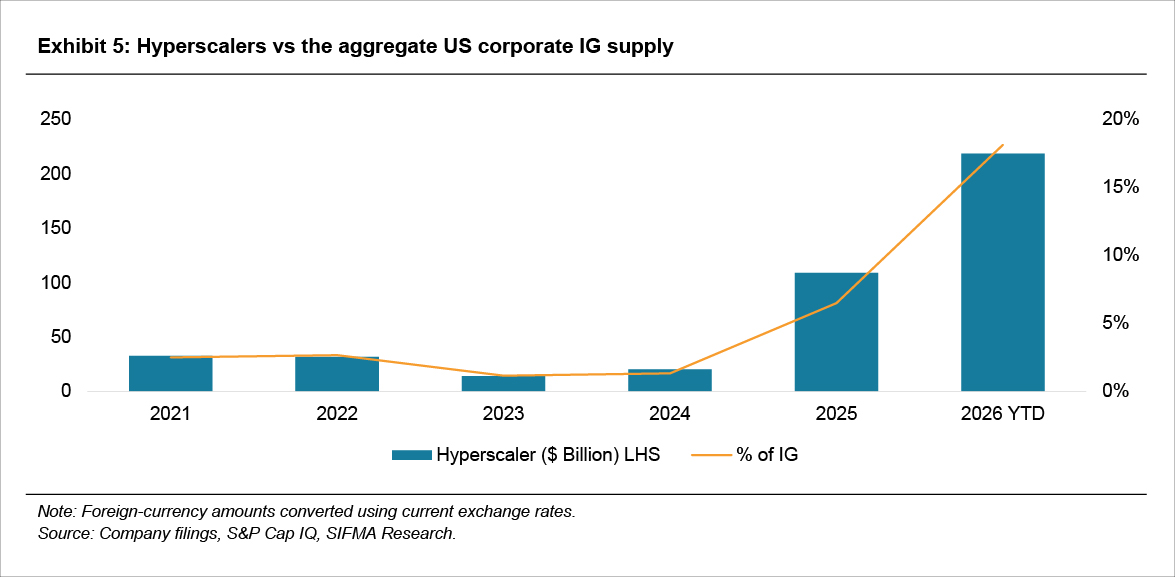
The scale of issuance is now testing the depth of the IG market. Hyperscaler debt issuance in 2026 year-to-date has exceeded that of the six largest US banks. Hyperscalers now account for about 18% of total US corporate IG supply, up sharply from approximately 6.5% in 2025.
AI capex is driving funding requirement
Hyperscalers are investing heavily in data centres, advanced semiconductors, power capacity, cooling systems and network infrastructure to support the next generation of AI applications. As a result, funding requirements are rising to unprecedented levels.
Aggregate hyperscaler capex increased 69% year-on-year to $379 billion in 2025 and is projected to nearly double to $733 billion in 2026 before reaching $1.1 trillion by 2029. This implies a compound annual growth rate of 31% from 2025 to 2029 and would lift spending to nearly three times the 2025 level.
Oracle is expected to record the fastest percentage increase in capex in 2026, while Alphabet and Amazon are likely to account for the largest absolute increases in spending.
For credit markets, the implication is straightforward: sustained investment on this scale is likely to keep external funding needs elevated, supporting a larger and more frequent pipeline of hyperscaler bond issuance in the years ahead.
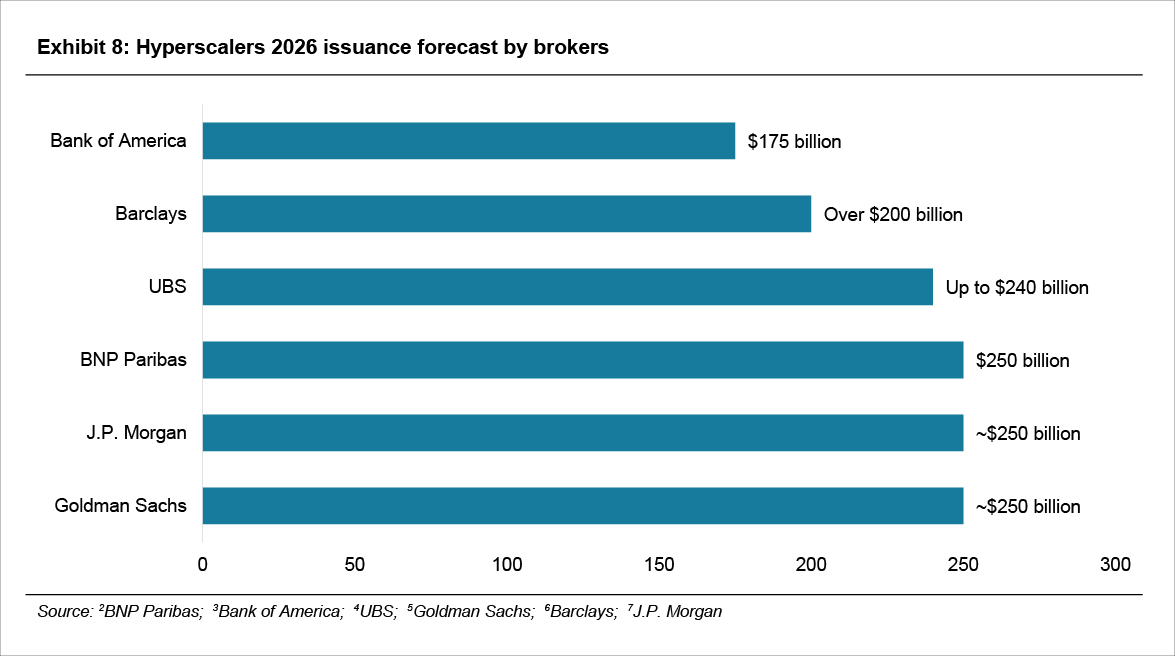
The funding wave may not be over. Broker forecasts suggest hyperscaler borrowing in 2026 could materially exceed initial expectations. Most public bond market estimates currently range from $240 billion to $250 billion. Given the roughly $218 billion raised year-to-date, reaching that range would require only an additional $22 billion to $32 billion of issuance before year-end.
Looking beyond the core hyperscalers, JPMorgan1 estimates cumulative global AI-related capex will reach $5.5 trillion by 2030, up from an earlier forecast of $5.1 trillion. AI-related debt financing is expected to account for approximately $4.1 trillion of that total. Although hyperscaler issuance has occasionally overwhelmed market participants, it is unlikely to overwhelm the market itself. The volume has caught investors off guard and contributed to wider spreads and weaker secondary-market performance.
Some of this pressure may ease as markets absorb the additional supply. However, spread performance will ultimately depend on investor demand and confidence that AI-related investments can generate attractive long-term returns.
The financing story is evolving because FCF is no longer sufficient to fund the AI buildout.
While hyperscalers are still expected to generate substantial cash flow, the amount available after capex and shareholder distributions is becoming increasingly constrained, particularly for Meta and Oracle. Amazon is also facing a growing external funding requirement, while Alphabet remains comparatively well positioned to self-fund its investments.
With capex forecasts continuing to rise, debt financing is expected to remain a critical source of funding for the sector's expansion.
Emerging risks across the AI financing ecosystem
The unprecedented scale of AI-related capex is forcing hyperscalers to rely more heavily on public and alternative debt markets, driving record bond issuance and materially altering their credit profiles.
While balance sheets remain strong, this funding shift introduces a broader set of risks for issuers, investors and the wider investment-grade (IG) market. From supply pressure and rising leverage to execution challenges and refinancing risk, investors will need to navigate an increasingly complex landscape as the AI infrastructure buildout accelerates.
- Market absorption and persistent supply pressure: Hyperscaler issuance is testing the absorption capacity of global IG markets. Weaker order-book coverage, larger new-issue concessions and recurring jumbo offerings suggest growing investor fatigue. Even strong issuers may face structurally wider secondary-market option-adjusted spreads and weaker post-issuance performance. As a result, borrowing and refinancing costs could rise while credit curves remain under sustained technical pressure
- FCF erosion and rising leverage: AI-related capex is growing faster than internally generated cash flow available after dividends and share repurchases. Cash balances may decline as companies increasingly rely on bonds, leases and guarantees to fund expansion. Because rating agencies often incorporate such obligations into adjusted debt calculations, rising capex could reduce FCF, increase leverage and trigger negative outlooks or downgrades
- Hidden leverage from off-balance-sheet structures: Reported debt may understate the true creditor burden. Leases, joint ventures, purchase commitments, vendor-financing arrangements and parent guarantees can create fixed or contingent obligations outside conventional unsecured debt. Rating agencies may include these exposures in adjusted leverage calculations, reducing ratings headroom and revealing higher economic leverage than reported figures suggest. Meta's Hyperion data-centre partnership with Blue Owl illustrates this dynamic. While much of the project financing sits within a joint venture rather than on Meta's balance sheet, the company remains exposed through long-term lease and support commitments, causing economic leverage to exceed reported leverage
- Index concentration and correlated exposure: Hyperscalers represent a growing share of IG market value and an even larger share of spread-duration risk. Exposure also extends to utilities, semiconductors and structured credit. A shift in AI sentiment could therefore affect multiple holdings simultaneously. This concentration may weaken diversification, amplify spread volatility and increase benchmark-driven exposure to the same underlying investment cycle. For example, an investor holding technology bonds, utility debt and infrastructure-backed credit may appear diversified at the sector level, yet all three exposures could be linked to expectations for AI-driven data-centre growth
- Long-duration and credit-curve risk: A significant portion of AI-related issuance is concentrated in long-dated bonds. These securities carry substantial spread duration and are highly sensitive to additional supply, higher interest rates and changing assumptions about technology adoption or financial policy. Continued issuance could steepen credit curves and pressure long-end valuations, resulting in meaningful mark-to-market losses even if near-term credit fundamentals remain intact
- Refinancing and lease-renewal risk: Project bonds remain highly dependent on lease structures and amortisation schedules. Debt that extends beyond the initial lease term exposes investors to tenant-renewal and refinancing risk. Cancellation rights, rent-abatement provisions and weak termination payments can further reduce cash-flow certainty. If a tenant does not renew, creditors may face wider refinancing spreads, asset-sale losses and significantly higher loss severity
- Cross-asset contagion and CDS pressure: The AI financing stack now spans unsecured bonds, project debt, private credit, asset-backed securities (ABS), commercial mortgage-backed securities (CMBS) and vendor-backed financing vehicles. Many of these structures are linked to the same hyperscaler payment streams, creating correlated exposure across markets. Investors may sell liquid parent-company bonds first, while counterparties hedge through CDS markets. As a result, stress could spread rapidly across cash bonds, derivatives and structured-credit markets, even in the absence of a corporate default
How we can help
As debt issuances by hyperscalers reshape the fixed-income market, investors need deeper insights into leverage, AI-driven capex, refinancing risk and long-term credit quality. Through independent research, analytics and ongoing issuer surveillance, we help asset managers, insurers, pension funds, family offices and other institutional investors make informed credit decisions.
Our fixed income analysts provide fundamental credit assessments, relative value analysis, covenant reviews, stress testing, rating transition monitoring and thematic research across sectors. Acting as an extension of investment teams, we help clients identify risks early, enhance portfolio construction and improve credit oversight.
Leveraging our growing AI and data capabilities, we help clients scale credit monitoring and research workflows through AI-enabled issuer surveillance, automated earnings and news analysis, document intelligence, early warning signal detection, and portfolio risk analytics. Our domain expertise and technology-driven insights enable faster coverage, improved efficiency and more actionable investment decisions in an increasingly complex credit environment.
1 What bubble? JPMorgan says the $5.5 trillion AI capex explosion is profitable–for now
2 Fixed Income Focus May 2026
3 BofA Lifts Hyperscaler Debt Forecast 25% to $175 Billion
4 UBS lifts forecast for big tech bond sales
5 Big Tech will fund more than a third of its AI investments with debt in 2027, Goldman Sachs predicts
6 AI Capex Boom Puts Hyperscaler Spending Under the Microscope
7 What bubble? JPMorgan says the $5.5 trillion AI capex explosion is profitable–for now
Appendix/source links
- Hyperscaler debt binge pushes yields up as investor demand cools – 29th July 2026
- What bubble? JPMorgan says the $5.5 trillion AI capex explosion is profitable–for now 25th June 2026
- Fixed Income Focus - May 2026
- AI Hyperscalers Are Taking on Debt, But the Broader Market Looks More Leveraged – 30th May 2026
- BofA Lifts Hyperscaler Debt Forecast 25% to $175 Billion
- UBS lifts forecast for big tech bond sales
- Big Tech will fund more than a third of its AI investments with debt in 2027, Goldman Sachs predicts
- AI Capex Boom Puts Hyperscaler Spending Under the Microscope