Explore Crisil, a company of S&P Global
Formerly known as Global Research & Risk Solutions
November 06, 2026
 Blog
Blog
Following the fault lines
November 06, 2026
Blog
Blog
Cautionary tale for asset managers: The piling up of debt is changing the way risk travels through portfolios
 Share




The channels of contagion
For much of the post-Global Financial Crisis period, asset managers operated in an environment where low interest rates, abundant liquidity and central bank support helped cushion portfolios from deeper stress. Government bonds were viewed as the natural hedge against risk assets, private markets benefited from low discount rates, and liquidity was generally available when investors needed it.
That environment has shifted materially. Global public debt has risen sharply, interest costs have increased, and governments are refinancing obligations at significantly higher rates. Corporates, real estate issuers and private credit borrowers face a similarly challenging refinancing landscape.
The International Monetary Fund (IMF) estimates global public debt reached nearly 94% of gross domestic product (GDP) in 2025 and projects it will approach 100% by 2029. Meanwhile, global interest payments have risen from about 2% to nearly 3% of GDP in just four years.
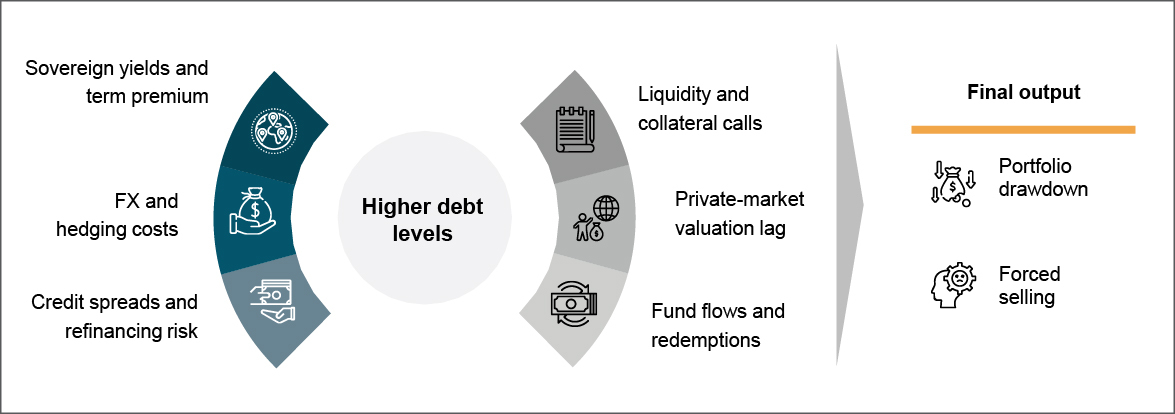
For asset managers, the issue is not merely higher debt levels in one segment of the market. It is how a more debt-sensitive environment alters the way risk travels through portfolios. Fiscal pressures, elevated rates and refinancing stress can transmit across sovereign yields, credit spreads, corporate funding costs, private-market valuations, liquidity conditions and investor flows. Higher debt may be the backdrop, but what matters for investors is how these pressures are transmitted into portfolio risks and investment outcomes.
These transmission channels are rarely linear. A shock that begins in rates, currencies or funding markets can rapidly spread across asset classes and strategies. Higher yields can increase hedging costs, wider spreads can restrict refinancing access, margin calls can force asset sales, and fund outflows can expose liquidity mismatches. What starts as a macroeconomic or funding shock can quickly escalate into a broader portfolio risk event.
The buy-side risk transmission: How a higher-debt shock can ripple across portfolios
Sovereign bonds have become a less reliable hedge
Government bonds remain core holdings for multi-asset investors, but their role has become more complex. In a traditional growth shock, sovereign bonds can still provide protection as investors seek safe-haven assets and central banks cut rates. In an inflationary or fiscal-confidence shock, however, those same bonds can become a source of volatility rather than stability.
Increasingly, sovereign risk is less about the absolute size of government debt and more about a government's capacity to manage and refinance that debt. Higher interest rates are raising debt-service costs, while heavier issuance is testing investor demand for longer-dated bonds. At the same time, monetary tightening has reduced central bank demand for sovereign debt, even as spending pressures linked to ageing populations, defence and climate-related priorities continue to weigh on fiscal positions.
Recent developments in Europe illustrate how quickly fiscal concerns can alter the role of government bonds. France provides the clearest example. The 10-year sovereign yield has risen towards 4.9%, while the spread over German Bunds widened to nearly 160 basis points in early October, its highest level since the euro-area debt crisis.
The pressure has also spilled over into other euro-area markets, including Italy, while the euro fell to a 17-month low amid concerns that French fiscal and political uncertainty could evolve into a broader regional issue. Together, widening sovereign spreads and currency weakness demonstrate how government bonds can shift from being a source of stability to a channel through which risk is transmitted across markets.
The United States (US) is facing a different dynamic. Rather than a sovereign-confidence shock, pressure has emerged at the long end of the Treasury curve. Ten-year and 30-year yields recently reached their highest levels in roughly 24 years as persistent inflation, large fiscal deficits and heavy issuance increased the compensation investors require to hold long-dated debt. Treasury auctions have continued to attract solid demand, suggesting concerns are less about confidence in US debt and more about whether sustained borrowing needs and inflation risks will keep long-term yields structurally higher.
These episodes reflect a broader structural shift in sovereign debt markets. The IMF has warned that elevated public debt and greater reliance on short-term issuance increase rollover risks in major sovereign bond markets and could revive sovereign-bank linkages. BlackRock has similarly argued that heavier debt issuance and rising debt burdens may require investors to demand a higher term premium for holding long-term bonds.
Many portfolio construction frameworks assume high-quality sovereign bonds will diversify equity and credit risk, particularly during periods of market stress. While this negative stock-bond correlation may hold during the initial stages of a shock, it may not persist when fiscal pressures, rising debt supply, persistent inflation or concerns over policy credibility become more entrenched. In such scenarios, higher yields can weigh on both bond prices and risk assets, causing them to move in the same direction and diminishing the diversification benefits traditionally associated with sovereign bonds. For allocators, this underscores the importance of looking beyond asset-class labels and focusing instead on the underlying factors driving returns and correlations.
At the portfolio level, investors need to look beyond the amount of duration they hold and consider the role sovereign bonds are expected to play: a hedge, a source of income, or an additional source of portfolio risk. In a world of elevated debt burdens, higher refinancing costs and more volatile inflation dynamics, the effectiveness of sovereign bonds will increasingly depend on the nature of the underlying shock. While high-quality government bonds can still provide liquidity and protection during growth-driven or disinflationary downturns, they may offer far less protection when rising yields are fuelled by inflation, fiscal concerns or increased debt issuance.
Critically, sovereign repricing does not stop at the bond market. Changes in yields, rate differentials and investor confidence can spill into currency markets, affecting both cross-border returns and hedging costs.
Currency risk can dominate cross-border returns
For global asset managers, foreign exchange has evolved from an overlay decision into a core driver of realised returns, particularly when rate differentials and hedging costs are substantial. A bond that appears attractive in local-currency terms can deliver significantly weaker returns once currency movements and hedging costs are incorporated.
Beyond their impact on returns, currencies increasingly serve as market barometers of fiscal credibility, external vulnerability and capital-flow pressures. Countries with large fiscal deficits, weak external balances or heavy reliance on foreign investors can be particularly vulnerable to currency stress.
Foreign exchange also plays a central role in portfolio construction because reporting currencies, liability currencies and asset currencies are not always aligned. As a result, what appears to be a secondary exposure can become a meaningful driver of portfolio outcomes.
The yen carry-trade unwind in August 2024 demonstrated how quickly currency shocks can spread across markets. As the yen strengthened, leveraged positions funded in yen came under pressure, forcing investors to unwind exposures across currencies and equities. The impact was significant. Japan's Nikkei fell 12.4% on August 5, 2024, its largest one-day decline since 1987, while the S&P 500 declined around 3%.
The Bank for International Settlements noted that this deleveraging amplified the initial reaction to weaker US macroeconomic data and estimated carry-trade positions at roughly ¥40 trillion ($250 billion) ahead of the episode. The IMF linked the unwind to narrowing US-Japan rate differentials and the Bank of Japan's rate hike. Although the episode proved short-lived, it showed how leveraged currency positions can both transmit and amplify shocks across otherwise unrelated markets.
Increasingly, currency markets act not merely as sources of return volatility but as transmission channels for leverage and liquidity stress. When large numbers of investors are funded in the same currency or exposed to the same carry trade, exchange-rate movements can trigger deleveraging across seemingly unrelated assets.
Once currency moves begin to tighten funding conditions and force deleveraging, the effects quickly reach borrowers, making refinancing capacity an increasingly important source of credit differentiation.
Credit risk is increasingly about refinancing, not just default
A more debt-sensitive market is changing the nature of credit risk. In the low-rate era, many borrowers could refinance despite elevated leverage. Today, maturity profiles matter more because refinancing is both costlier and less certain.
This is particularly relevant for leveraged borrowers, real estate issuers, lower-rated corporates, private credit borrowers and sectors with limited pricing power. Even in the absence of imminent defaults, higher refinancing costs can erode free cash flow, pressure credit ratings and widen spreads.
Refinancing stress is often first felt by borrowers with the weakest funding profiles. Higher rates do not affect all issuers equally or simultaneously. Companies with long-dated fixed-rate debt may have time to adjust, while those with near-term maturities, floating-rate obligations or constrained market access are likely to feel the impact much sooner. The result is a more uneven credit cycle, where default rates may remain manageable even as downgrade risk, spread dispersion and refinancing pressures intensify beneath the surface.
The stress in US commercial real estate during 2023 illustrates the point. Brookfield defaulted on approximately $1.1 billion of loans backed by three downtown Los Angeles office towers as higher borrowing costs, declining property values and looming debt maturities made refinancing increasingly difficult. The episode demonstrated how funding pressures can evolve into credit events well before defaults become widespread across the broader market.
For buy-side credit investors, this places a greater premium on security selection. Broad spread measures can obscure the growing divergence between issuers with extended debt maturities, strong cash generation and reliable market access, and those that remain dependent on favourable refinancing conditions.
Refinancing pressures are also not confined to corporate borrowers. Banks and other financial institutions can come under strain when sovereign stress raises funding costs, weakens market confidence or erodes the value of domestic government-bond holdings. The IMF has specifically warned that elevated public debt and refinancing pressures could revive sovereign-bank linkages in stressed markets.
As refinancing conditions tighten and credit quality diverges, liquidity often becomes the next transmission channel through which market stress spreads across portfolios.
Liquidity risk is often invisible until markets are already under stress
Liquidity risk becomes most apparent when investors need to raise cash quickly. Ultimately, liquidity is not defined by trading volumes in normal markets, but by the price investors can obtain when many market participants are attempting to sell simultaneously.
During periods of stress, volatility, redemptions and margin calls often reinforce one another. Falling prices trigger additional selling and collateral demands, which in turn place further pressure on prices. Assets that appear liquid under normal conditions can therefore become difficult to exit without incurring meaningful discounts.
The UK's gilt crisis in 2022 demonstrated how quickly liquidity stress can emerge. As gilt yields rose sharply, pension funds employing liability-driven investment strategies were required to post additional collateral. To meet those calls, many sold gilts, pushing prices lower and yields higher, which in turn triggered further collateral demands. The result was a self-reinforcing cycle of forced selling that ultimately required intervention by the Bank of England to prevent broader market disruption.
Not all risks stay in their lane: When one shock becomes many
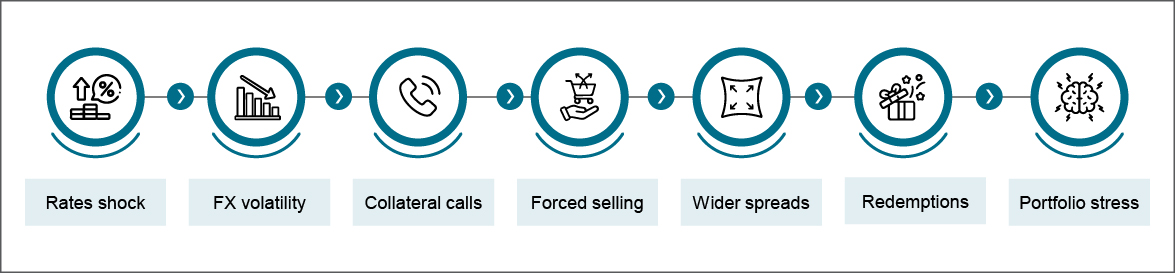
Liquidity pressures often intensify when funds require cash for multiple reasons at the same time. Sharp moves in interest rates, foreign exchange or credit spreads can increase margin and collateral requirements for strategies that rely on derivatives, repo financing or hedging instruments. Simultaneously, investor withdrawals can create an additional drain on liquidity, particularly for open-ended funds and multi-asset products. When both occur at once, managers are often forced to sell the assets they can sell rather than the assets they would prefer to sell.
The key lesson for portfolio-construction teams is that liquidity risk is not confined to lower-quality assets. It can emerge across asset classes when leverage, collateral demands, market structure and investor behaviour interact. For open-ended funds, exchange-traded funds, private credit vehicles and multi-asset portfolios, liquidity management must therefore extend beyond asset quality to encompass fund structures, investor concentration, collateral requirements and crowded positioning.
When liquidity and funding conditions tighten, the consequences are typically reflected quickly in public markets but much more slowly in private assets, where valuations tend to adjust with a lag.
Private market risk is partly hidden by smoother valuations
As private markets have grown as sources of yield and diversification, slower valuation cycles have become an increasingly important portfolio-risk consideration. Lower reported volatility does not necessarily imply lower economic risk.
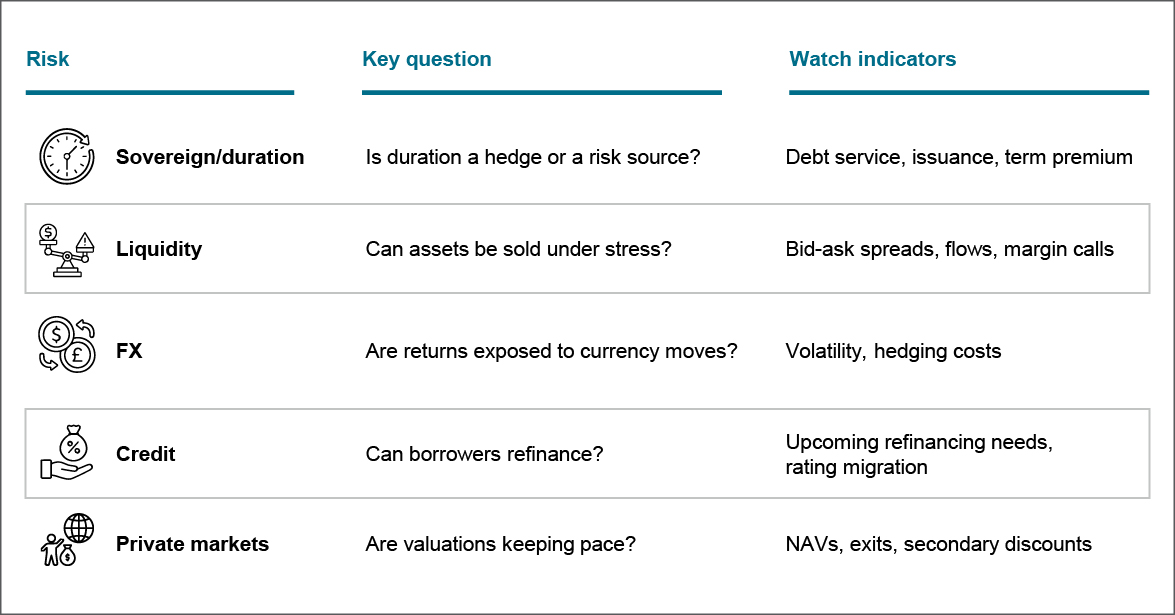
When debt becomes contagious: Five risks asset managers should monitor
In a more debt-sensitive environment, private credit, infrastructure and real estate face many of the same pressures affecting public markets, including rising refinancing costs, weaker exit conditions and more selective investor demand. However, because assets are valued less frequently, these pressures may take longer to appear in reported valuations. The IMF has also noted that rising borrower stress and growing retail participation could test the resilience of semi-liquid private-credit structures.
Another important consideration is the denominator effect. When public markets reprice more rapidly than private assets, private-market allocations can increase as a share of total portfolio value even without any additional capital deployment. This can leave asset owners overallocated to private markets, limiting their ability to make new commitments and increasing pressure to sell secondary positions, often at discounts. The repercussions can affect fundraising activity, liquidity management and exit timing across the investment cycle.
The broader risk is that portfolios appear more stable than they actually are at precisely the moment when financing conditions and exit assumptions are deteriorating. A portfolio may exhibit relatively low volatility even as the underlying funding environment becomes more fragile. In such cases, the risks extend beyond credit losses to include valuation lags, exit uncertainty and potential mismatches between investor liquidity expectations and the liquidity of the underlying assets.
Because these vulnerabilities emerge at different speeds and through different channels, investors need a framework that identifies how they interact before they accumulate into broader portfolio stress.
Monitoring the transmission channels
In this environment, buy-side risk monitoring must extend beyond traditional measures such as volatility and tracking error. The focus increasingly needs to shift towards understanding the channels through which macroeconomic stress is transmitted into portfolio stress.
Viewed individually, sovereign yields, currency moves, refinancing conditions, liquidity pressures and valuation changes may appear manageable. The greater risk lies in their interaction. Sovereign repricing can alter currency dynamics, currency moves can tighten funding conditions, tighter funding can increase refinancing pressure, and refinancing stress can ultimately expose liquidity vulnerabilities. Understanding these linkages is as important as monitoring the individual risks themselves.
Together, these indicators can help investors assess whether a macroeconomic shock is likely to remain contained or spread across asset classes, funding markets and portfolio exposures.
In a more debt-sensitive market, risks can emerge in unexpected places. Duration can become a source of volatility rather than diversification. Credit risk can shift from concerns over default to concerns over refinancing capacity. Foreign exchange can overwhelm local-market returns. Private-market valuations can lag economic realities. Liquidity can evaporate when collateral calls and redemptions occur simultaneously.
Ultimately, portfolio resilience depends less on any single exposure and more on how risks interact. A bond, loan or private-market investment may appear attractive in isolation, but vulnerabilities often emerge when multiple transmission channels reinforce one another.
How we can support
The practical challenge for asset managers is converting this interconnected risk landscape into a repeatable monitoring framework. Increasingly, firms need an approach that links sovereign conditions, funding markets, issuer fundamentals, portfolio positioning and liquidity dynamics into a single view of risk transmission. Doing so requires combining macroeconomic signals, issuer-level fundamentals, market indicators and portfolio-exposure data to identify emerging vulnerabilities before they translate into portfolio losses.
We help clients identify where risks are accumulating, understand how they may propagate across portfolios and pinpoint exposures that warrant closer scrutiny. This can include sovereign and macroeconomic monitoring, issuer-level credit surveillance, bank-sovereign linkage analysis, rates and foreign-exchange dashboards, sector heat maps, private-credit monitoring, liquidity indicators and stress-testing capabilities.
A recent engagement illustrates how such a framework can be operationalised. Working with a global asset manager, we developed a real-time portfolio-intelligence platform that integrated risk monitoring, signal detection and portfolio analytics to support faster investment decisions and improve risk-adjusted outcomes. The platform enabled a more proactive approach to portfolio oversight, helping identify both emerging vulnerabilities and potential opportunities.
For example, a portfolio-risk dashboard could track fiscal deterioration, sovereign-rating actions, yield-curve movements, currency pressures, bank funding costs, credit-spread sensitivity, refinancing requirements and fund-flow stress signals in a single framework. The objective is to move beyond reactive risk reporting towards earlier identification of vulnerabilities and a more forward-looking approach to risk management.