Explore Crisil, a company of S&P Global
Formerly known as Global Research & Risk Solutions
November 20, 2026
 Blog
Blog
The back-end of deposit growth
November 20, 2026
Blog
Blog
Turning standardization, root-cause intelligence and continuous improvement into scalable operations at banks
 Share




Banks competing for deposits have obvious customer-facing priorities. They must battle it out on pricing, digital convenience, product innovation and customer experience, among other factors.
But competition at the front end also has implications for the operating model behind it. As deposit franchises grow, banks need to assess whether the infrastructure supporting them can accommodate higher volumes and greater product complexity without generating additional rework, operational dependencies or control risk.
Deposit operations extend well beyond transaction processing. Interconnected processes, systems and teams support account servicing, deposit balancing, reconciliations, exception management, settlements and general-ledger activities.
As products evolve and customer expectations rise, the operating instructions, approval requirements and technology dependencies underpinning these activities also tend to become more complex.
This complexity is not always visible to customers. A bank may deliver a seamless digital experience even when fragmented workflows, manual interventions and multiple approval points sit behind it.
The challenge, therefore, is not simply to process more transactions. It is to build an operating model capable of managing greater volume and variability while maintaining quality, control and responsiveness.
A growing deposit franchise demands a more resilient operating model
The scale and growth of the deposit market in the United States (US) underscore the importance of operational resilience.
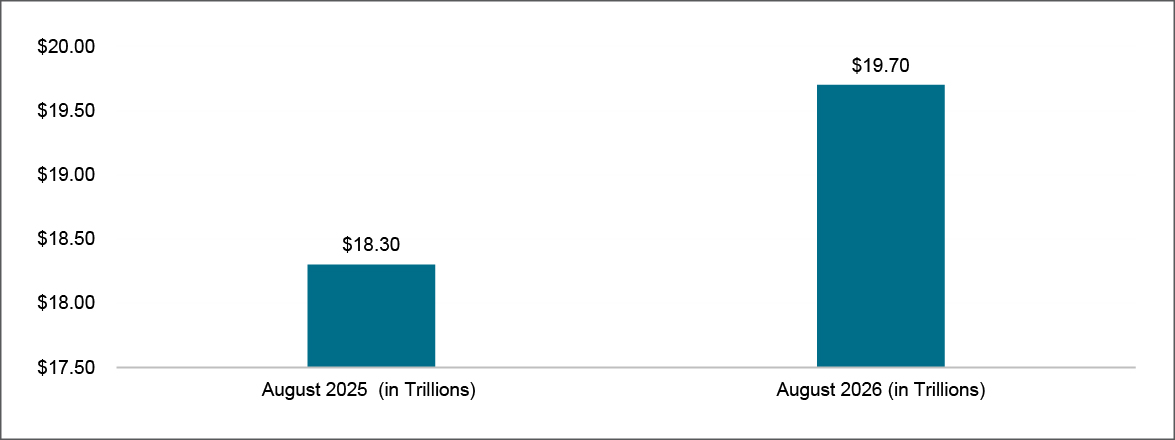
According to the US Federal Reserve's H.8 statistical release, deposits at US commercial banks increased to about $19.7 trillion in August 2026 from about $18.3 trillion in August 2025, representing growth of 7.7% based on the rounded figures.
US commercial bank deposits
Yet deposit growth is only one part of the story. The waycustomers interact with banks has also changed significantly.
According to the Federal Deposit Insurance Corporation (FDIC)'s 2023 National Survey of Unbanked and Underbanked Households, 48.3% of banked US households primarily used mobile banking to access their accounts.

Digital banking is now a primary access channel
Digital channels have made it easier for customers to open accounts, transfer funds and access banking services with limited physical interaction. But convenience at the front end does not automatically translate into operational simplicity at the back end.
Consider an account-maintenance request initiated through a digital channel. From the customer's perspective, it may be a single interaction. For the bank, however, completing that request may involve information validation, documentation checks, account updates, approvals and reconciliation across multiple systems.
Deposit servicing, settlement activities and exception management involve similar dependencies. As products become more varied and operating processes more interconnected, banks must manage not only higher transaction volumes but also a broader range of processing requirements and exceptions. In other words, scale increases the challenge not merely by adding volume, but by amplifying operational variability.
The economics of operational efficiency are equally important. According to McKinsey, end-to-end banking operations account for 60-70% of a bank's cost base. Although this estimate covers banking operations more broadly rather than deposit operations alone, it illustrates why operating-model efficiency remains an important management priority.
Simply adding processing capacity, however, does not create scalability. If underlying processes remain fragmented, higher volumes can generate more manual intervention, review effort and operational dependencies. Capacity may increase, but so can complexity and cost.
Sustainable scale, therefore, requires banks to improve how work is organized, executed and controlled rather than merely increase the resources available to process it.
The real operational challenge is managing variability
Traditional operational performance measures tend to emphasize transaction volumes, turnaround times, service-level adherence and error rates. These indicators remain important, but they do not always explain why performance varies or why particular activities repeatedly generate exceptions.
A deposit-servicing process, for instance, may consistently attract quality-review observations. The immediate response may be to introduce additional checks, retraining or supervisory review.
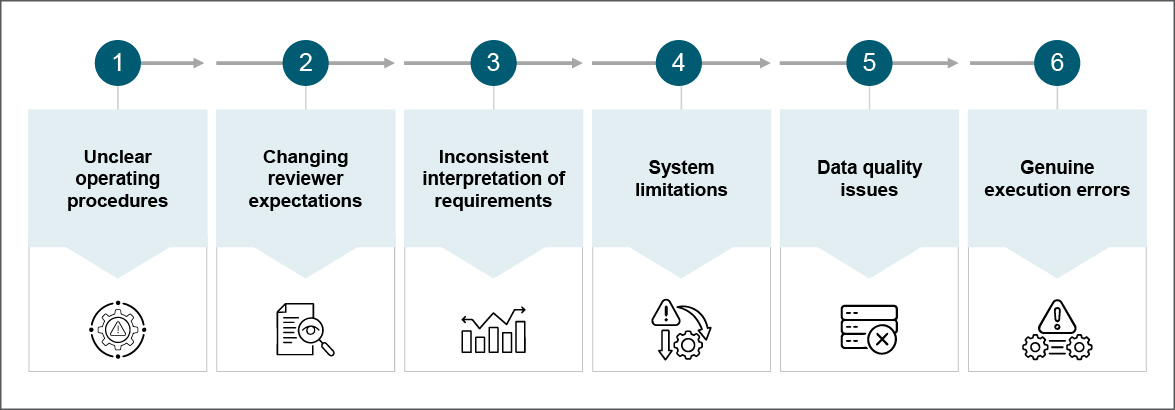
Yet the underlying causes could be very different. An exception may arise from unclear operating instructions, inconsistent interpretation of requirements by reviewers, incomplete customer data, limited system functionality or an employee processing error.
Understanding the six sources of operational variability
Treating all such situations as execution failures can lead to additional controls without resolving the source of the problem. Additional downstream checking, for example, may do little to address recurring reconciliation breaks caused by inconsistent upstream data. Similarly, repeated account-maintenance exceptions resulting from ambiguous documentation requirements may require clearer operating instructions rather than further staff training.
This distinction matters because different causes require different interventions. Execution errors may call for targeted coaching or quality checks. Data issues may require stronger upstream validation, while recurring system limitations may warrant technology enhancements.
Without such differentiation, banks risk creating operating models in which exceptions are repeatedly corrected but their underlying causes remain unresolved. Over time, the result can be more rework, processing effort and operational complexity even when headline service levels remain satisfactory.
The objective, therefore, should be to understand why errors occur, determine whether they are recurring and identify how to prevent them from recurring.
That requires stronger process discipline, supported by structured root-cause intelligence.
Building a scalable deposit operating framework
A resilient deposit operating model should establish consistency in routine execution while preserving the flexibility needed to manage exceptions and activities requiring professional judgement.
1. Strengthen the eight operating foundations
The objective is not to impose identical procedures on every activity. Deposit balancing, account maintenance, reconciliations and settlements carry different risks and may require different controls. Instead, banks should standardize repeatable activities within each process, clearly identify where judgement is required and establish consistent escalation mechanisms.
This becomes particularly important when operations are centralized or rely on shared delivery models. Scaling inconsistent processes across larger teams can multiply exceptions and dependencies rather than improve efficiency.
Process documentation and knowledge transfer should, therefore, function as ongoing operating controls rather than one-off transition activities.
2. Use root-cause intelligence to reduce recurring exceptions
Once processes are standardized, banks can develop a more systematic understanding of where operational variability originates.
Quality-review observations, recurring exceptions, reconciliation breaks and escalation patterns can provide valuable intelligence about weaknesses in processes, data, systems or governance. Instead of treating each issue independently, banks can classify observations by underlying cause and prioritise recurring problems that generate disproportionate rework or control risk.
For instance, repeated exceptions linked to incomplete customer information may justify improvements in upstream data capture. Inconsistent review outcomes may indicate a need for clearer approval standards, while recurring manual adjustments could reveal opportunities for system integration or automation.
The emphasis should shift from repeatedly correcting individual cases to addressing the conditions that cause them.
Crucially, not every exception should lead to another control layer. In some cases, simplifying instructions, improving data quality or clarifying ownership may be more effective than adding reviews. The aim is not more control for its own sake, but better-targeted control.
3. Embed continuous improvement into operating performance
Process standardization and root-cause analysis become more effective when supported by continuous performance monitoring.
Traditional metrics such as turnaround time and transactions processed per employee should be complemented by indicators that reveal the quality and consistency of execution. These could include first-time-right processing, repeat exception rates, rework volumes, frequency of manual intervention and the time taken to resolve recurring issues.
Together, these measures can help management distinguish short-term productivity gains from more sustainable improvements in operating performance.
A team, for instance, may consistently meet turnaround targets while relying heavily on manual corrections and repeated supervisory intervention. Headline productivity measures may therefore suggest strong performance even though hidden operational dependencies remain. A broader set of metrics can make those dependencies visible and help management prioritize improvements.
Banks can then use recurring operational insights to refine process instructions, strengthen upstream controls, improve technology workflows and adjust training requirements. This creates a feedback loop in which operational experience continuously informs process design.
It can also provide a stronger foundation for automation. Activities that are clearly defined, repeatable and supported by reliable data are generally better suited to automation than those characterized by inconsistent requirements and unresolved exceptions. Standardization, therefore, is not merely an efficiency measure; it can also be an enabler of effective automation.
The elements reinforce one another: standardization makes execution more consistent; root-cause intelligence identifies what needs to improve; and continuous monitoring helps ensure those improvements endure as operations scale.
Conclusion: Scale should not come at the cost of control
Scaling deposit operations is not simply a matter of processing higher volumes with more people or introducing isolated automation initiatives.
As customer interactions become more digital, products more varied and banking operations more interconnected, managing operational variability becomes increasingly important.
Banks need operating models that set clear expectations, distinguish standard execution from activities requiring judgement, address recurring problems at source and continuously improve through operational intelligence.
When people, processes, systems and controls work together in this way, deposit operations can become more repeatable, transparent and resilient.
Ultimately, the true test of scalability is not simply how much additional volume a bank can process. It is whether the bank can absorb that growth without a corresponding increase in complexity, rework or control risk.
Sources
1. Federal Reserve, Assets and Liabilities of Commercial Banks in the United States (H.8) — US commercial bank deposit balances, August 2025 and August 2026.
https://www.federalreserve.gov/releases/h8/
2. Federal Deposit Insurance Corporation, 2023 FDIC National Survey of Unbanked and Underbanked Households — primary mobile banking access among banked US households.
https://www.fdic.gov/analysis/household-survey/
3. McKinsey & Company, banking operations research — estimate that end-to-end banking operations represent approximately 60–70% of banks' cost base.