Explore Crisil, a company of S&P Global
Formerly known as Global Research & Risk Solutions
December 04, 2025
 Blog
Blog
 Share




Adoption of strong underwriting, liquidity strategies among imperatives
Business Development Companies (BDCs) have experienced exponential growth over the past decade, emerging as a mature and mainstream asset class. Since 2012, industry AUM has grown nearly tenfold, crossing the $500 billion mark and the number of BDCs has reached roughly 150.
A favorable interest rate environment, increasing demand for private credit, robust credit quality, strong portfolio performance and increased retail participation fueled this growth, with BDCs offering investors access to private markets and attractive yields.
Originally created as SEC-regulated investment funds to provide capital to small and midsize businesses, they have since become a significant part of the private credit ecosystem.
Recently, however, the sector has faced mounting pressures including an economic slowdown, tighter spreads, and persistently high base rates. Public traded BDCs have experienced decline in NAV, and market stress even led Blue Owl to withdraw its planned merger after a drop in its public BDC valuation.
High base rates increase the cost of borrowing for these companies, while tighter spreads reduce their profit margins. Uncertain trade policies, meanwhile, have a ripple effect on the overall economy, potentially impacting the credit quality of their portfolios and triggering negative investor sentiments seeking exit options.
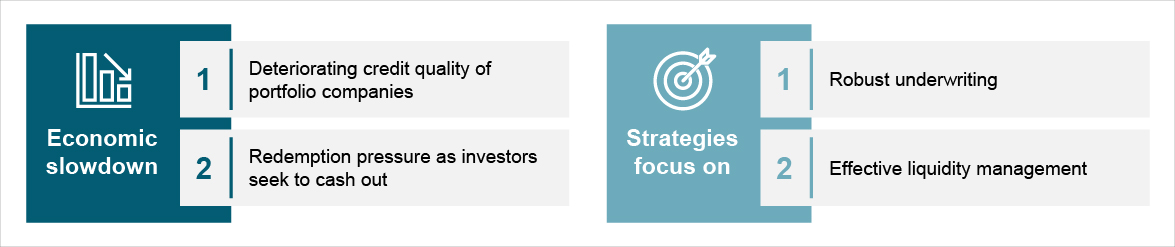
To navigate the challenges, BDCs need to adapt and evolve. Here are two key strategies these companies can employ.
Robust underwriting standards
With M&A volumes still recovering and interest rates remaining relatively higher, the players are currently navigating a slow market by using defensive, capital-preservation strategy. This involves diversifying investment portfolios, maintaining a sharp focus on credit quality, better risk management, and enhancing portfolio performance to ensure they continue to deliver attractive yields to their investors.
Let us look at the strategy in detail.
Portfolio management: Top-rated BDCs have a defensive strategy, thereby investing more than 90% of assets in senior secured loans. The portfolio is diversified across many sectors and companies, and no single company has a share of more than 2-3%.
Position sizing helps curtail losses if a company goes bankrupt. An example is First Brands bankruptcy in 2025. Most of the rated BDCs had minimal exposure to the company and hence their losses were minimal.
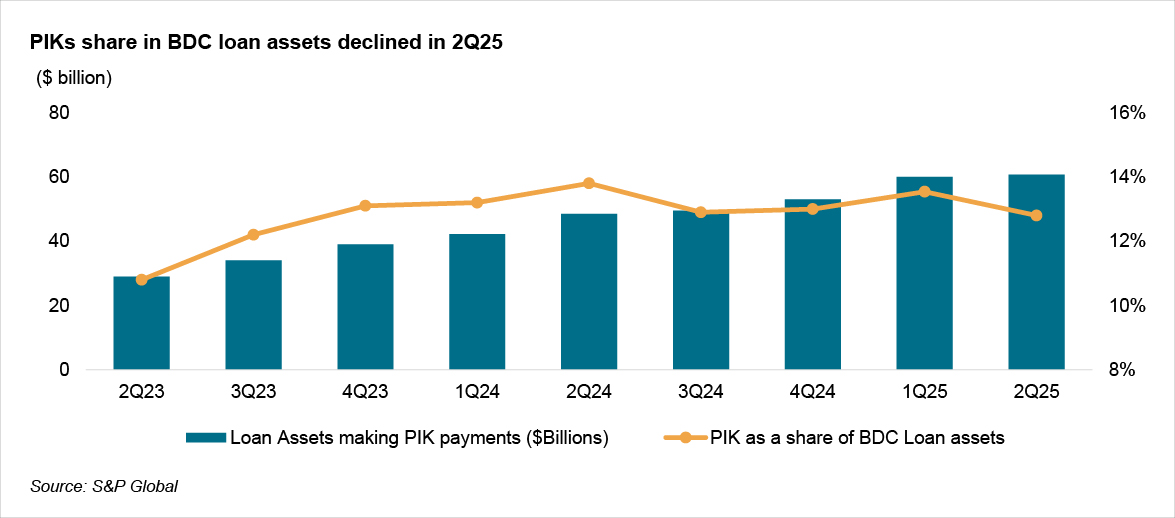
Also, the share of payment-in-kind (PIK) loans in their overall portfolio has seen a decline in recent quarters. Earlier, the rise in the share was a cause of concern for investors despite the mix of structured and amended ones.
In the second quarter of 2025, despite an increase in these loans in value terms to $60.7 billion, up $18.5 billion over 1Q24, their share stood at 12.8%, down from 13.5% in the first quarter.
Defensive structuring: BDCs are prioritizing “incumbency lending” where new capital is being invested in existing portfolio companies for add-on acquisitions or refinancing. This reduces underwriting risk because the players already have historical data on borrowers’ management and cash flow resilience.
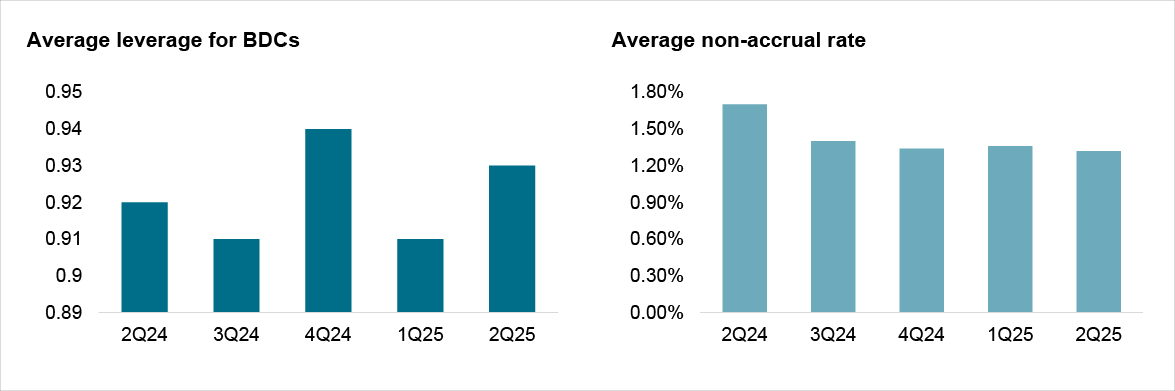
Strengthening the credit quality: Top-tier BDCs have demonstrated their ability to maintain high credit quality, with strong asset coverage ratios, conservative leverage and low non-accruals.
As of the second quarter this year, the average leverage at fund level was up slightly but still below 1.0x providing a cushion of 100% over the regulatory limit. The non-accrual loans have also declined since last year, thereby showcasing improved credit quality.
Rigorous due diligence: Top-tier BDCs such as Ares, Blackstone and Blue Owl have extensive and experienced investment committees (ICs) that are part of their deal team, specialized in different industry verticals.
These committees do rigorous due diligence of a target company, vetting its various operating metrics, before making an investment decision.
BDCs are also closely involved with the portfolio companies, providing them with operational and managerial assistance, thereby helping them improve performance.
Effective liquidity management
The next strategy revolves around liquidity management, typically a major concern during economic downturns.
As BDCs invest primarily in private markets with debt maturity periods of 3-5 years, large-scale withdrawal of investors could trigger a liquidity crisis, potentially causing collapse of funds and posing a systemic risk to the financial sector.
To mitigate this risk, BDCs have the following strategies in place:
The 5% quarterly cap: This is an industry standard for non-traded BDCs under which funds limit the redemptions to 5% of the total shares outstanding per quarter.
If the redemption requests rise above the 5% threshold, BDCs hold back, fulfilling the requests on first-come-first-served basis but using proration. So, if redemption request is 10%, then every investor gets 50% of the request fulfilled. The remaining sell orders are pushed to the next quarter.
Board discretion: The Board of Directors of the players has the ultimate authority to suspend redemptions during market stress to protect investors from a fire sale of assets.
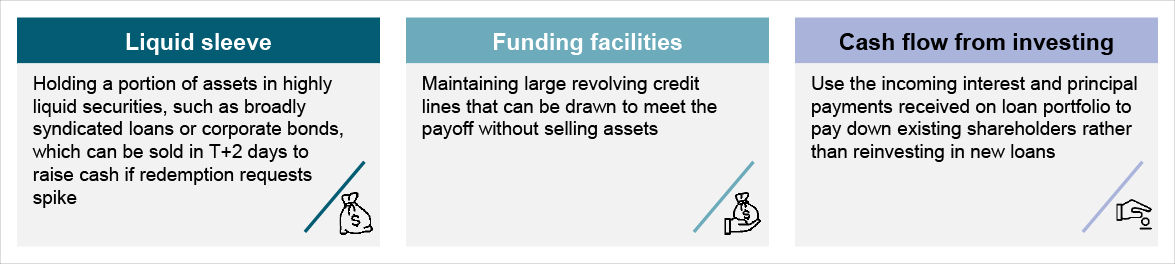
Asset-liability management: In order to bridge the duration mismatch between assets and liabilities, BDCs divide their assets into three buckets:
Conclusion
Despite the significant challenges, the BDC industry is expected to continue growing, supported by demand for private credit and a growing base of retail investors seeking access to private markets and attractive yields.
Rated BDCs, backed by strong asset management teams, are well positioned to navigate the landscape of higher credit risk and economic uncertainty with disciplined underwriting, focus on portfolio quality, and ability to attract capital from a diverse investor base.
As the industry continues to evolve, it is likely that BDCs will play an increasingly important role in supporting small and middle-market businesses, in turn, providing investors a unique opportunity to participate in the growth of these companies.