Explore Crisil, a company of S&P Global
Formerly known as Global Research & Risk Solutions
January 28, 2026
 Blog
Blog
Professionalizing the family office
January 28, 2026
Blog
Blog
Building institutional-grade capabilities the imperative
 Share




Evolution of family offices
In this article, we look at some key trends in the assets under management (AUM) and number of family offices, recent shifts in their investment portfolio, and the effect of these changes on the evolving structure of family offices.

Increase in wealth driving up the number and AUM of family offices
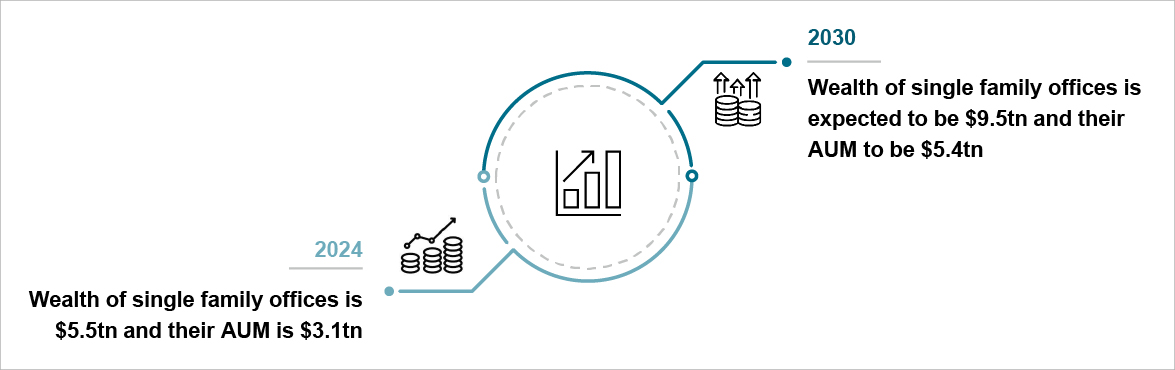
The total AUM of single-family offices is projected to reach $5.4 trillion by 2030, from $3.1 trillion in 2024, according to a Deloitte report1. With the wealth of families served by family offices expected to grow from $5.5 trillion to $9.5 trillion over the same period, the number of single-family offices is expected to increase 33%.
Further, over 75% of the 11K family offices analyzed in a PricewaterhouseCoopers (PwC) report2 have been established in the three decades since 1993, and about half since 2006. Notably, 30% manage assets of at least $1 billion each. The expanding corpus is accelerating the shift towards more professionalized operational structures.
Family offices diversifying across assets classes and geographies
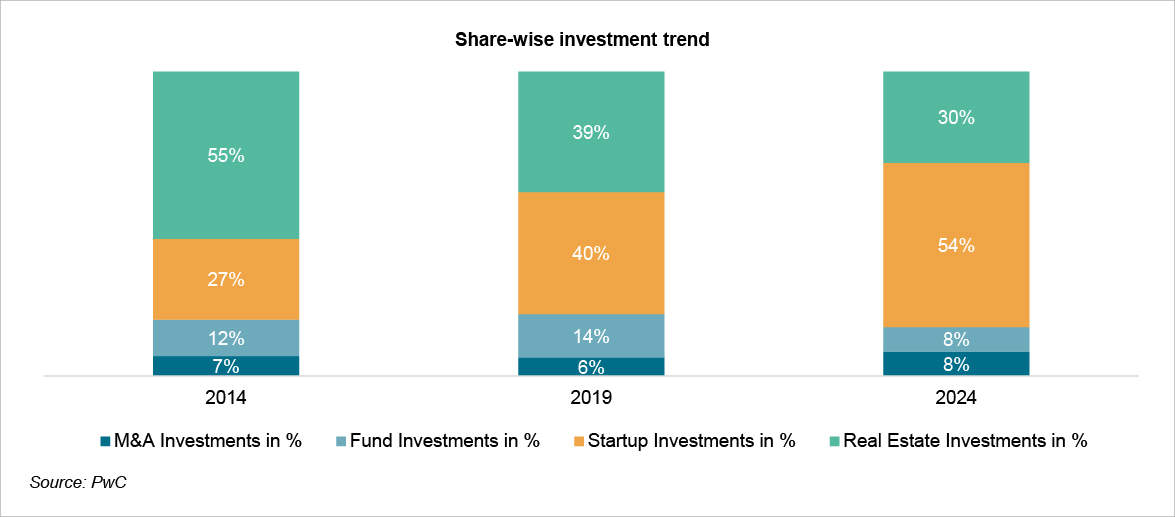
Family office allocations have shifted sharply over the past decade: real estate has declined from 55% in 2014 to 30% in 2024, while startup investments have risen from 27% in 2014 to 54% in 2024.
In recent years, club deals or pooled investments have made up 60% of family office deal activity compared with 40% for sole deals. Impact investments – those aiming for measurable social or environmental outcomes alongside financial returns – rose to 55% of deal volume and 56% of the deal value in 1H24. This growth is driven by next-gen interest in sustainable investments as well as strategic imperatives. Within impact investing, renewable energy, (especially wind and solar) and education have seen strong deal flow.
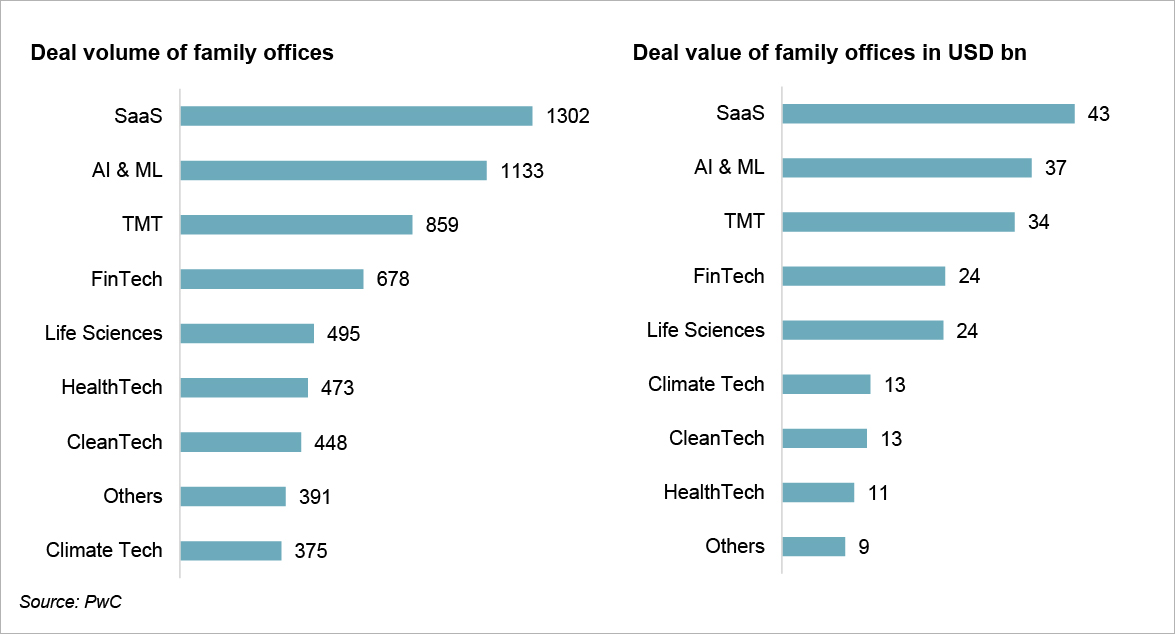
SaaS, AI, machine learning and TMT remain the most common startup themes for family office investments, followed by fintech and life sciences. Region-wise, the US accounted for 50% of all family office startup investments in 2024 by deal volume.
As families broaden their global footprint, family offices are scaling across regions to capture growing investment opportunities and regulatory advantages. Expansion is increasingly centered around key hubs in North America, Europe, and Asia-Pacific (APAC), where families also seek diversification, geopolitical protection, talent access, and support for members relocating abroad.
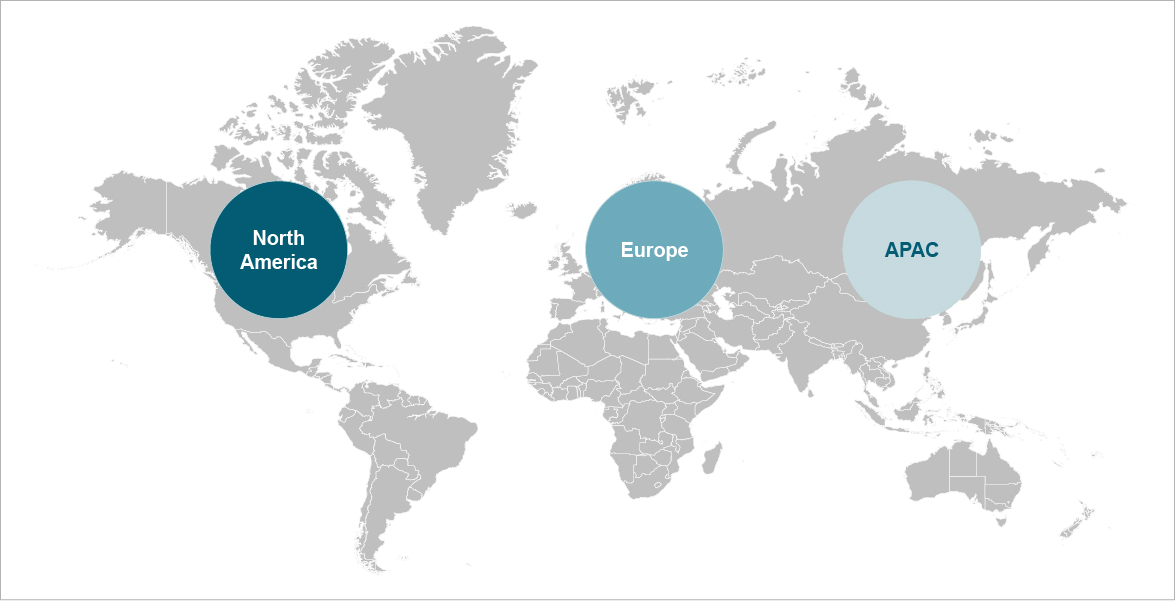
Around 28% of family offices now operate multiple branches, the Deloitte report indicates. While nine out of ten family offices in North America and Europe prefer their own regions for secondary offices, 61% of APAC-based family offices expand into North America (38%) and Europe (23%). Additionally, 12% plan to set up another branch, with expansion split evenly between North America and APAC at 34% each.
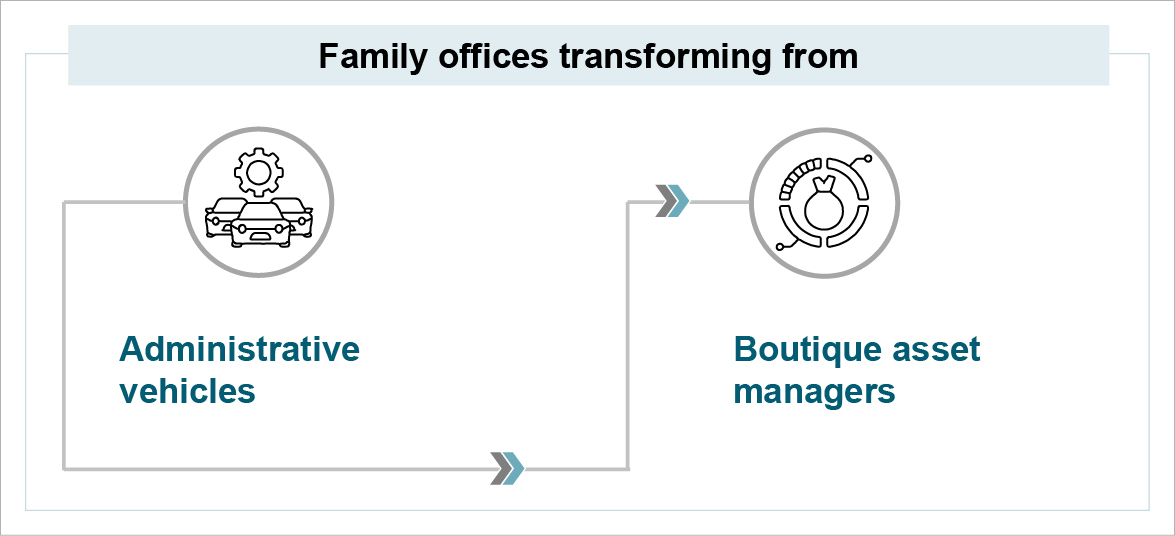
From legacy structures, family offices transforming into boutique asset managers
As family offices accumulate greater wealth and their percentage of contribution in deals increase, they are becoming far more than administrative vehicles for affluent families.
With rising AUMs, expanding global footprints, and increasingly complex portfolios, many family offices now resemble boutique asset managers—requiring institutional discipline, professional investment processes, and specialized expertise.
Limited pools of AUM, cross-asset portfolios, and multi-regional exposure demand a structured approach to research, analysis, and risk. This is pushing family offices to strengthen their operating models, leverage external experts where needed, and manage costs with the same rigor expected of established investment firms.
Building institutional-grade capabilities the new imperative
As portfolios expand across geographies and asset classes, many family offices are shifting towards institutional-style operating models.
To build these models, family offices are engaging specialized third-party providers for areas such as due diligence, investment oversight, compliance, tax and reporting. External expertise helps strengthen control frameworks, reduce operational and regulatory risks, and introduce greater independence and transparency—factors that are becoming particularly important as next-generation family members assume larger roles in decision-making and stewardship. Third-party partners also allow family offices to access niche investment skills and institutional processes that are difficult to replicate in-house.
As family offices accelerate their evolution – professionalizing operations, expanding across sectors/ markets, and embracing more sophisticated investment strategies – the need for institutional-grade processes and expert support is becoming central.
Modern family offices must build scalable research capabilities, adopt robust risk frameworks, strengthen oversight, and leverage advanced technology to operate with the discipline of boutique asset managers. Specialized partners can play a crucial role in helping them achieve efficiency, independence, and long-term sustainability.
How we help family offices
We support family offices with investment research, analytics and portfolio insights that help them evaluate opportunities across public and private markets, assess risks effectively and deploy capital with greater conviction. Our teams work as an extension of the CIO office, providing deep domain expertise across asset classes, sectors and strategies.
We also help family offices build scalable operating frameworks – from investment operations and data management to performance reporting, governance workflows and risk oversight – enabling them to streamline front-, middle- and back-office activities, improve transparency for principals, and enhance engagement with external managers and stakeholders.
Our experience working with sophisticated family offices globally ensures they can operate with the discipline of institutional asset managers while maintaining the flexibility required to meet the unique needs of the families they serve.
Links
Asia–Pacific's family office boom: Opportunity knocks
The Family Office Insights Series - Global Edition
Five trends in family office investments in startups
Family offices 'becoming more professional but face more complex challenges'
Family offices increasingly setting up in new jurisdictions to meet family needs
1 The Family Office Insights Series - Global Edition - 2024 - Deloitte
2 PwC's Global Family Office Deals Study 2024