Explore Crisil, a company of S&P Global
Formerly known as Global Research & Risk Solutions
March 18, 2026
 Blog
Blog
Blog
Blue Owl’s $1.4 billion exit signals a new blueprint
March 18, 2026
Blog
Blog
Spurs business development companies to be active sellers
 Share
Share




Business development companies (BDCs) have been the investor favorite over the past decade, offering double-digit returns amid the exponential expansion of private credit.
However, the era of outsized returns in private credit has of late faced increasing skepticism with regard to the lofty valuations in the backdrop of tightening liquidity conditions and shifting investor sentiment.
No starker has the unravelling been than with Blue Owl Capital, one of the largest players in this space, executing a massive $1.4 billion strip sale of assets this February.
But the key takeaway is not of the large-scale redemption requests, it is of the alternative investment asset manager not just telling investors to wait, instead proving it could turn ‘illiquid’ loans into cash.
What happened to Blue Owl
Blue Owl liquidated $1.4 billion worth of direct lending assets to four major pension funds and insurance companies at 99.7% of the par value In February 2026.
These sales consisted of 97% senior secured debt investments, with an average size of $5 million, which include investments in 128 portfolio companies across 27 industries, with the largest concentration of 13% in the battered software and services sector.
The $1.4 billion loans were held through three credit funds: $600 million in Blue Owl Capital Corp II (OBDC II), $400 million in Blue Owl Technology Income Corp (OTIC), and $400 million in Blue Owl Capital Corp (OBDC).
Blue Owl will use the proceeds to partly pay investors in OBDC II, which it had unsuccessfully tried to merge with the publicly-traded fund last year, and all the three funds will use a portion of the proceeds to pay down existing credit facilities, de-leveraging their balance sheets in a high interest rate environment.
OBDC II shareholders will receive a return of capital of up to $2.35 per share, i.e. ~30% of fund’s net asset value (NAV) by March 2026, effectively replacing the industry practise of quarterly redemption at 5% cap.
The orderly liquidation is a watershed moment for the BDC space for three reasons:
1. It is the ‘valuation receipt’ the industry required
The loudest criticism of private credit has been its valuation opacity. For years, skeptics have argued that BDCs ‘mark their own homework,’ claiming that the NAV reported by the private lenders are inflated because these are not tested in a live market.
By selling $1.4 billion in loans at 99.7% of par, Blue Owl has provided a massive, audited data point to the contrary. It did not just claim these loans were worth 100 cents on the dollar, it found four major institutional buyers willing to pay the valuation. This validates:

2. It sets a new standard for shareholder liquidity
The shift from tender offers to return of capital distribution in the case of OBDC II was a brilliant structural evolution.

3. It allows for portfolio optimization
While the headline focuses on ‘liquidity’, the real story is portfolio optimization. By offloading 128 different company exposures, Blue Owl essentially cleaned the slate.
In a 2026 high interest rate environment, having $1.4 billion of dry powder or reduced leverage is a massive advantage.
Blue Owl is exiting older, low spread deals and positioning itself to swoop in on new, higher yielding opportunities that may arise from the current market volatility.

The perfect storm
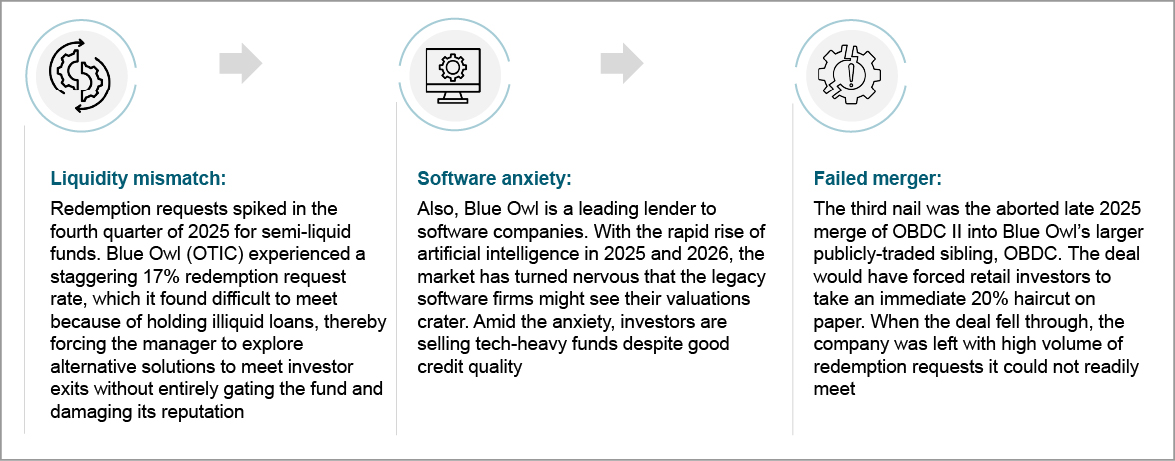
The fire sale in Blue Owl’s case was not just about one fund but was the result of three converging pressures that have made investors nervous about the $1.3 trillion private credit market.
Road ahead
- K-shaped recovery
The BDC boom is not over, but it has changed. The easy money era of 2023-2024, where every BDC went up, is in the rearview. 2026 will be of manager selection.
Giants such as Ares Capital and Blackstone Secured Lending have remained resilient, trading near NAVs. These benefit from deep-pocketed sponsors and ‘first look’ access to high-quality deals.
Small/niche players, though, are struggling with higher non-accruals and are forced to curtail dividend payouts as their borrowing costs stay high while the interest income dips.
- Liquidity panic in non-traded BDCs
The biggest story is not the credit default, it is the redemptions. In late 2025 and early 2026, retail investors began pulling cash out of non-traded BDCs at an unprecedented rate.
Blue Owl became the face of this trend by halting regular withdrawals in February 2026, shifting instead to a ‘liquidation-style’ model, whereby it only paid out what it could sell.
This has caused a 20-30% slump in the stock prices of asset managers such as Blue Owl, as investors worried about the ‘private wealth gold mine’ drying up.
- Robust institutional demand
By selling to sophisticated third parties such as CaLPERS and Kuvare, Blue Owl has provided a macro signal to the entire market that its private loan ‘marks’ were accurate. And the pension funds’ eagerness to buy the $1.4 billion in debt suggests that despite the higher rates, the smart money still views senior secured private debt as a safer haven than volatile equities or low-yield treasuries.
Dawn of a new era
The recent $1.4 billion asset sale by Blue Owl’s BDC was not just a routine rebalancing, it was a calculated strategic flex.
In a market where whispers about the valuation paradox and illiquidity trap of private credit abound, Blue Owl just showed that the exit doors are wide open, and the pricing is excellent.
In doing so, Blue Owl is setting the blueprint for how private market giants will handle the next phase of the cycle by becoming active sellers, not just passive holders.
Hence, in 2026, BDCs with robust backing will be uniquely positioned to leverage significant dry powder for new deal flows and meet institutional appetite, all the while successfully balancing the liquidity requirements of their retail base.