Explore Crisil, a company of S&P Global
Formerly known as Global Research & Risk Solutions
May 13, 2026
 Blog
Blog
Dual guardrails: PE support and redemption gates in BDCs
May 13, 2026
Blog
Blog
Synthesizing strategy and duration mechanism to preserve value
 Share




As the private credit market matures, business development companies (BDCs) have emerged as a vital bridge between institutional capital and middle-market companies managing over $500 billion assets. However, as retail participation in non-traded BDCs grows, so does the scrutiny regarding liquidity—especially the use of redemption gates. While publicly traded BDCs offer daily exits, in periods of distress they often trade at deeper discounts to net asset value (NAV), reflecting immediate liquidity. On the other hand, perpetual non-traded BDCs offer a more stable exit at NAV, but typically have a limit on quarterly redemptions at 5% of NAV.
As BDCs use gates where redemptions exceed the 5% threshold in Q1 2026, meeting only a fraction of exit requests, it may appear to signal a liquidity crunch. But for seasoned investors, this development demonstrates the ‘illiquidity premium’ functioning as intended. A closer look at the BDC structure reveals that redemption gates are not indicative of distress, but rather a sophisticated mechanism to safeguard value for all stakeholders.
Asset-liability mismatch and the alignment mechanism
Current scenario: Spike in redemption request
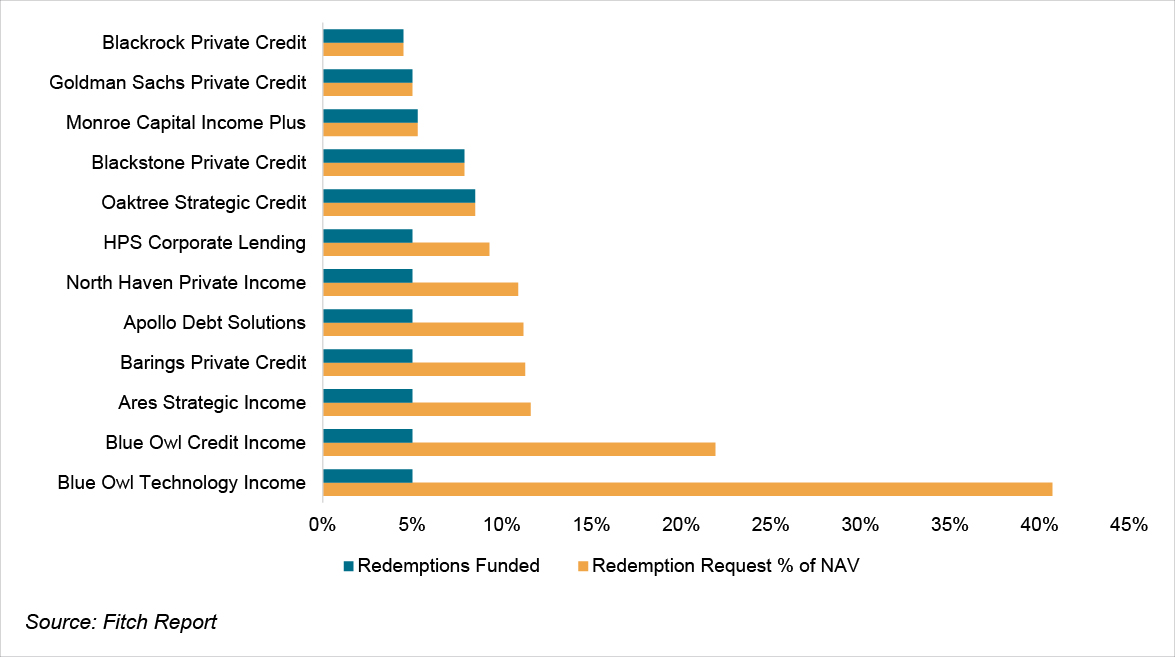
According to a Fitch report1, perpetual non-traded BDCs have seen outsized redemptions and slower funding in early 2026. Average redemptions peaked at 5.3% in 1Q26, up from 5.1% in 4Q25. Most BDCs, such as Blue Owl Credit Income Fund, Barings Private Credit, Oaktree Strategic Credit, and Apollo Debt Solutions, capped redemptions at 5% in 1Q26. However, Oaktree Strategic Credit Fund funded 6.8% of redemptions of NAV, with an affiliate of the company's investment advisor, Brookfield, purchasing an additional 1.7% from an investor. Meanwhile, Blackstone Private Credit Fund met the 7.9% redemptions by raising the cap and receiving a capital infusion from its private equity sponsor, Blackstone.
Redemptions requests averaged 12.3% in 1Q26, 2.4x of the amount funded
Strategic alignment: The sponsor advantage
When a BDC limits redemptions, it is often a sign of prudent financial management aimed at protecting the integrity of the yield-generating portfolio, rather than catering to short-term exit requests.
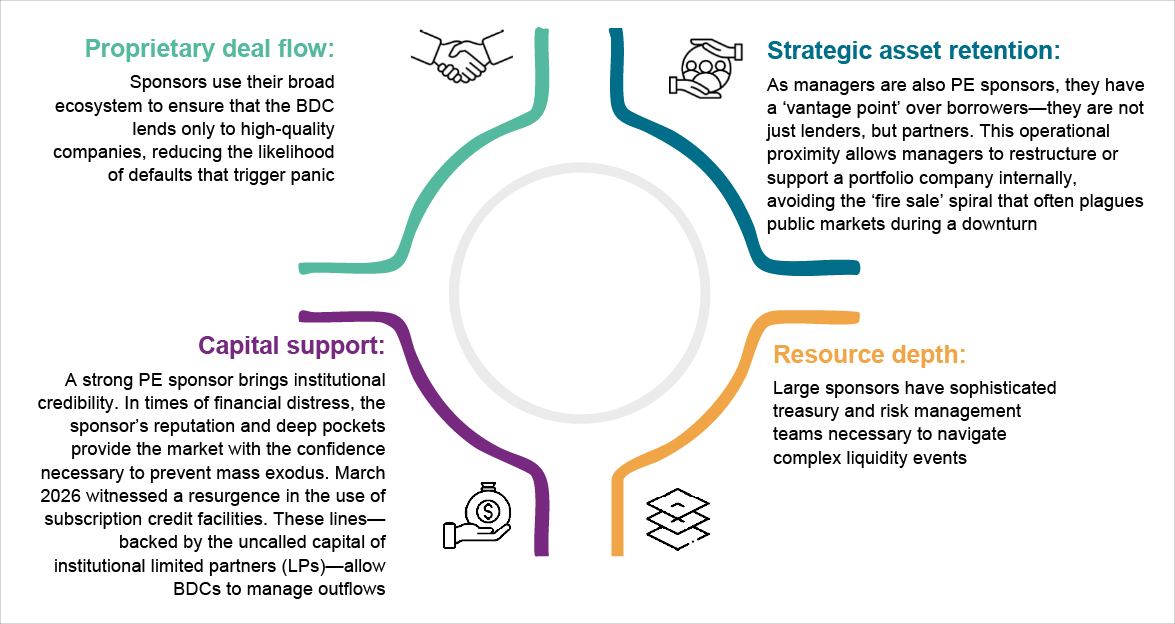
The presence of a sophisticated sponsor means that the BDC is backed by professional infrastructure capable of weathering shifts in business cycles.
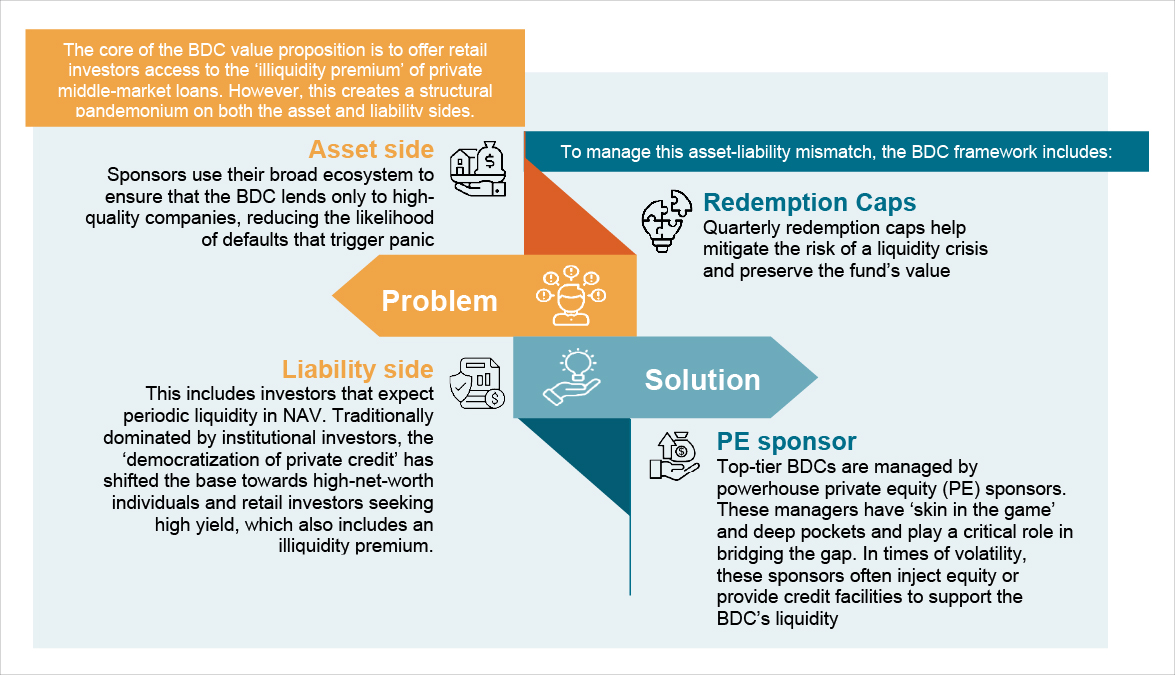
Unlike a bank, which is often a standalone entity vulnerable to deposit flight, many BDCs are effectively the ‘credit arm’ of large PE ecosystems. This correlation provides three critical layers of support that are currently stabilising the market.
Duration Alignment: Redemption gates are crucial ‘circuit breakers’
Asset-liability mismatch is the primary challenge that a BDC faces, as it invests in illiquid, long-term private loans that cannot be sold overnight without a significant ‘fire-sale’ discount.
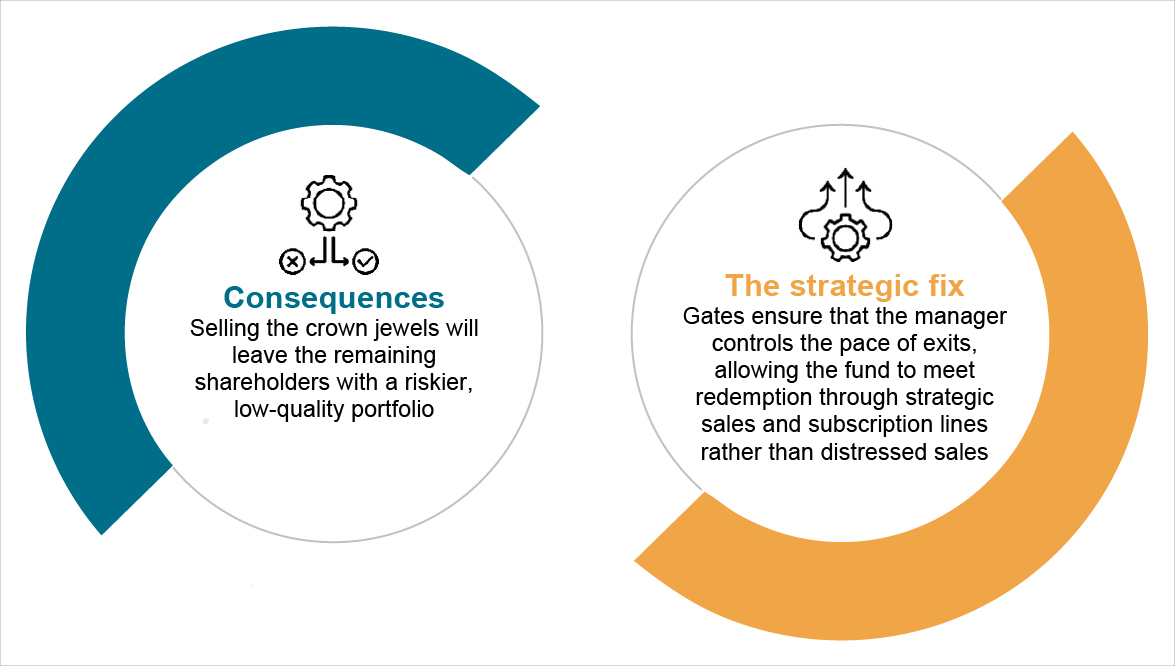
If a BDC allows unlimited, immediate redemptions, it would be forced to sell its best-performing assets at a loss to raise cash, harming the interests of investors that choose to stay invested.
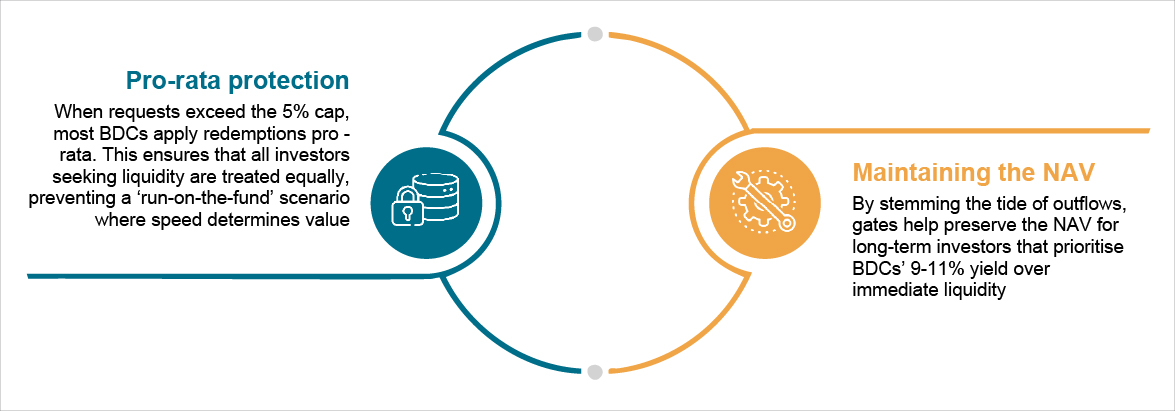
Redemption gates typically cap repurchases at 5% of a fund’s NAV per quarter, preventing a ‘run-on-the-fund’ scenario and ensuring that the NAV remains reflective of the underlying performance of the loan rather than market hype.
For example, Apollo Debt Solutions (ADS) received redemption requests of 11.2% in its Q1 2026 tender offer, well above the typical 5% quarterly limit. As a result, the firm opted to cap redemptions at 5%, honoring investor requests on a pro-rated basis. Similarly, Ares announced it would limit redemptions from its Ares Strategic Income Fund (ASIF) to 5% for the quarter after requests surged to 11.6% of the fund’s net assets.
Guarding against ‘fire-sale’ spiral
The primary function of a redemption gate (repurchase cap at 5% of NAV) is to prevent forced asset liquidations.
In a period of market stress, such as the 2026 volatility driven by artificial intelligence (AI)-related software disruption, investors often react with a herd mentality. And without gates, a BDC might be forced to sell its most liquid, highest quality loans at a discount to meet a surge in withdrawal requests.
Ensuring shareholder equity and fairness
Redemption gates act as a fairness mechanism. In an ungated environment, the first to exit during a panic get 100 cents on the dollar, while those who stay behind are left holding a devalued bag.
Protecting the yield engine
BDCs are designed to act as income generators, and not high-frequency trading vehicles. To generate the premiums inherent in private credit, managers must keep the capital ‘at work’.

Engineered for stability
The 2026 redemption wave is a stress test, but it is one that BDCs are engineered to pass.
By leveraging the financial engineering and deep pockets of their PE parents, these vehicles are proving that ‘private’ does not mean ‘risky’—it means protected.
In a world of instant volatility, BDCs’ ability to stand their ground is their greatest strength.
When the market enters a period of ‘unpleasantness’, BDCs need not liquidate. Notably, by enforcing redemption caps, managers protect long-term investors from the ‘run-on-the-fund’ mentality.
Redemption gates might trigger investor panic and impact a fund’s reputation in the short term, but they provide structural stability and allow BDCs to maintain their status as ‘stable income’ vehicles, even when public markets are volatile.
By decoupling from the hair-trigger volatility of public equity markets and the rigid constraints of traditional banking, BDCs provide a stable source of capital for the economy.
Time and again, the BDC model has proved that holding firm is often safer than folding. It is not just about lending money, but about the structural permanence of the capital behind it.