Explore Crisil, a company of S&P Global
Formerly known as Global Research & Risk Solutions
July 30, 2026
 Blog
Blog
Blog
Basel IV and the Rise of Private Credit
July 30, 2026
Blog
Blog
Asset managers see new opportunities as the credit landscape resets with Basel IV
 Share
Share




Endgame beginning to reshape lending
The Basel IV (a.k.a. Basel 3.1 or Basel III Endgame) framework announced by the Basel Committee on Banking Supervision is not just another regulatory update, it is reshaping the global credit ecosystem.
As banks face tighter capital constraints and reduced balance-sheet flexibility, a structural shift is taking shape: a growing share of credit risk is migrating to private credit, accelerating the evolution of the lending ecosystem.
What began as a niche asset class has evolved into a ~$2 trillion market, transforming corporate lending.
The Basel IV reforms are poised to reinforce this trajectory, not by design, but as an unintended consequence of stricter capital rules.
This blog explores the key changes introduced by Basel IV and how they are accelerating the evolution of private credit, reshaping the relationship between banks and asset managers, and redefining the way credit is originated, funded and distributed.
Background
The Basel IV framework was developed in 2017 and was initially set to take effect on January 1, 2022. Its implementation was pushed back to the late 2020s due to various reasons, including pandemic-related disruptions.
Current implementation timeline
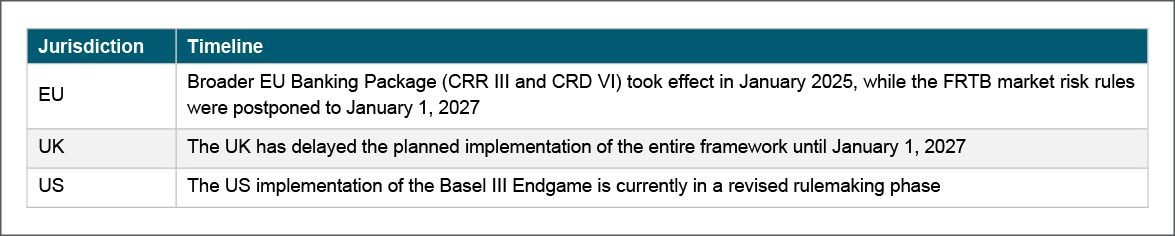
CRR III: Capital Requirements Regulation III; CRD VI: Capital Requirements Directive VI; FRTB: The Fundamental Review of the Trading Book
Source: European Commission, Prudential Regulation Authority, US Federal Reserve
What is changing and why it matters
The Basel IV framework introduces several reforms designed to improve consistency, transparency and resilience in bank capital calculations.
Key changes
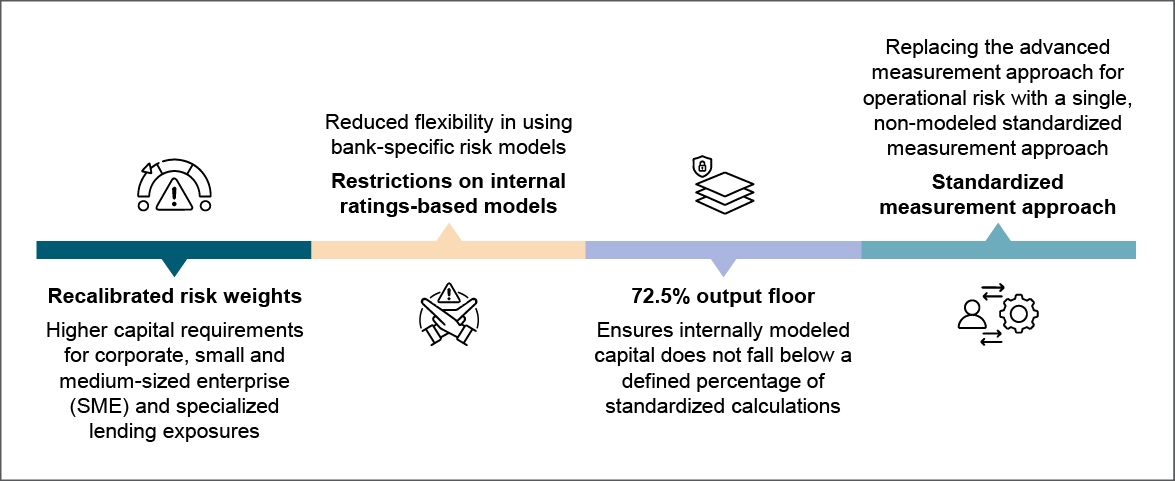
While these measures aim to strengthen the banking system, their economic implications are significant. In practice, they increase the cost of holding riskier or less standardized loans on banks’ balance sheets. The upshot is lending to segments such as unrated corporates, leveraged borrowers and certain real estate sectors will become materially less capital-efficient.
The rise of private credit, from alternative to mainstream
Private credit’s rise predates Basel IV. The asset class has benefited from investors’ search for yield, demand for flexible financing solutions and the retrenchment of banks from certain lending segments following the global financial crisis.
Basel IV is reinforcing these trends. By increasing the capital intensity of selected exposures, the framework creates additional incentives for banks to optimize balance sheets and partner with third-party capital providers. As a result, private credit is positioned not only to capture loan demand that banks may choose not to retain, but also to participate directly in bank-originated lending opportunities.
From regulation to opportunity: How private credit is benefiting from banks’ strategic shift
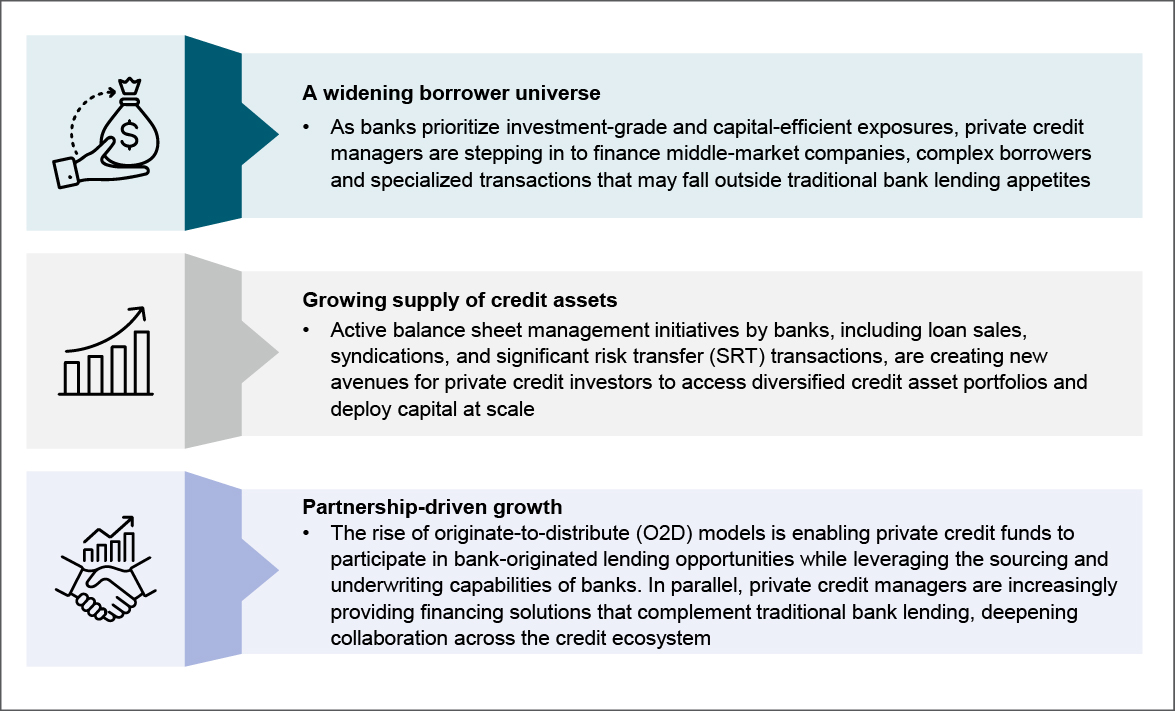
As banks change their lending and capital management strategies to adapt to the new norms, the universe of assets and financing opportunities available to asset managers is expanding.
Opportunity themes
Collaboration over competition
With the emergence of these opportunities, private credit managers are increasingly partnering with banks rather than competing directly with them. Structures such as SRT transactions and O2D models provide asset managers greater access to diversified credit exposure, while supporting banks’ capital optimization objectives.
While some partnerships involve the transfer of credit risk, others involve the transfer of funding or loan ownership.
- SRT transactions: The SRT market is one of the fastest-growing segments of private credit, offering institutional investors access to diversified bank loan portfolios through structured credit risk transfer transactions. According to the International Association of Credit Portfolio Managers (IACPM), global SRT issuance reached a record €30 billion of protected tranches in 2025, backed by €378 billion of underlying loans, compared with €11 billion and €140 billion, respectively, in 2021. Outstanding SRT-protected loan portfolios increased to €905 billion by 2025, demonstrating the growing demand for this asset class
Institutional investor participation in the SRT market has expanded significantly in recent years, with asset managers emerging as one of the most important sources of capital. According to the IACPM, asset managers accounted for 32% of global SRT issuance in 2025, up from just 10% in 2021. Moreover, multi-strategy asset managers and dedicated SRT funds together represented more than 70% of the investor base in 2025, underscoring the growing role of non-bank capital in supporting bank lending and the continued maturation of the SRT market as an institutional investment strategy.
SRT issuance by 'direct' investor* type over time (%)
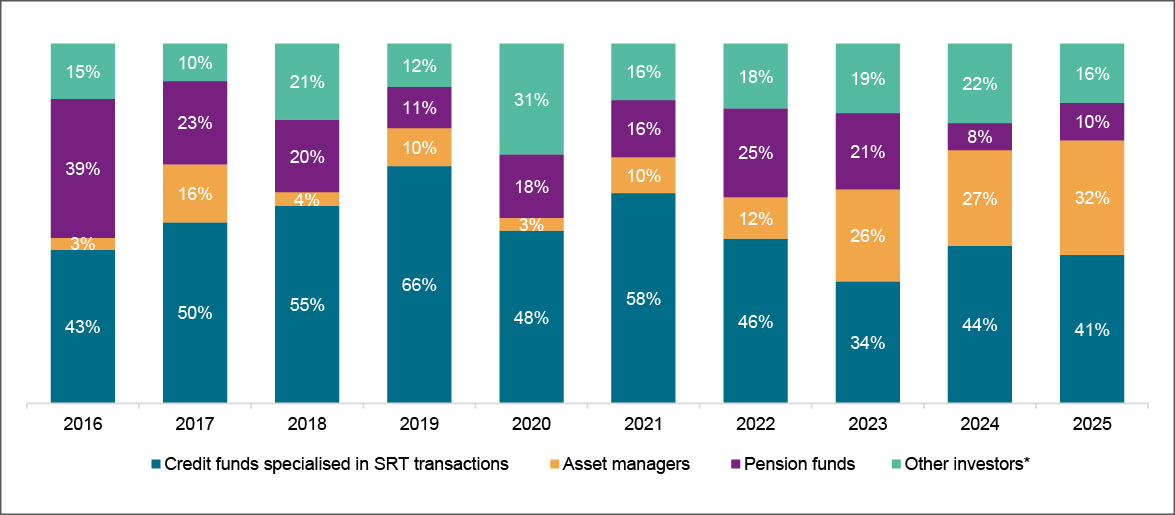
(*) ‘Direct’ investors might not reflect the ultimate risk owner.
Other investors here include: 0% risk-weighted MDBs and International Organisations, Credit Risk Insurers, Insurance Companies, Central Governments or Central Banks, and Other
Source: IACPM Global SRT Bank Survey 2016-2025 (iacpm.org)
While corporate and SME lending portfolios dominate issuance volumes, the market has broadened to include specialized lending, commercial real estate (CRE), trade finance, infrastructure and renewable energy assets, creating a wider opportunity set for investors seeking targeted credit exposures.
Europe remains the most active SRT market, accounting for approximately €241 billion of underlying portfolio issuance in 2025. This reflects both regulatory differences and greater capital optimization pressures, whereas North American banks face less urgency following the Basel III Endgame re-proposal.
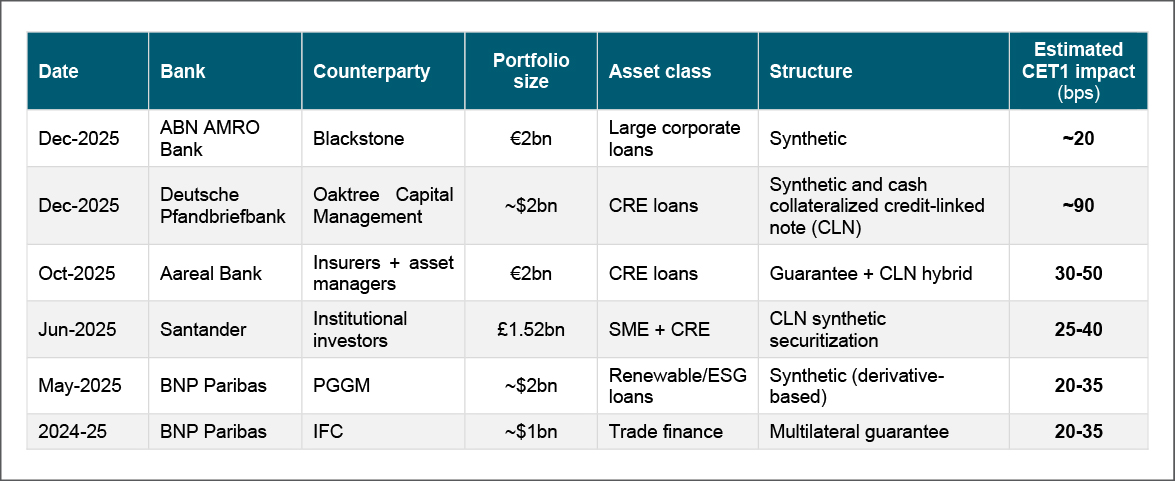
The major recurring participants in the European SRT market include Santander, BNP Paribas, UniCredit, Deutsche Bank, Barclays, ING, Crédit Agricole and several Nordic banks. Most transactions are negotiated privately, resulting in limited public disclosure.
Publicly disclosed SRT deals in 2025
Source: Company News and Bloomberg
The outlook for the SRT market is highly positive from an investor perspective. The continued growth of private credit is expanding the pool of capital capable of supporting future issuance. At the same time, regulatory developments in the EU, UK and other jurisdictions appear increasingly supportive of risk-sharing structures, which could further broaden market participation and transaction volumes.
- O2D models: Asset managers are also partnering with banks through O2D models, in which banks originate and structure loans while institutional investors provide the funding and hold part of or all the credit exposure
For asset managers, these arrangements offer access to proprietary, bank-originated credit opportunities that may otherwise be difficult to source directly, while benefiting from the underwriting expertise, origination networks and longstanding borrower relationships of banks. The model enables investors to deploy capital at scale across diversified portfolios without the need to build extensive origination or servicing infrastructure, while gaining exposure to attractive risk-adjusted returns.
For many market participants, O2D represents the clearest example of how the future lending ecosystem may evolve.
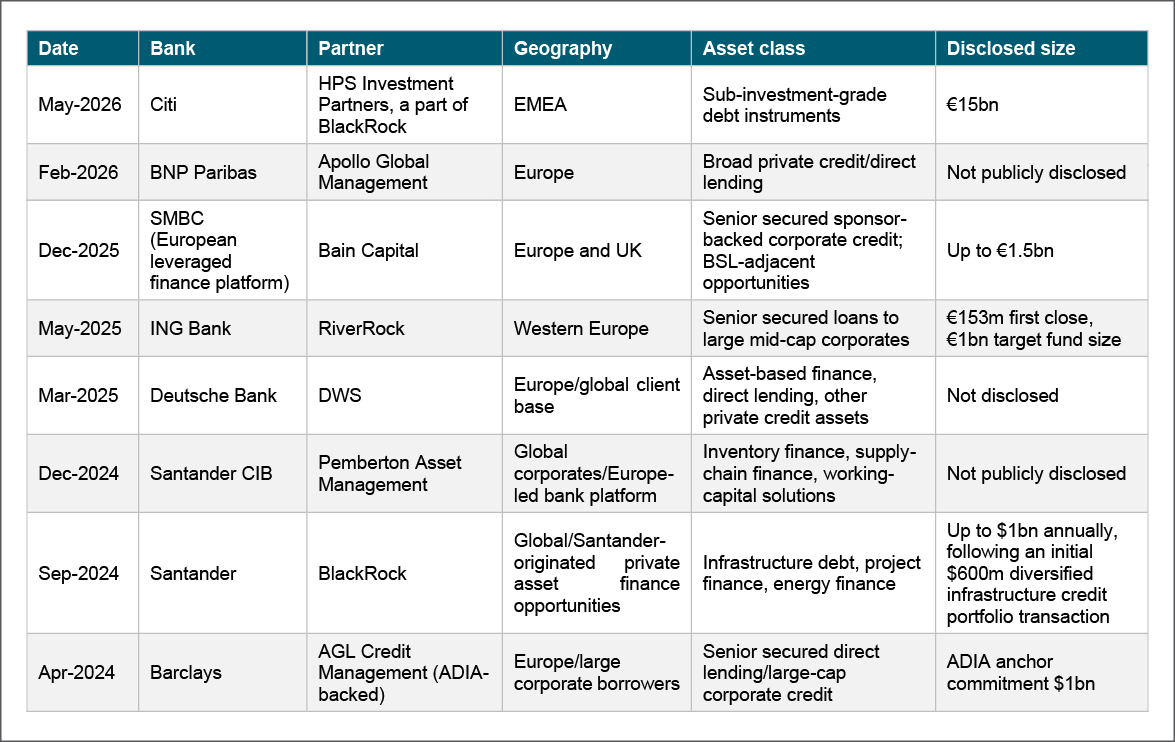
Estimates suggest that more than a dozen major banks established or expanded private credit partnerships in 2025 and 2026, significantly higher than in previous years. High-profile partnerships such as Citi-HPS and SMBC-Bain highlight the growing move toward programmatic, long-term collaboration between banks and private capital providers rather than one-off transactions.
Known O2D deals
Source: Company News and Bloomberg
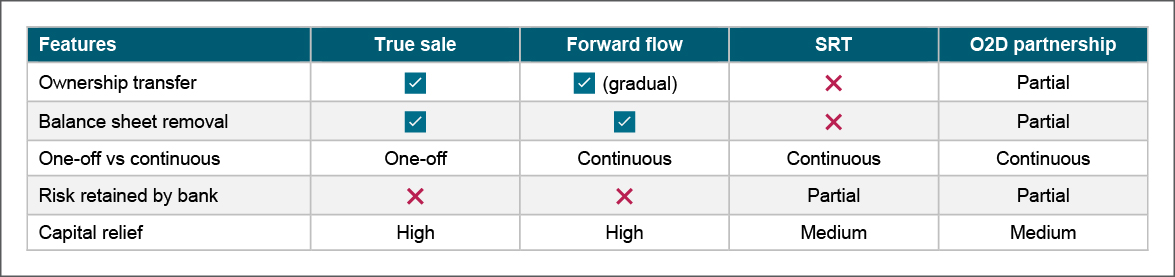
- Other forms of collaboration: Asset managers also access bank-originated credit assets through mechanisms such as true-sale transactions and forward-flow arrangements, which provide them direct ownership of loan portfolios
True-sale transactions offer immediate portfolio scale and full economic exposure to the underlying assets. While historically associated with distressed asset sales, the mechanism has increasingly expanded to include performing loans as banks seek to optimize balance sheets and recycle capital more efficiently. For example, in July 2025, SMBC sold a portfolio of performing loans of more than $1.5 billion in the Asia-Pacific region to Apollo Global Management. Such transactions highlight the growing range of opportunities available to private credit investors seeking access to proprietary bank-originated assets.
Strategic arrangements/capital relief strategies and their key features
Source: Crisil Integral IQ
These partnerships mark a fundamental evolution: Banks are transitioning from lenders to originators and arrangers, while private credit funds become the ultimate holders of risk. As a result, collaboration between banks and private credit funds is creating a more interconnected and scalable credit ecosystem.
But it’s not all positive: New risks and constraints are emerging
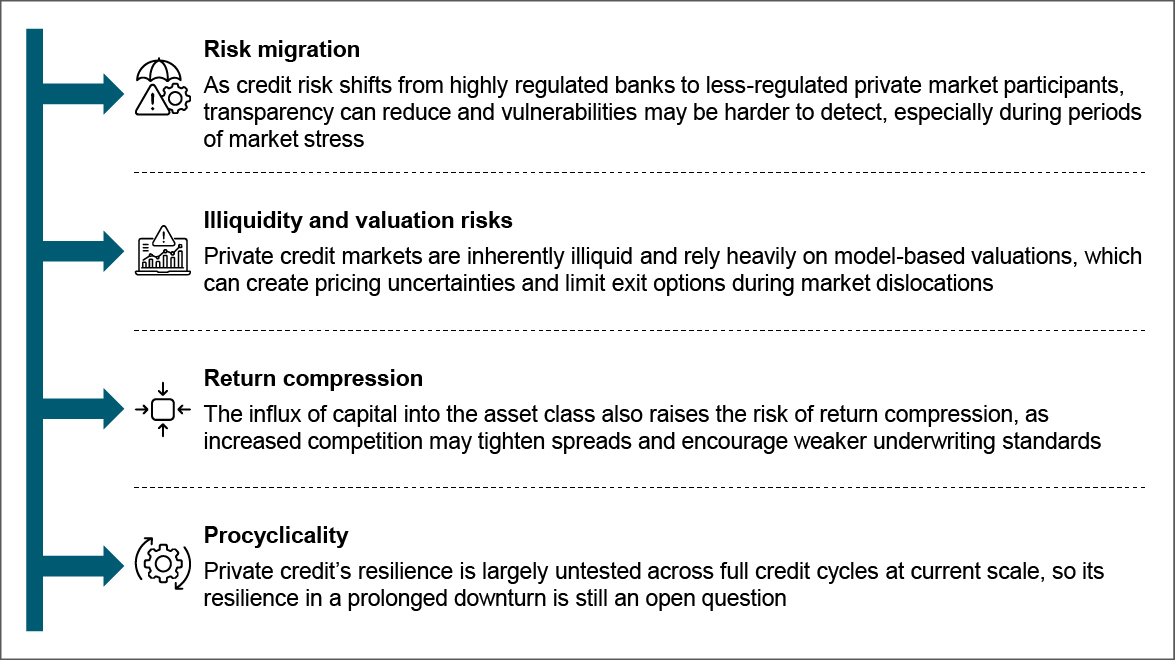
The opportunity set for private credit is expanding, but growth is not without risks. As private capital assumes a larger role in funding the real economy, investors face new challenges, including increased competition, spread compression, potential deterioration in underwriting standards and growing regulatory scrutiny of bank-private credit partnerships. The resilience of these models will ultimately be tested across a full credit cycle.
Emerging risks and constraints include:
Summing up
The most important development in private credit today is not the growth of the asset class itself, but its increasing integration with the banking system. Basel IV may be a banking reform, but its most enduring legacy could be the emergence of a new credit architecture, one in which banks and private capital are increasingly intertwined in financing the real economy.
This convergence is creating a more diversified and flexible credit market, but it is also redistributing credit risk to a broader set of investors.
For asset managers, the opportunity is clear: access to proprietary assets, stronger deal flow and a larger role in financing the real economy. The challenge is equally clear: maintaining underwriting discipline and investor returns as capital flows into the sector accelerate.
Ultimately, the winners will not be those with the largest pools of capital, but those with the strongest ability to originate, evaluate, price and manage risk through the cycle. In that sense, the future of private credit will be determined as much by investment discipline as by market growth.