Explore Crisil, a company of S&P Global
Formerly known as Global Research & Risk Solutions
August 07, 2026
 Blog
Blog
Reprieve, not get-out-of-jail-free card
August 07, 2026
Blog
Blog
EBA No-Action Letter (NAL)
Banks must not ease up on transforming compliance into competitive advantage
 Share



Dodging the regulatory bullet
- Supervisory forbearance: On August 3, 2026, the European Banking Authority (EBA) issued a no-action letter (NAL) instructing national authorities not to enforce the Fundamental Review of the Trading Book (FRTB) trading book/banking book boundary rules, or the related reporting requirements, until December 31, 2029
- Resolving a policy paradox: The NAL addresses an operational challenge created by the European Commission's Third FRTB Delegated Act (3rd FRTB DA). By allowing banks to calculate capital requirements using the Capital Requirements Regulation 2 (CRR2) boundary rules, the EBA prevents cross-border institutions from incurring costly dual-boundary infrastructure expenses while protecting the European Union (EU) single market from internal competitive distortions
- The takeaway: All EU banks, including both multiplier and non-multiplier institutions, may continue using the legacy CRR2 boundary framework to calculate capital requirements and manage book transfers until December 31, 2029, or until the European Commission enacts a formal legislative amendment, expected in the first quarter of calendar year 2027
The macro policy context
On June 4, 2026, the European Commission adopted the 3rd FRTB DA under Article 461a of the Capital Requirements Regulation (CRR). The act delays full implementation of the revised market risk capital standards until January 1, 2027, and establishes a transitional regime through December 31, 2029, to preserve an international level playing field.
International-coordination failures and capital asymmetry: The Basel Committee's FRTB framework was designed for global implementation. However, delays and modifications in several jurisdictions, particularly the United States (US), where Basel III Endgame proposals are still being calibrated, have created a coordination challenge. Had the EU implemented the unadjusted FRTB framework in 2025-2026 without corresponding action by the US, EU-domiciled entities and European subsidiaries of US banks would have faced a structural capital disadvantage [2, p. 5].
To address this misalignment, European policymakers have prioritised maintaining a level playing field over strict adherence to regulatory timelines [2, p. 5]. The 3rd FRTB DA therefore introduced targeted operational relief measures and scaling multipliers aimed at achieving temporary capital neutrality for institutions adversely affected by the transition from CRR2 to FRTB [1, pp. 1, 3; 2, p. 2].
Why the NAL was issued
The EBA's NAL (EBA/Op/2026/08) was necessitated by an operational inconsistency embedded within the 3rd FRTB DA [2, pp. 1-2]. In practice, banks risked having to operate two boundary architectures simultaneously, requiring parallel trade allocations, duplicate reclassifications and separate internal risk transfer (IRT) structures.
The boundary framework determines whether an instrument is assigned to the trading book, which attracts market risk capital, or the banking book, which attracts credit risk capital [2, p. 2]. FRTB introduced highly prescriptive rules governing instrument eligibility, desk-level allocations, book reclassifications and IRTs [2, pp. 2, 5].
The boundary problem
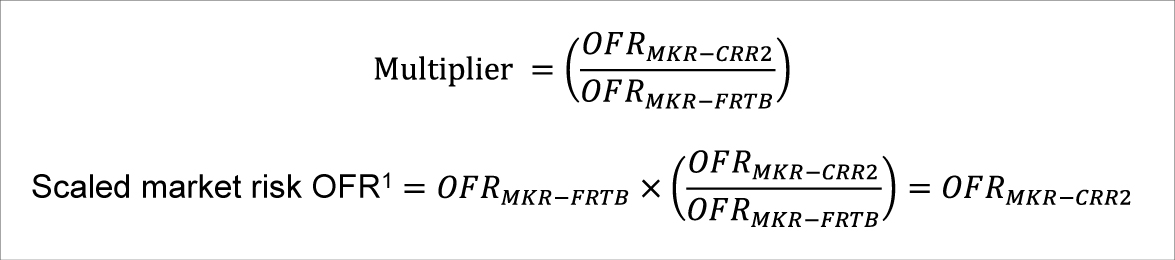
When migration from the CRR2 framework to FRTB results in a significant increase in a bank's market risk own funds requirements (OFR), the 3rd FRTB DA provides a mitigating mechanism in the form of an overall multiplier.
As of the reference date of March 31, 2027, banks must calculate market risk capital under both the new FRTB framework (OFRMKR-FRTB) and under the old CRR2 framework (OFRMKR-CRR2). Where OFRMKR-FRTB > OFRMKR-CRR2, the institution is deemed adversely impacted. In such cases, it may apply a scaling multiplier that reduces the FRTB capital charge towards the CRR2 level, thereby achieving temporary capital neutrality. The multiplier is neither mandatory nor automatic. Banks must opt in by notifying their national supervisor, such as the European Central Bank, before May 12, 2027.
Before capital requirements can be calculated, assets must be classified into either the trading book or the banking book. FRTB introduced a substantially stricter and more prescriptive framework governing classification, reclassification and hedging through IRTs.
This created both operational and regulatory challenges:
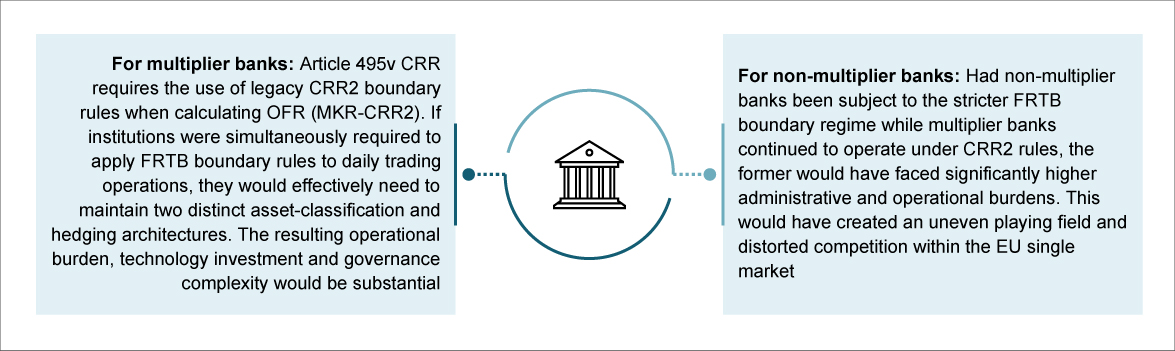
Article 495v CRR requires multiplier banks to calibrate their scaling factors using the CRR2 boundary framework as it existed before July 2024. However, the 3rd FRTB DA would have required those same banks to apply the new FRTB boundary framework when calculating the multiplier [2, p. 2].
Requiring institutions to support both approaches simultaneously would have forced market-risk IT systems, trade-capture platforms and hedging desks to maintain dual book allocations, duplicate reclassification records and fragmented IRT structures [2, p. 5].
A second structural concern arose for non-multiplier banks [2, p. 3]. Subjecting them to full FRTB boundary requirements while multiplier banks continued operating under legacy CRR2 rules would have imposed unequal operational burdens and created competitive distortions within the EU single market [2, pp. 3, 5].
EBA’s forbearance solution
To address these inconsistencies, the EBA issued the NAL, advising supervisors not to prioritise enforcement of the following requirements across all institutions:
- FRTB boundary provisions: Articles 104, 104a, 106(2)-(7), 204a and 325j(5) of the CRR [2, p. 6].
- Boundary supervisory reporting: Reporting obligations relating to trading book composition and reclassifications under Implementing Regulation (EU) 2024/3117 [2, pp. 3, 6].
This supervisory forbearance will remain in effect until December 31, 2029, or until the European Commission implements a formal legislative amendment, currently expected in the first quarter of 2027 [2, p. 6]. During this period, institutions may continue managing market risk boundaries under the legacy CRR2 framework [1, p. 2; 2, pp. 3, 6].
The power-up you need
We help global financial institutions navigate complex regulatory transitions such as FRTB by turning compliance obligations into balance-sheet optimisation opportunities. Our expertise enables banks to assess transitional decisions, including Article 495v multiplier opt-ins, build dual-calculation environments and realign desk-level capital allocation to protect return on equity.
By combining quantitative risk analytics with robust model governance frameworks, including assessments of alternative internal model approaches and the advanced standardised approach, we help institutions remain competitive, minimise operational friction and engage confidently with regulators worldwide.
A temporary relief, not a permanent solution
The EBA's August 2026 NAL provides valuable operational relief for cross-border market-risk management [2, p. 6]. By postponing enforcement of the complex FRTB trading book boundary framework, regulators have avoided what could have become a costly dual-system implementation challenge [2, p. 5]. Nevertheless, the NAL merely suspends enforcement priorities; it does not remove the underlying legal obligations contained in Articles 104, 104a, 106(2)-(7), 204a and 325j(5).
More importantly, this pragmatic pause transfers much of the strategic burden to market-risk functions. Institutions must still manage dual-calculation environments, navigate evolving disclosure requirements and position their model approvals and capital frameworks to preserve efficiency when the transitional regime expires on December 31, 2029 [1, pp. 1-2, 4-5; 2, p. 2].
The regulatory risk has not disappeared. It has simply been deferred. Banks that use this window to strengthen their capital and operating models will be best positioned when the transition period ends.
Document references and citations
- European Banking Authority (EBA), “EBA consideration on the application of the FRTB from 1 January 2027” (Technical Considerations Document), August 3, 2026.
- European Banking Authority (EBA), “Opinion of the European Banking Authority on the application of the provisions relating to the boundary between trading book and banking book and on the internal risk transfer between books” (No-Action Letter, EBA/Op/2026/08), August 3, 2026.
1 OFR: The total minimum regulatory capital baseline an institution must hold against unexpected losses stemming from market positions
Related articles