Explore Crisil, a company of S&P Global
Formerly known as Global Research & Risk Solutions
September 16, 2026
 Blog
Blog
Blog
Courting excellence in investment research
September 16, 2026
Blog
Blog
Why AMs are seeking strategic partnerships
 Share
Share




Overview
This paper explores the challenges shaping research functions across the asset management industry and examines how leading firms are evolving their operating models through strategic partnership approaches. It also examines how Centre of Excellence (CoE) models are being used to combine specialized research expertise, technology-enabled capabilities and scalable operating structures to support decision-making pertaining to investments across asset classes.
For asset managers with less than $5 billion in AUM, scaling research capabilities efficiently remains a key priority. Expanding investment universes, evolving client expectations and the need for greater specialization are prompting many firms to reassess how research activities are structured, delivered and supported.
Shifting dynamics in investment research space
Investment research teams are operating in an increasingly complex environment, shaped by evolving market dynamics, expanding coverage requirements and growing expectations for differentiated research. As the traditional company, issuer and thematic coverage becomes increasingly commoditized, firms are under pressure to generate deeper insights, leverage data, automation and artificial intelligence (AI)-enabled workflows to improve efficiency and decision-making. Simultaneously, research functions are being asked to broaden coverage across areas such as private credit, sustainability-related risks and other emerging themes, often without a corresponding increase in resources. Against this backdrop, asset managers are facing several common challenges across their research and portfolio-support functions, including:
- Widening coverage requirements – more issuers, sectors and benchmark indices – without the proportional increase in team headcount
- Broad issuer coverage creates capacity pressure, especially when analysts need to balance routine monitoring with deeper work on watchlist names, new issuance and higher-risk credits
- Research workflows often vary by analyst, leading to inconsistent review practices, documentation standards and visibility into investment views
- Lack of defined ownership and communication routines can result in duplication of efforts, delayed follow-ups and inconsistent research outputs
- Integrating AI into existing research systems without creating fragmented tools, inconsistent outputs, or additional review burden for analysts
- Continued fee and margin compression, which puts research and middle-office cost structures under scrutiny
These challenges are driving firms to rethink how research activities are delivered, governed and scaled. Investment teams are increasingly seeking operating models that provide additional analytical capacity, improve process consistency and leverage technology effectively, while maintaining the quality and rigor required to support investment decision-making.
While research teams are under pressure to broaden coverage and improve efficiency, many asset managers are also reassessing the broader operating models that support these functions. Our companion paper, Unlocking Operational Alpha for Asset Managers, explores how outsourcing, automation and digital transformation can help create scalable, resilient, and cost-efficient operating structures, enabling investment teams to focus on higher-value research and decision-making.
How leading asset managers are evolving their operating models
In response to these challenges, many firms are moving beyond the traditional fully in-house structures and adopting more flexible operating models that combine internal expertise with external capabilities, technology and specialized support functions.
One approach picking up traction is the CoE model. Under this structure, research activities are organized around centralized pools of expertise, standardized processes and shared technology platforms. This enables firms to support a broader range of research activities, while promoting consistency in execution, oversight and knowledge sharing across teams.
A CoE approach provides a structured framework for organizing and scaling research activities, while maintaining appropriate levels of governance and quality control. By centralizing certain capabilities and standardizing key processes, firms can improve coordination across research, portfolio management and support functions. As research requirements evolve, CoE models are being used to support broader coverage needs, facilitate knowledge sharing and integrate technology more effectively into research workflows.
Key elements of our CoE
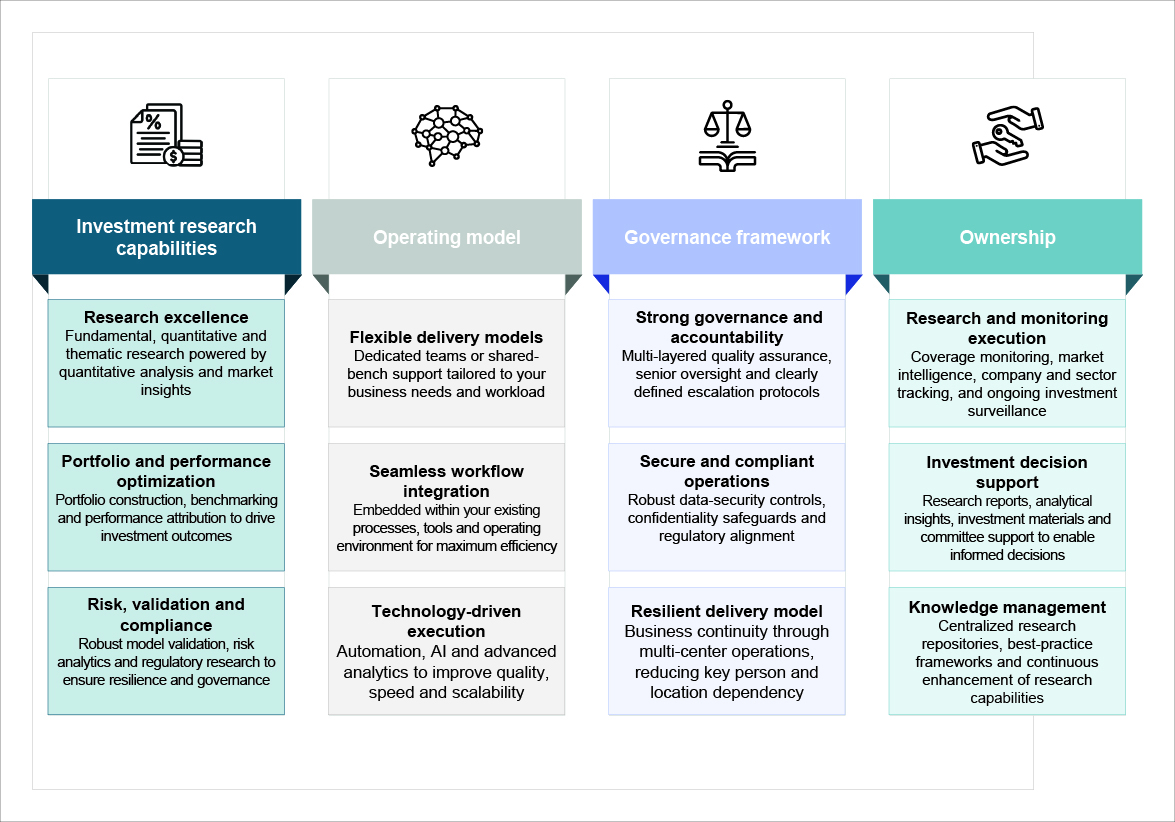
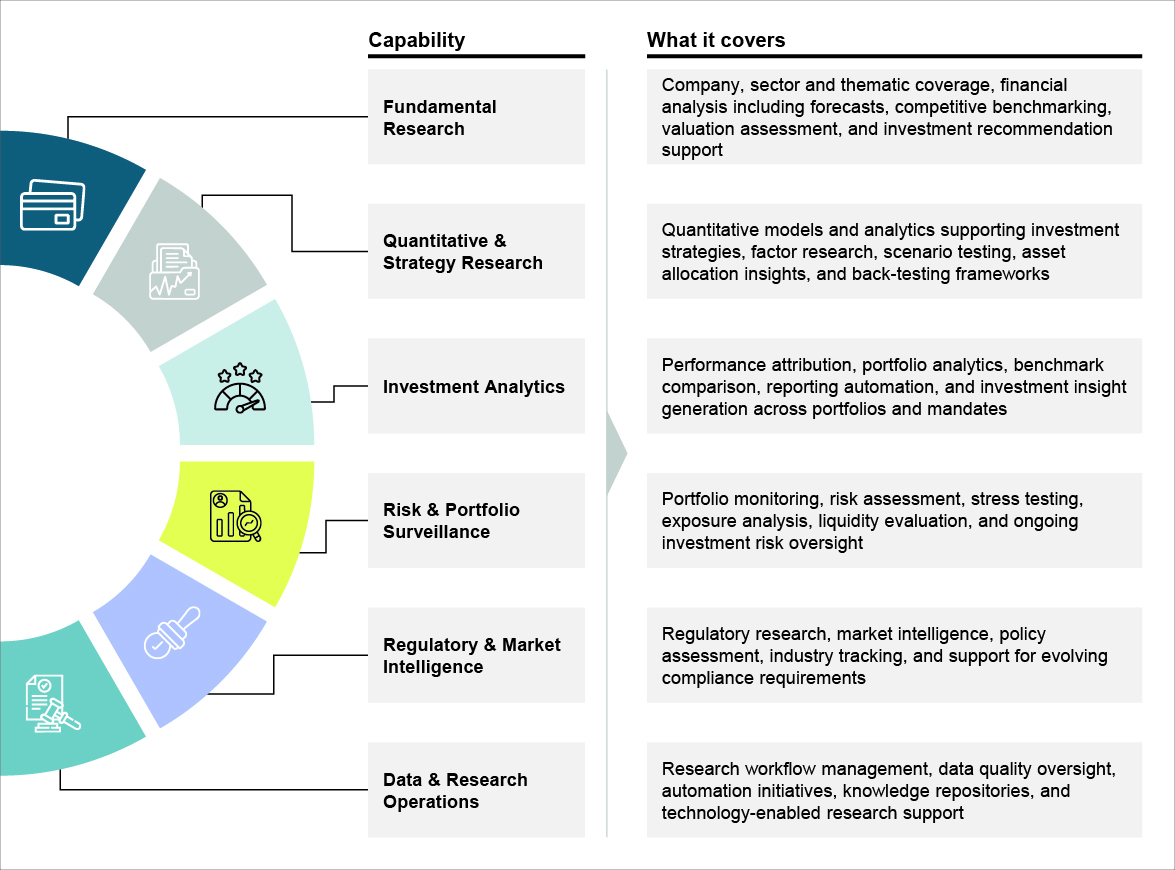
Investment research capabilities:
Our research capabilities support the end-to-end investment life cycle, combining domain expertise, rigorous analytics, along with technology-enabled delivery across research, portfolio management, quantitative analytics and risk oversight. Key capability areas include:
Operating model:
Investment research operating models vary significantly across firms, reflecting differences in asset classes, investment styles, coverage mandates and research requirements. As a result, we tailor our operating model to align with each client’s existing workflow, providing the flexibility, governance and scalability needed to support their team, rather than imposing a one-size-fits-all approach:
- Dedicated pod model – a named team aligned with the client’s investment research function or a shared-bench model for lower and variable volumes
- Integration into existing tools and workflows rather than requiring the client to adapt to ours
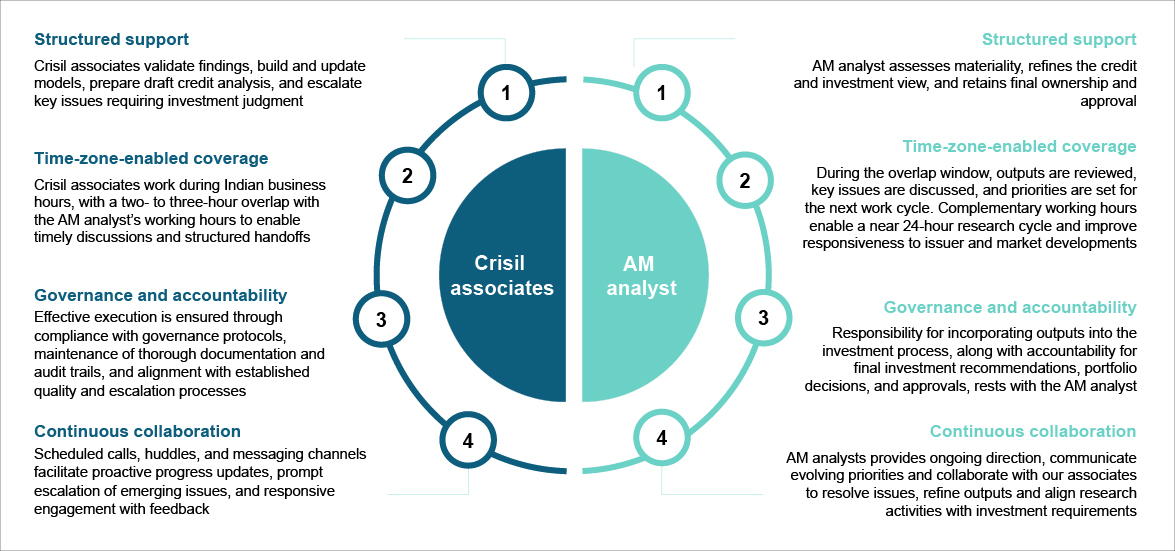
- Strategic time-zone alignment (the US, the UK and Asia-Pacific) enables real-time collaboration, accelerated turnaround times and continuous progress across research workflows
- Defined service-level agreements and multi-layer quality review built into every deliverable
- Technology-enabled delivery, using automation (including Python and Power BI) and AI/data science tooling to reduce manual and repetitive work, rather than by simply adding to the headcount
Every engagement begins with a detailed assessment of the AM's coverage universe, research workflows, operating model and support requirements. Based on this assessment, we design a tailored support model with clear ownership, delivery priorities, governance protocols and quality review mechanisms. Implementation typically follows a phased approach, with agreed success metrics, review checkpoints and communication cadences to ensure alignment and measurable outcomes. Engagements can range from focused pilots supporting specific sectors or workflows to broader embedded models spanning multiple coverage teams.
Governance framework:
Strong governance, clear accountability and robust data security are fundamental to effective investment research partnerships. Our governance framework is designed to provide transparency, consistency and confidence that research activities are executed and reviewed to the highest standards. Key elements of our partnership model include:
- Multi-layer quality assurance and senior review before deliverables are shared with the AM team
- Confidentiality, access control and data security protocols aligned with institutional AM requirements
- Defined review and escalation protocols for sensitive issues, exceptions, or quality concerns
- Business continuity through a multi-center delivery model, reducing single location and key person dependency
- Ongoing alignment with the regulatory environment in which the investment research function operates
Ownership:
While the overall responsibilities within the research life cycle are generally well understood, ownership at key handoff and review points can sometimes lack clarity. Establishing precise responsibilities at these stages enhances efficiency, minimizes duplication of effort and promotes consistency throughout the research and investment process.
Typically, ownership is split along execution and judgment lines. Data-intensive and process-driven activities such as model updates, data aggregation, trend tracking, earnings review, valuation models, peer benchmarking and preparation of draft outputs generally sit with our associates. On the other hand, AM analysts typically own the analytical interpretation and decision-making components of the process, including challenging conclusions, refining the investment thesis, assessing risks and portfolio implications and making final decisions on recommendations, positioning, and approvals. This allocation of responsibilities helps create a more efficient operating model by aligning execution work with associate-level support, while ensuring that investment judgment and accountability remain with the AM analyst.
Integrated research partnership
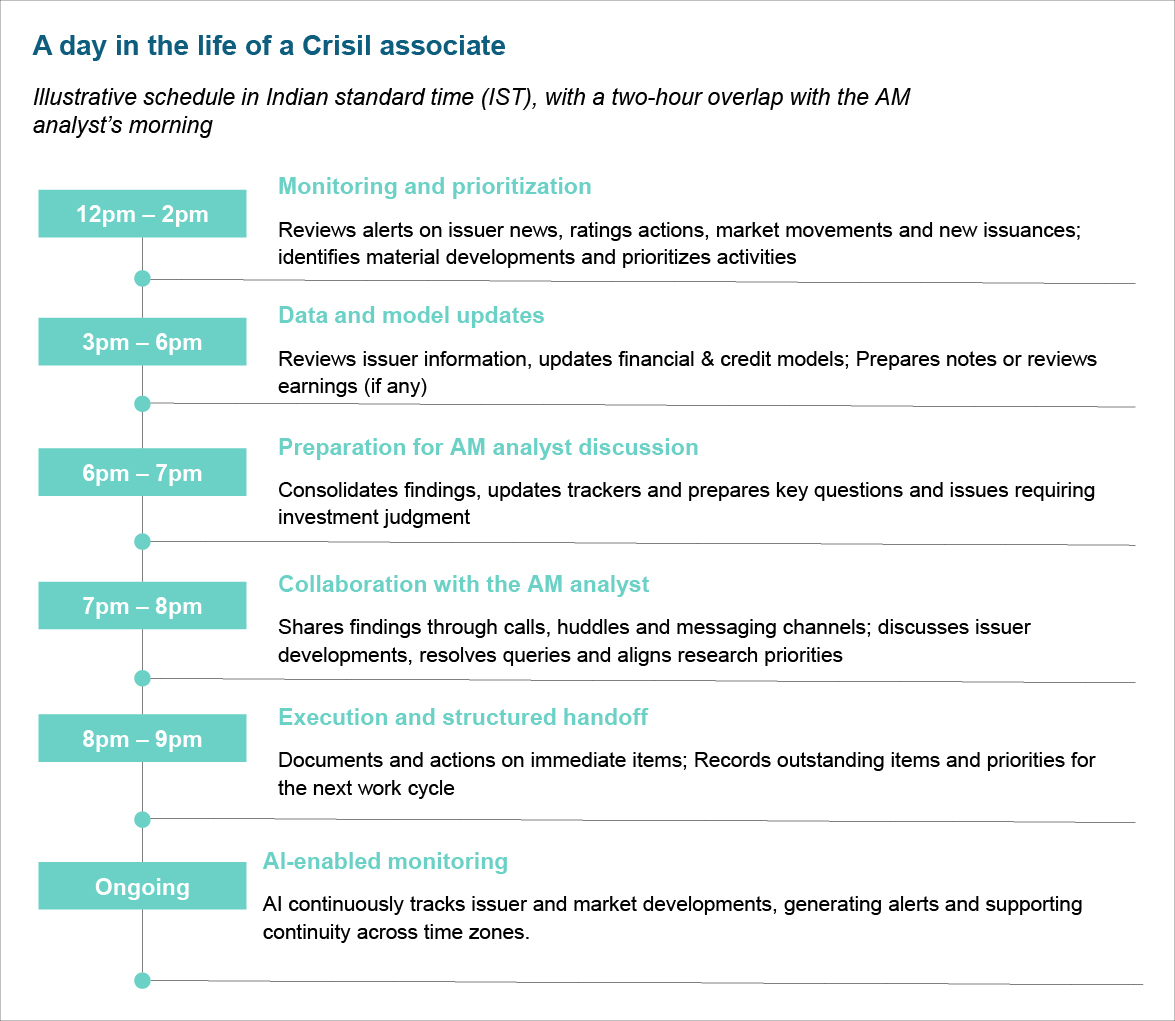
Asset managers typically ask who does what. Presented below are select workflows, with clear ownership defined for our associates and AM analysts, along with AI embedded to accelerate preparation work.
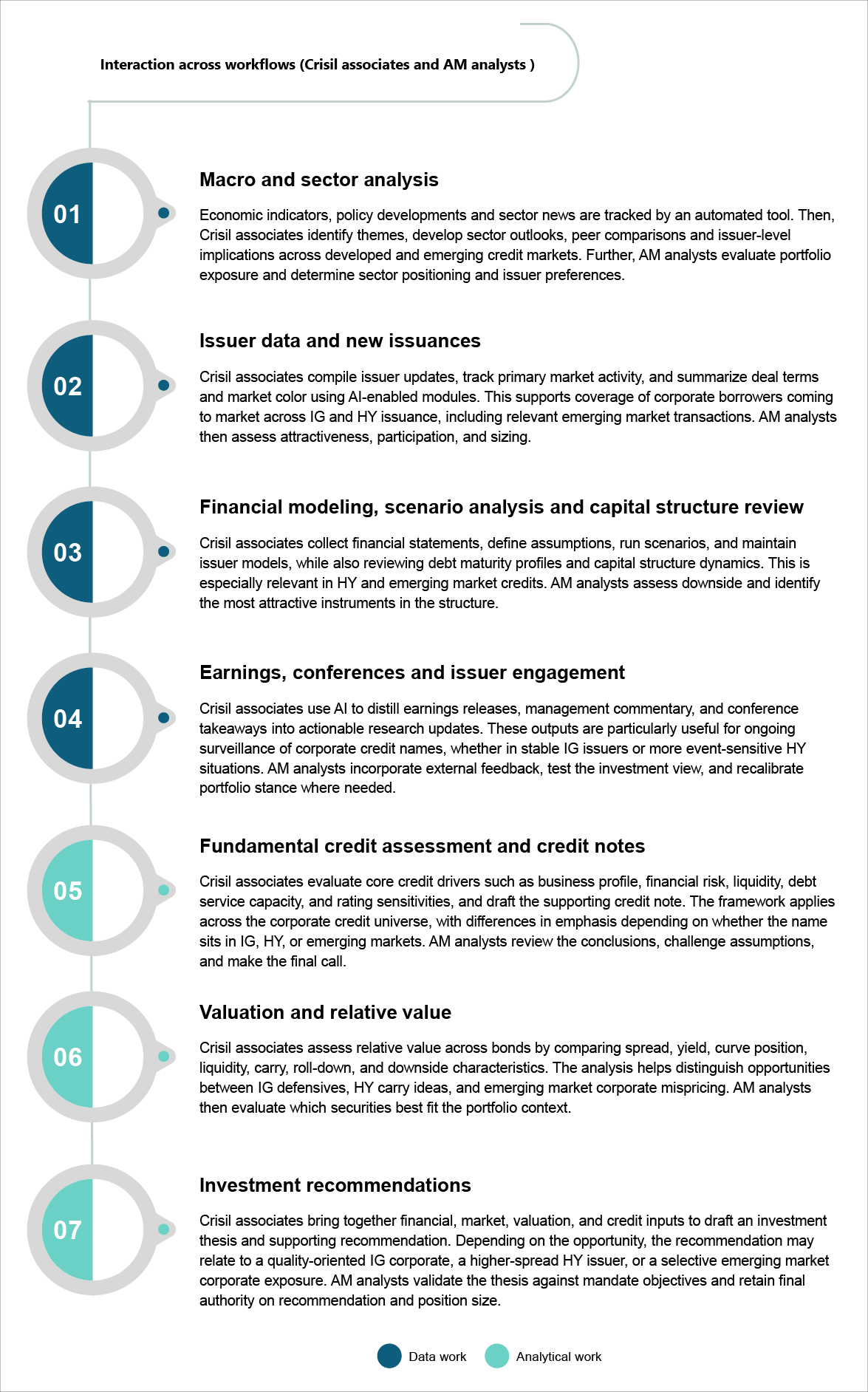
To execute these responsibilities effectively, our CoE and related engagements are staffed with experienced investment research professionals aligned to the AM’s coverage needs (IG, HY, corporate, financial institutions, etc) and investment objectives. Teams include CFAs, CAs, MBAs, and other relevant specialists across sectors and asset classes, supported by senior oversight to ensure quality, consistency and timely delivery. AMs benefit from deep domain expertise, rigorous analysis, and meaningful working-hour overlap that enables real-time collaboration and responsive support.
Structured collaboration between our associates and AM analysts
Unlocking value through AI
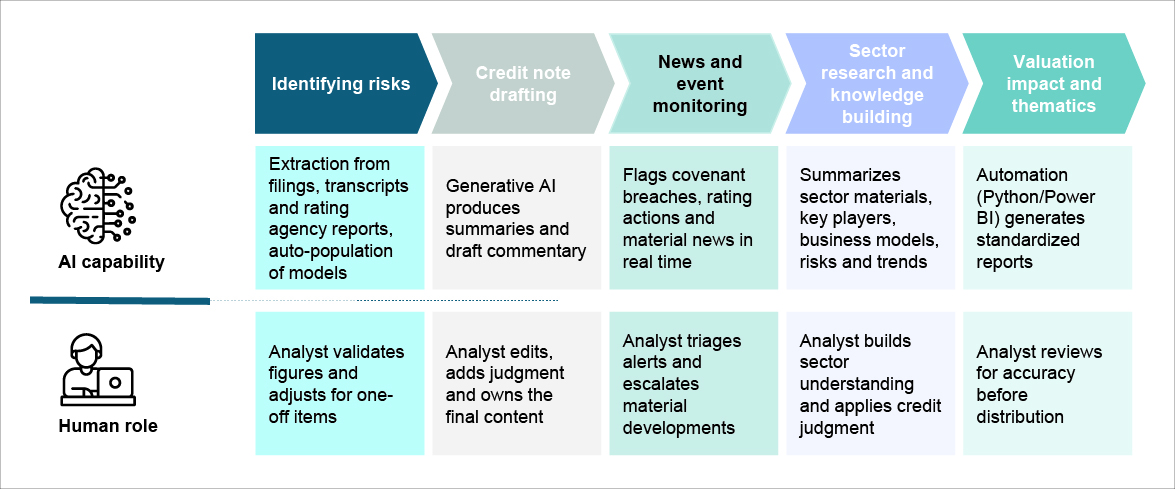
Our associates leverage AI across the investment life cycle to enhance efficiency, improve analytical accuracy, accelerate turnaround times and strengthen investment decision-making. The following examples highlight use cases where AI-enabled accelerators can augment existing processes and enhance research outcomes:
How our CoE helps
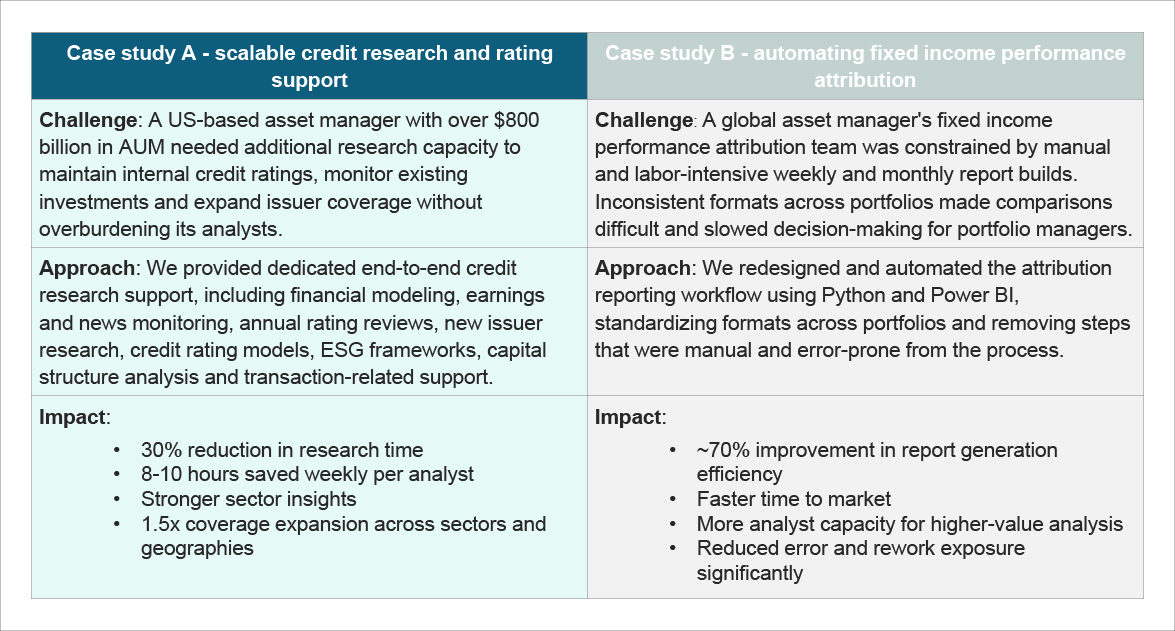
The following case studies highlight how our CoE has partnered with global asset managers to address evolving challenges, from expanding coverage to improving workflow efficiency and strengthening day-to-day execution.
The edge we provide
- Our CoE provides a flexible and scalable alternative to building and maintaining equivalent capabilities in-house, with a cost structure that adapts to evolving business needs
- AMs gain access to specialized expertise across investment research, quantitative analytics, portfolio research, and data-driven workflows
- Our trained specialists enable rapid ramp-up and scalable coverage, eliminating the delays associated with hiring, onboarding, and training
- Meaningful overlap with AM working hours enables real-time collaboration, faster issue resolution, and improved responsiveness to market developments
- Technology and automation capabilities, including Python, Power BI, and AI-enabled tools, are embedded within the engagement from day one, resulting in efficiency gains
- A multi-center delivery model provides resilience, business continuity, and reduced dependence on individual resources or locations
As investment teams navigate an evolving landscape, flexibility and adaptability are becoming critical to research operating models. The most successful firms are likely to be those that can effectively combine domain expertise, disciplined processes and technology-enabled workflows while preserving the quality and governance required to support investment decisions. Our CoE approach is designed to support this evolution by providing a scalable framework that aligns research expertise, technology and governance with the changing needs of asset managers.