Explore Crisil, a company of S&P Global
Formerly known as Global Research & Risk Solutions
September 16, 2026
 Blog
Blog
From maturity wall to the refinancing gap in commercial real estate
September 16, 2026
Blog
Blog
A forward-looking measure for assessing risk
 Share




Commercial Real Estate (CRE) refinancing remains a key focus area for banks, even as the maturity wall shows signs of easing. However, a CRE loan’s current performance may not fully reflect its ability to be successfully refinanced at maturity.
According to an article published by Multi-Housing News on March 24, 2026, approximately $875 billion of commercial and multifamily mortgage balances is scheduled to mature in calendar year 2026, representing 17% of the $5 trillion in outstanding commercial mortgages held by lenders and investors. While this amount is about 9% lower than the $957 billion scheduled to mature in 2025, it still represents a significant refinancing requirement.
Over time, market attention has shifted from the size of the maturity wall alone to the refinanceability of individual loans. Recent trends suggest that maturity-related stress remains a major concern. In July 2026, non-performing matured balloon loans accounted for roughly two-thirds of newly delinquent Commercial Mortgage-Backed Securities (CMBS) balances. This underscores the importance of evaluating a borrower’s refinancing prospects rather than relying solely on current loan performance.
The challenge extends beyond the volume of debt coming due. A CRE loan may remain current, comply with its covenants, and continue to demonstrate adequate debt-service coverage, yet still face a significant refinancing shortfall at maturity. This is particularly relevant for loans originated or repriced during periods of lower borrowing costs, as well as for interest-only or minimally amortizing structures in which a substantial portion of the principal remains outstanding.
For banks, the key credit question is shifting from how much CRE debt is maturing to how much of that debt can be refinanced on sustainable terms.
Note: CMBS data is illustrative and not directly representative of bank-held CRE portfolios
Maturity volumes do not necessarily indicate refinancing risk
Maturity schedules provide an important starting point for portfolio surveillance, but maturity alone is not a reliable indicator of credit deterioration. A borrower’s ability to refinance depends on several factors, including the economics of the underlying property, the outstanding debt balance, and the terms on which a new lender is willing to extend financing. This distinction is especially important when evaluating loans approaching maturity.
Current debt-service performance may indicate that a property can support its existing financing structure. However, it does not necessarily demonstrate that the outstanding principal balance can be refinanced under current interest rates, property valuations, and underwriting standards. As a result, two loans with similar payment histories may present markedly different forward-looking credit risks.
| ||
|
|
|
Source: MBA Research, Multi-housing news, March 24, 2026
Current performance may mask refinancing pressure
Key factors in assessing risks associated with CRE loans include payment performance, occupancy, net operating income (NOI), debt-service coverage, collateral protection, sponsor strength, and market conditions. While these remain fundamental measures of credit quality, refinancing capacity adds an important forward-looking dimension.
At maturity, a prospective lender is likely to evaluate the property using current financing conditions. Sustainable loan proceeds may be constrained by prevailing interest rates and amortization requirements, debt-service coverage ratio (DSCR), debt yield, or loan-to-value (LTV) limits based on an updated property valuation. The most restrictive of these metrics may ultimately determine the maximum amount of debt the property can support.
As a result, a property may continue to satisfy its existing DSCR covenant yet still be unable to support the same debt balance at the anticipated refinancing rate. Similarly, even with stable occupancy and NOI, collateral coverage may weaken if property values decline.
The refinancing gap
The refinancing gap refers to the difference between the current outstanding loan balance and the amount of debt supportable under current refinancing assumptions. However, the existence of a gap does not automatically imply impaired credit. Its significance depends on the size of the shortfall, the time remaining until maturity, and the availability of funding sources to bridge it. These sources may include sponsor equity, principal paydowns, additional collateral, subordinate financing, or proceeds from an asset sale.
The focus should therefore extend beyond identifying a refinancing shortfall to determining whether the proposed source of repayment is available, sufficient, and credible.
Incorporating refinancing capacity in credit analysis
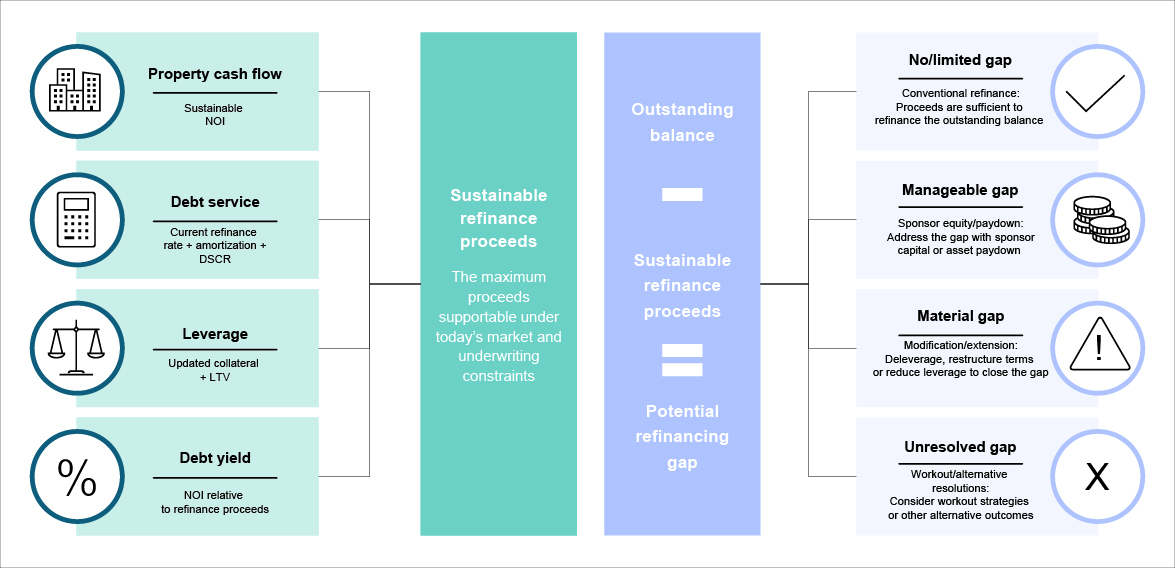
A refinancing gap should not automatically lead to a rating action.
Judgment is key
A relatively modest refinancing shortfall for a property with stable cash flows, meaningful collateral coverage, and a sponsor with the demonstrated capacity and willingness to inject capital may present a very different risk profile from a similar shortfall that depends on asset-value appreciation or uncommitted future equity.
Timely risk identification is equally important
Identifying refinancing pressure well before maturity provides greater opportunity to address it through deleveraging, additional collateral, improved leasing, asset sales, or other measures. By contrast, identifying the same shortfall shortly before maturity may leave far fewer options and create a more immediate credit concern.
Banks should therefore incorporate refinancing capacity into existing risk-rating and early-warning frameworks rather than treat it as a separate or mechanical score. This approach creates a stronger link between refinance analysis, watchlist identification, and remedial action.
Extensions do not necessarily resolve refinancing risk
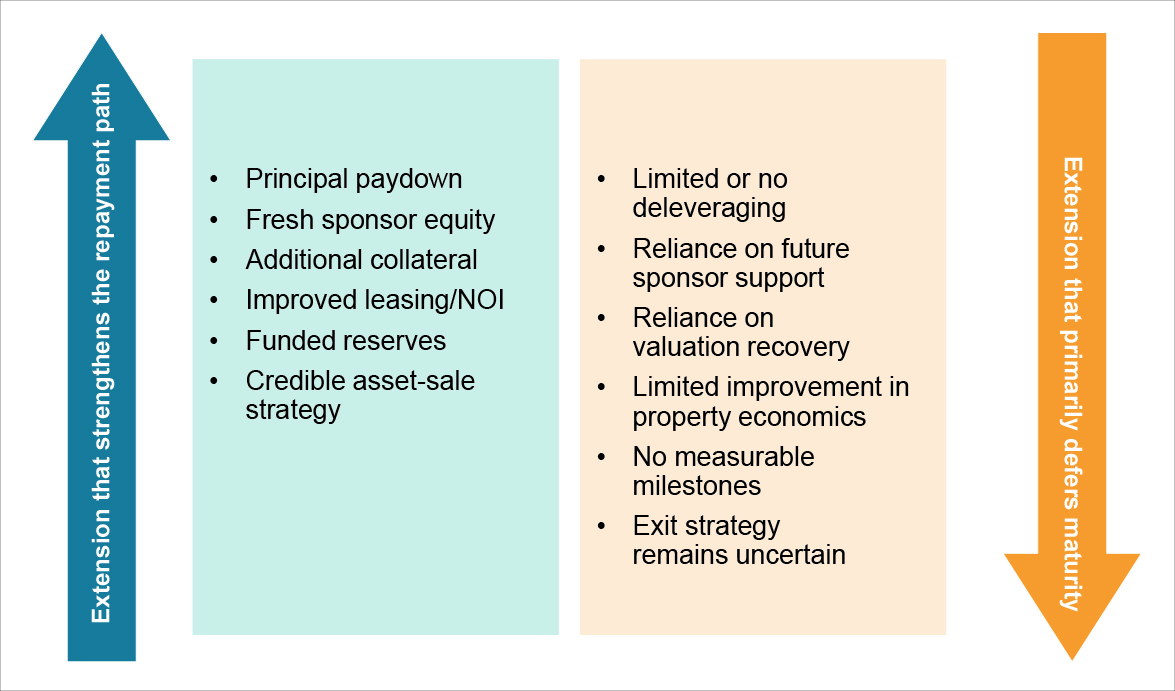
Extensions and modifications can be appropriate tools for borrowers facing temporary refinancing constraints. However, it is important to distinguish between an extension that improves the path to repayment and one that merely postpones the maturity date.
Recent CMBS performance highlights why this distinction matters. According to Business Wire’s February 27, 2026 article, CMBS Loan Performance Trends: February 2026, the office delinquency rate within its rated private-label CMBS universe declined by 110 basis points to 12.8%.
However, CMBS structures and servicing arrangements differ from bank-held CRE portfolios, and individual examples should not be generalized. The table below illustrates an important credit principle: a return to performing status does not, by itself, demonstrate that refinancing risk has been resolved.
Extension versus resolution
Integrating refinanceability into portfolio monitoring
Loan-level refinancing assessment becomes even more valuable when aggregated across the portfolio.
The Office of the Comptroller of the Currency (OCC) expects banks to identify and monitor the number and volume of loans maturing with outstanding principal balances, assess portfolio segments exposed to common external risk factors, and use tools such as stress testing to identify portfolios with elevated refinancing risk.
For banks with significant CRE exposure, this presents an opportunity to move beyond maturity reporting and toward refinanceability segmentation. Near-term maturities can be grouped according to their likely repayment path rather than viewed as a single pool of exposure.
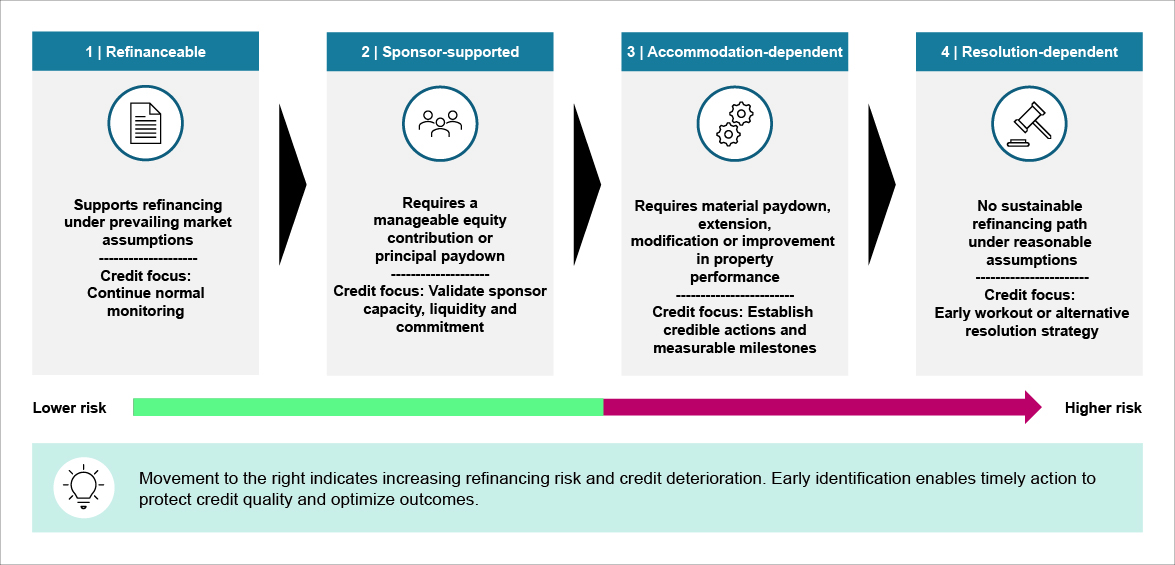
Increasing refinancing risk
Such segmentation is particularly relevant given the composition of upcoming maturities. CRE Daily, citing Trepp data, reported that an estimated $76.6 billion in private-label CMBS loans face hard maturities in 2026, with 39% concentrated in the fourth quarter. More importantly, from a refinancing-risk perspective, 36% of these loans have debt yields of 8% or lower, highlighting a cohort that may face greater refinancing pressure as maturities approach.
While CMBS experience is not directly transferable to bank-held CRE portfolios because of differences in servicing structures, extension provisions, and workout flexibility, it provides transparent loan-level evidence of why maturity cohorts should be assessed based on underlying repayment capacity rather than maturity dates alone.
Moving from loan-level analysis to portfolio intelligence
For senior credit management and boards, the objective is not to introduce another layer of loan-level reporting. Rather, it is to identify where refinancing pressure is emerging early enough to enable timely action.
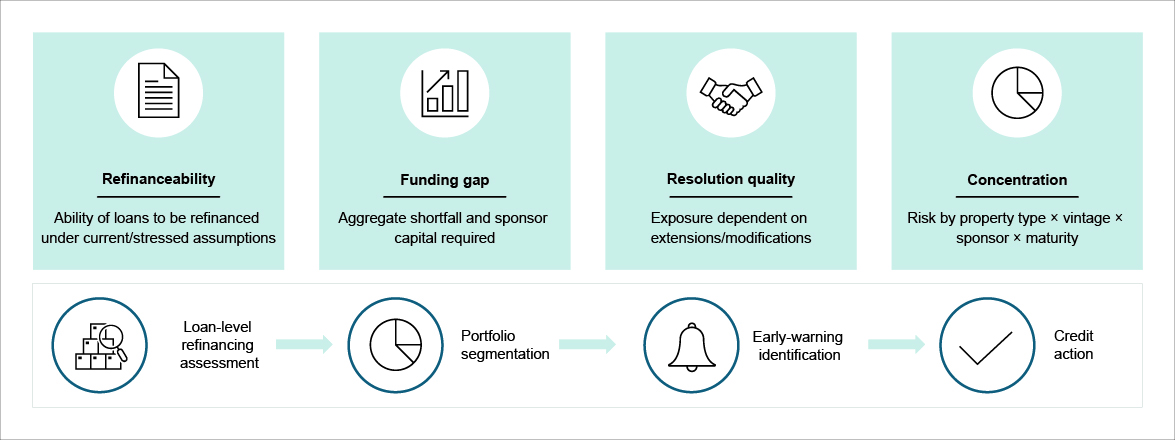
A forward-looking portfolio view can address four key questions:
- Refinanceability: What proportion of CRE exposure maturing over the next 12-36 months can be refinanced under current and reasonably stressed assumptions?
- Funding gaps: What is the aggregate difference between outstanding balances and estimated sustainable refinance proceeds, and how much depends on sponsor support?
- Resolution quality: Are extensions and modifications improving repayment capacity, or are they primarily shifting maturities?
- Concentration: Where does refinancing risk tend to cluster across property type, geography, sponsor, origination vintage, maturity period, and current risk grade?
This approach enables management to distinguish between broad CRE concentration and the narrower subset of credits that require significant equity contributions, repeated accommodations, or active intervention.
The way forward
While the maturity wall remains relevant, it is primarily a measure of volume. It does not indicate how much of that exposure will ultimately be refinanced, require additional capital, or need another form of resolution.
This distinction becomes increasingly important as banks manage loans originated under very different financing and valuation environments.
A clean payment history demonstrates current performance, but a credible refinancing path provides greater visibility into repayment at maturity. Banks that evaluate both factors can identify emerging pressure earlier, distinguish manageable refinancing needs from more fundamental credit weaknesses, and preserve a broader range of resolution options.
For CRE portfolios, the next step in maturity-risk management is therefore not simply identifying when debt comes due, but determining how much of that debt can be refinanced on sustainable terms.