Explore Crisil, a company of S&P Global
Formerly known as Global Research & Risk Solutions
October 29, 2026
 Blog
Blog
The speed of stress vs liquidity resilience
October 29, 2026
Blog
Blog
Ringfencing banks in a hyperconnected world
 Share





Overcoming liquidity risk
Liquidity risk is the possibility that a financial institution may be unable to meet its financial obligations on time without incurring significant losses because it cannot readily convert assets into cash or secure additional funding.
It remains a critical concern for regulators, boards and senior management.
In response to the global financial crisis, regulatory frameworks and governance expectations have been strengthened to enhance financial resilience, promote transparency and maintain systemic stability.
This whitepaper explores the evolving regulatory landscape and the governance structures necessary for effective liquidity risk management.
A wake-up call: The banking system’s stability and resilience rely on more than just profitability and capital adequacy—a bank’s ability to meet financial obligations under stress is equally important.
As a result, liquidity risk has emerged as a key priority for executive leadership and boards.
The collapse of Silicon Valley Bank (SVB) in March 2023 demonstrated how quickly liquidity pressures can emerge in a digitally interconnected world. Rising interest rates, geopolitical uncertainties and rapid deposit outflows, or ‘runs’ have heightened both the complexity and urgency of liquidity management.
Consequently, liquidity risk management has evolved into a strategic priority, requiring strong governance, embedded risk oversight and alignment with business strategy.
Regulatory frameworks, such as the Basel III’s liquidity coverage ratio (LCR) and net stable funding ratio (NSFR), have strengthened industry resilience, but proactive monitoring, robust stress testing and clear executive accountability are also essential in today’s dynamic risk environment.
Ways banks can tackle inadequate liquidity
Given banks’ structural reliance on short-term funding for long-term assets, maintaining robust liquidity is fundamental to preserving market confidence and operational continuity.
For leadership, this entails ensuring that the institution has adequate liquidity buffers, diversified funding sources and the capacity to perform under both normal and stressed conditions.
Effective liquidity management must be integrated within enterprise strategy, supported by rigorous stress testing, credible contingency funding plans and appropriate pricing of liquidity costs.
Alignment with regulatory metrics, such as the liquidity coverage ratio (LCR) and the net stable funding ratio (NSFR) is essential. Equally important are strong governance practices and proactive oversight to mitigate funding pressures, protect franchise value and support sustainable growth.
Liquidity risk has two faces:
- Funding liquidity risk: The risk that a bank cannot meet its cash outflows (for instance, deposit withdrawals, maturing debt and collateral/margin calls) when due or can do so only at excessive cost. This risk is related to a bank’s liabilities and cash flows and managed with high-quality liquid assets (HQLA) buffers, diversified funding sources, committed credit lines and contingency funding plans. Key metrics used to monitor this risk include the LCR, the NSFR and survival horizons
- Market liquidity risk: The risk that assets or hedges cannot be sold, repurchased or unwound quickly at or near fair value due to lack of market depth (wider bid-ask spreads, gapping prices and larger haircuts). Market liquidity risk is an asset- and market-execution problem that is managed through the implementation of limits on concentration, instrument liquidity, collateral quality and execution capacity
As moving parts morph, so do the dynamics
Liquidity risk has become very complex, driven by macroeconomic volatility and structural shifts in the financial system.
Rising interest rates have increased funding costs and reduced the value of long-duration assets, while inflation and geopolitical uncertainty have made funding conditions more volatile and less predictable.
Digitalization has fundamentally changed the speed and nature of liquidity stress. Real-time payments, mobile banking and social media have amplified the risk of rapid deposit outflows, as seen in recent bank failures and market events.
Liquidity pressures can now emerge abruptly, often driven by shifts in market sentiment or depositor confidence rather than by gradual deterioration in balance sheet.
As a result, liquidity risk is no longer confined to treasury functions. It has become a strategic risk with direct links to interest rate exposure, reputational risk and operational resilience.
Senior management must adopt a forward-looking, integrated approach to liquidity management, supported by robust governance, real-time monitoring and scenario-based stress preparedness.
The 2023 banking failure
The 2023 banking failures, including SVB, Signature Bank, Credit Suisse and First Republic Bank, exposed significant gaps in liquidity risk management, governance and supervisory effectiveness.
These events demonstrated how quickly underlying vulnerabilities can escalate when market confidence deteriorates.
In SVB’s case, weaknesses in interest rate risk management, liquidity planning and reliance on uninsured deposits persisted despite supervisory warnings. Similarly, Credit Suisse’s prolonged governance and risk-control challenges highlighted the limitations of fragmented supervisory interventions in driving sustainable improvements.
A common vulnerability across these institutions was the combination of concentrated funding, aggressive balance-sheet growth and reliance on less stable deposits, leaving them exposed to rapid outflows during periods of market stress.
Factors that lead to these failures:
Interest rate risk: Rising market interest rates reduced the value of long-term bond holdings, notably in case of SVB, weakening balance sheet strength and increasing liquidity pressure.
Concentration risk: Many banks had large share of their deposits coming from a particular group or type of depositor, making them vulnerable to bank runs.
High volatility exposure: Signature Bank and Silvergate Bank had significant cryptocurrency exposure, which amplified losses during market turbulence.
Regulatory shortcomings: Federal regulators had identified risky practices years earlier, but enforcement actions were delayed, limiting preventive measures.
Era of hyper-speed liquidity risk
The advent of digital banking has fundamentally transformed liquidity risk dynamics. With the widespread adoption of internet and mobile banking and real-time payment systems, traditional frictions that once slowed deposit outflows have largely disappeared.
As a result, cash flows have become more volatile and less predictable, requiring institutions to deploy real-time liquidity monitoring and advanced analytics to maintain visibility and control.
Tokenized deposits and the broader adoption of stablecoins facilitates enhance settlement efficiency, while simultaneously accelerating the movement of liquidity and facilitating flows across institutional boundaries. As a result, liquidity-risk management is evolving from a primarily end-of-day, balance-sheet-oriented discipline toward continuous, real-time monitoring and funding management.
In response to these developments, regulators have strengthened expectations around liquidity risk management.
The updated guidance by the FDIC (press release) after the SVB collapse in 2023 emphasized the need for robust and regularly reviewed contingency funding plans, encouraging institutions to maintain sufficient liquidity under stress conditions.
Recent crisis events have also exposed structural vulnerabilities, particularly among mid-sized banks with concentrated depositor bases and sector-specific exposures.
These events have accelerated the regulatory focus on strengthening risk management practices and governance frameworks, underscoring the growing importance of proactive, technology-enabled liquidity management as a critical safeguard for financial stability in an increasingly fast-moving financial environment.
Evolution of liquidity regulations
Liquidity regulations have evolved significantly over the past two decades, moving from fragmented, principles-based frameworks to a coordinated global regime grounded in quantitative standards. The 2008 Global Financial Crisis (GFC) exposed the limitations of traditional supervisory approaches, particularly their inability to capture the speed and severity of liquidity stress. In response, regulators introduced forward-looking metrics designed to embed structural resilience into banking institutions and reduce reliance on market liquidity during periods of stress.
Basel III framework
In response to the GFC, regulators introduced the Basel III framework to strengthen banks’ resilience to liquidity and funding shocks. A key focus was addressing structural weaknesses in liquidity management, including overreliance on short-term wholesale funding and insufficient liquidity buffers. The framework established globally consistent standards to ensure banks maintain adequate high-quality liquid assets and adopt more stable funding profiles.
Two cornerstone measures were introduced:
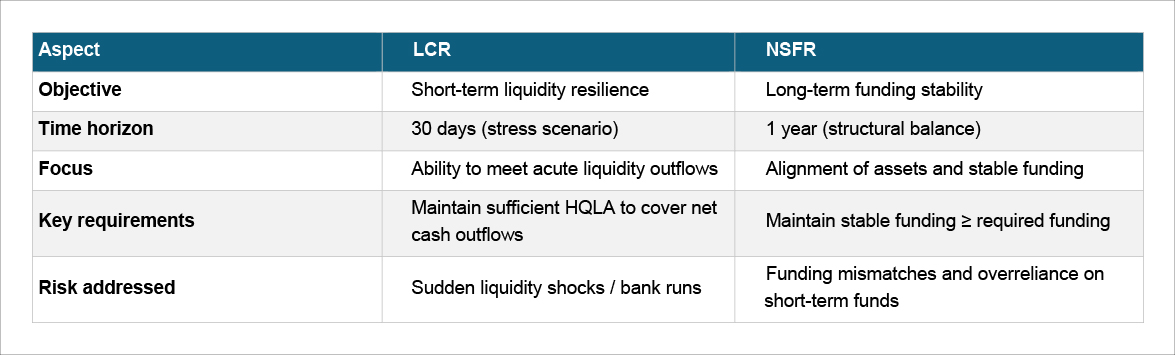
- LCR: Ensures banks hold sufficient HQLA to withstand a 30-day stressed funding scenario
- NSFR: Promotes longer-term resilience by requiring banks to maintain stable funding over a one-year horizon relative to their asset profile
These measures marked a shift from reactive liquidity management to a more proactive, forward-looking regulatory approach.
LCR vs NSFR
Additional liquidity monitoring metrics
In addition to the LCR and NSFR requirements, Basel III introduced additional liquidity monitoring metrics (ALMM) as a supervisory framework to provide regulators with a comprehensive understanding of banks’ liquidity risk profiles.
These metrics are not binding regulatory requirements but serve as early warning indicators, enabling supervisors to identify emerging vulnerabilities and structural weaknesses in funding and liquidity positions.
The framework encompasses five key areas: contractual maturity mismatch, concentration of funding sources, available unencumbered assets, currency-specific LCR positions and market-related indicators.
By capturing dimensions not fully addressed by the LCR and NSFR, such as funding concentration risk and currency-specific liquidity pressures, the ALMM enhances supervisory dialogue and supports a more granular, forward-looking assessment of liquidity risk.
This layered approach reinforces the Basel III objective of establishing a resilient banking system capable of withstanding idiosyncratic and systemic liquidity shocks.
Liquidity risk arises from mismatches between cash inflows and outflows. However, these mismatches are often closely linked to the interest rate profile of the banking book. Banks typically finance long-term assets with a combination of short- and long-term liabilities. This maturity transformation exposes them not only to liquidity pressures but also to interest rate movements. Consequently, interest rate risk in the banking book (IRRBB) becomes an important consideration, as changes in interest rates can significantly affect both the economic value of a bank’s positions and its earnings.
Interest Rate Risk for Banking Book (IRRBB) is a regulatory priority with the Basel III/ IV framework mandating banks to quantify and hold capital against the impact of interest rate movements on short-term earnings and long-term economic value of equity (EVE), where exposures sit in the banking book.
Changes in interest rates alter the timing and present value of future cash flows across assets, liabilities and off-balance-sheet positions, potentially weakening profitability and capital adequacy.
Institutions must also conduct regular stress tests to ensure that rate sensitive mismatches do not erode liquidity buffers or weaken capital adequacy.
IRRBB assessment generally relies on two complementary approaches adopted by regulators and internal risk frameworks, such as EVE or earnings at risk (EaR). Together, these approaches provide a comprehensive assessment of IRRBB by capturing both capital and earnings sensitivity to interest rate movements. The dual perspective allows banks to balance long-term balance-sheet resilience with near-term earnings objectives. An effective IRRBB governance requires constant monitoring of both measures, backed by robust behavioral assumptions, stress tests and active asset liability management (ALM).
Global approaches to liquidity regulation
Although the Basel III framework provides the foundation for liquidity risk regulation internationally, major jurisdictions have implemented the framework in different ways, reflecting their banking structures, supervisory priorities and experience with financial crises.
The United States (US), European Union (EU), United Kingdom (UK), Canada and Japan each represent distinct regulatory models, offering valuable insights into how global banking systems manage liquidity resilience in practice.
US
The US has adopted one of the most stringent and supervisory-driven approaches to liquidity regulation, particularly following the global financial crisis.
The regulatory reforms introduced under the Dodd-Frank Act in 2010 significantly strengthened oversight of large banking institutions through enhanced prudential standards, mandatory stress testing and stricter liquidity requirements.
US regulators, including the Federal Reserve (Fed), require major banks to maintain compliance with Basel III liquidity standards such as the LCR and NSFR, while also conducting periodic supervisory stress tests to evaluate resilience under severe market conditions.
EU
The EU follows a highly coordinated and harmonized regulatory framework designed to support financial stability across member states. Liquidity regulations are primarily implemented through the Capital Requirements Regulation and Capital Requirements Directive, both of which closely align with Basel III standards.
Because of the interconnected nature of the European banking system, EU regulators emphasize consistency in supervisory practices, cross-border cooperation and systemic risk management.
European banks are subject to LCR and NSFR requirements, alongside additional oversight from the European Banking Authority and the European Central Bank for significant institutions. The EU framework also incorporates regular stress tests to assess banks’ resilience under adverse macroeconomic and market scenarios.
United Kingdom (UK)
The UK has implemented the Basel III liquidity guidelines through the Prudential Regulation Authority (PRA) under the aegis of the Bank of England (BoE). The PRA’s approach is characterized by a strong emphasis on proportionality and supervisory judgment, tailoring requirements based on the size, complexity and systemic importance of individual banks.
UK banks are required to comply with LCR and NSFR, in line with Basel III, but the PRA also applies additional liquidity guidance and expects institutions to maintain internal liquidity assessments under the Internal Liquidity Adequacy Assessment Process (ILAAP).
Additionally, the BoE conducts regular stress tests, including specific liquidity stress scenarios, to evaluate the resilience of major banks. The framework is also notable for its focus on recovery and resolution planning, ensuring that banks have credible strategies for managing liquidity under stress and for orderly resolution, if needed.
Canada
Canada is widely recognized for maintaining one of the most stable and conservative banking systems globally, driven by a strong regulatory culture and prudent risk management practices. Canadian banks are supervised by the Office of the Superintendent of Financial Institutions, which has implemented Basel III liquidity standards with a strong emphasis on early risk identification and supervisory discipline.
Canadian regulators require banks to maintain robust liquidity buffers through compliance with LCR and NSFR requirements, while also conducting regular stress testing and liquidity monitoring exercises.
Japan
Japan implements Basel III liquidity standards through the Financial Services Agency (FSA) and Bank of Japan. Japanese banks must comply with LCR and NSFR requirements, with a phased rollout tailored to the domestic banking sector’s characteristics.
The FSA emphasizes robust liquidity risk management, requiring banks to conduct regular stress tests and submit comprehensive liquidity policies. Additionally, special attention is given to foreign currency funding risks, reflecting the significant overseas operations of Japanese banks. Regulatory guidance is also updated periodically to align with international best practices and market developments.
How we can help address liquidity risk management challenges
Liquidity risk management is being reshaped by digital disruption, market volatility and rising regulatory complexity. For senior management, the emphasis has moved beyond periodic reporting and historical analysis towards real-time visibility, forward-looking stress preparedness and integrated risk governance.
These challenges are addressed through a combination of strong governance frameworks, advanced analytics and strategic funding optimization, enabling institutions to enhance resilience, maintain regulatory compliance and respond effectively to rapidly evolving liquidity risks.
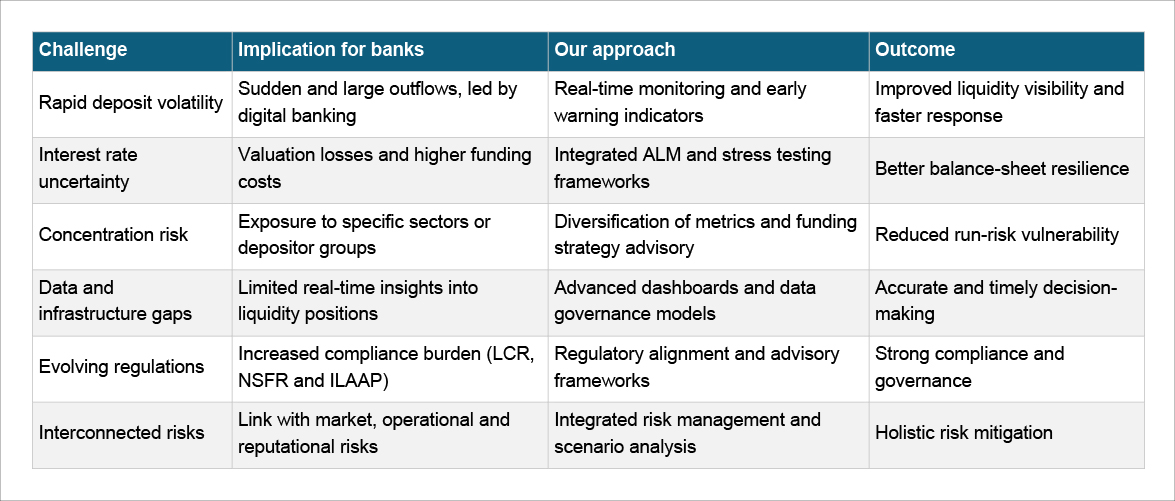
Our approach focuses on technology-enabled, real-time liquidity intelligence rather than standalone tools. By integrating data, analytics and dashboards, this approach enables senior management to:
- Constantly monitor liquidity positions
- Detect early signs of stress
- Respond quickly to emerging risks
- Maintain regulatory compliance and operational resilience
In essence, the emphasis is on building a scalable, real-time liquidity monitoring ecosystem tailored to each institution’s architecture and risk profile.
Conclusion
Liquidity risk remains a major threat to financial stability in the modern banking system. While reforms, such as Basel III post the global financial crisis, have boosted global liquidity resilience, recent market disruptions have shown that regulatory compliance alone cannot fully eliminate liquidity vulnerabilities.
As financial systems become increasingly digitalized and interconnected, the speed, complexity and transmission mechanisms of liquidity stress continue to evolve. To safeguard future systemic stability, regulatory bodies and financial institutions must adopt more dynamic, technology-driven and forward-looking liquidity management practices.