Explore Crisil, a company of S&P Global
Formerly known as Global Research & Risk Solutions
November 05, 2026
 Blog
Blog
Rethinking credit-risk monitoring
November 05, 2026
Blog
Blog
The path from periodic reviews to continuous awareness
 Share



Informed lending and portfolio decisions depend on effective credit risk monitoring. While periodic credit reviews remain a cornerstone of prudent risk management, borrower risk can evolve far more quickly than traditional review cycles allow.
As a result, relying solely on scheduled assessments may leave institutions exposed to emerging risks that develop between review periods.
Consider a common scenario. A borrower begins exhibiting signs of financial stress in March, yet its next scheduled credit review is not due until October. During those intervening months, operating performance weakens, liquidity tightens and covenant headroom narrows. However, the lender's credit assessment may continue to reflect information captured during the previous review, limiting visibility into the borrower's changing risk profile. By the time the next formal assessment takes place, the deterioration may already be materially advanced.
This highlights a fundamental challenge in credit risk management: borrower conditions often change more rapidly than formal review processes can capture.
While periodic reviews provide a structured framework for assessing financial performance and creditworthiness, they are inherently point-in-time exercises. Without ongoing monitoring, institutions risk identifying problems only after they have become more pronounced and potentially more difficult to mitigate.
This is where an effective early-warning framework becomes critical. By combining continuous monitoring, relevant risk indicators and clearly defined escalation matrix, lenders can identify emerging risks sooner and respond more proactively.
Why periodic reviews may not be enough
Several factors can delay the timely recognition of credit deterioration.
- Review-cycle gaps: Borrower performance can change significantly between scheduled reviews. In the absence of interim monitoring, important shifts in financial health, liquidity or operating performance may go undetected until the next review cycle
- Limited visibility into unrated exposure: Middle-market and privately held borrowers often lack the market signals and external assessments available for larger rated entities. Consequently, lenders must rely more heavily on internal analysis, borrower disclosures and alternative data sources to identify emerging risks
- Resource-intensive monitoring processes: Analysts frequently spend substantial time collecting information, updating spreadsheets and preparing reports. When resources are consumed by administrative tasks, less capacity is available for investigating potential warning signs and undertaking deeper risk analysis
Importantly, these limitations do not diminish the value of periodic reviews. Rather, they underscore the need to complement them with ongoing monitoring capabilities that can detect material developments as they occur.
Four foundations of an effective early-warning framework
An effective credit risk monitoring framework rests on four interconnected elements.
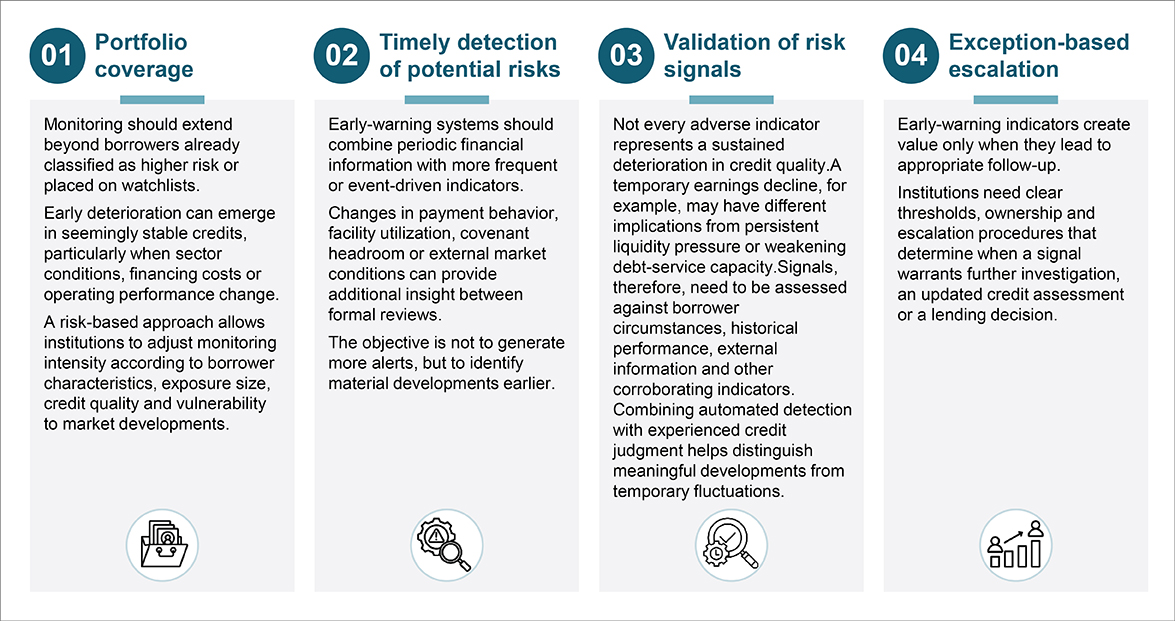
Key credit risk indicators
No single metric can provide a complete picture of borrower risk. Effective monitoring requires institutions to examine a range of indicators that collectively reveal changes in credit quality.
- Internal performance indicators: Payment delays, rising facility utilisation, declining collateral coverage and shrinking covenant headroom may signal growing liquidity pressure or reduced financial flexibility
- Financial weakening indicators: Falling interest coverage, increasing leverage, weakening cash flows and declining liquidity can point to reduced debt-servicing capacity. Equally important is the direction of travel. Trends across multiple reporting periods often provide greater insight than isolated data points
- External market signals: Credit rating actions, widening bond spreads, movements in credit default swap spreads and sector-specific developments can offer an independent assessment of changing risk conditions where reliable market data is available
- Qualitative and event-driven signals: Management changes, litigation, customer concentration, supplier disruptions, governance concerns and adverse audit findings may reveal emerging vulnerabilities well before they become visible in financial metrics
The real value lies not in monitoring these indicators individually, but in understanding how they interact. A decline in covenant headroom, for example, may warrant closer scrutiny when accompanied by weakening cash flows, higher facility utilisation and deteriorating industry conditions. Viewed in isolation, each signal may appear manageable. Together, they may indicate a materially higher level of risk.
Turning early-warning signals into credit decisions
The effectiveness of a monitoring framework ultimately depends on its ability to translate insights into timely decisions. Detecting risk is only the first step; institutions must also be equipped to respond appropriately.
Achieving this requires clear monitoring thresholds, reliable and timely data sources, and well-defined accountability for investigating and escalating exceptions. Equally important is a disciplined process for distinguishing meaningful warning signs from routine volatility. Three common challenges can undermine effectiveness:
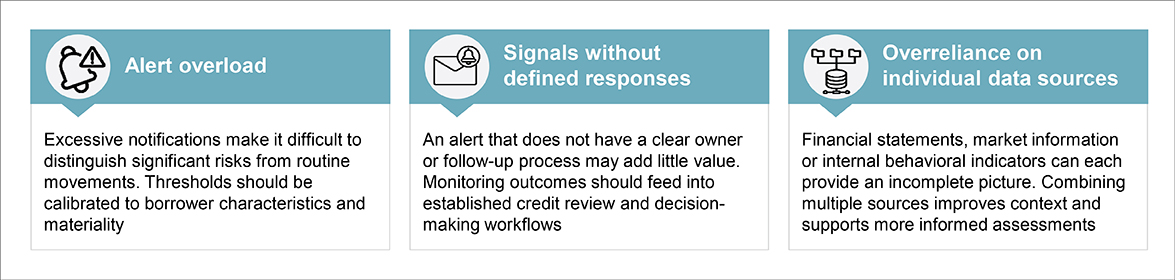
The objective is to create a framework in which emerging risks are identified, validated and translated into proportionate actions. Depending on the severity and nature of the risk, those actions may include enhanced monitoring, revisions to internal risk assessments, adjustments to lending terms or a reassessment of exposure limits.
Building a more responsive monitoring approach
Strengthening early-warning capabilities does not require institutions to replace existing credit review frameworks. Instead, it involves enhancing them.
A practical starting point is to identify portfolios where delayed risk recognition could have the greatest impact, establish a focused set of monitoring indicators and embed monitoring outcomes into existing credit workflows. This enables institutions to prioritise resources where they can deliver the greatest risk-management value.
As data volumes increase and risk environments become more complex, advanced analytics and artificial intelligence-enabled solutions can further strengthen monitoring capabilities. These technologies can help institutions process large volumes of structured and unstructured information, identify connections across disparate data sources and prioritise exposures that warrant closer attention.
However, technology is most effective when it augments, rather than replaces, expert credit judgement. The quality of outcomes will continue to depend on reliable data, rigorous validation and clearly defined decision-making responsibilities.
Conclusion
The goal of credit risk monitoring is not simply to review borrowers more frequently. It is to identify meaningful changes earlier, develop a clearer understanding of emerging risks and respond with greater confidence.
For banks and other lending institutions, this shift from periodic assessment to continuous risk awareness can support more proactive portfolio management, more effective allocation of analytical resources and better-informed lending decisions.
Explore Crisil Integral IQ's credit and lending solutions to know how integrated credit expertise, portfolio monitoring and data-driven insights can help strengthen risk visibility and support more confident decision-making.